Towards sustainable and circular fashion: learn about different textiles, their characteristics, and how to identify and dye them using natural ingredients.
If there is one thing that most societies and cultures have in common, it is the custom of wearing clothes every day. But have you ever wondered what the clothes you are wearing right now are made of? What are their characteristics? How are they obtained? And how will their end-of-life look like? The first activity presented here proposes different experiments to identify the composition of clothes, understand their properties and learn about their environmental impact.
Once students have identified the behaviour of natural fibres such as cotton and wool, they will discover how to dye them using pigments extracted from everyday natural sources such as red cabbage, avocado skins and onion peels in Activity 2. It will explain the basic chemistry behind colour extraction and fabric fixation, offering a home-friendly procedure that uses accessible materials and can be extended to many other natural sources.
Finally, Activity 3 encourages students to try new plant-based dye sources and giving old garments a second life by customising them with natural colours, extending their lifetime and reducing the demand for new clothes.
Through this activity, participants will gain hands-on experience in identifying textiles and dyeing them sustainably, while exploring the principles of circular fashion. Above all, they will experience how creativity, science and sustainability can be brought together to reduce textile waste and inspire more conscious choices in everyday life.
Dyeing fabric with tea powder to get brown and natural earthy shade. Image: Monica dahiye/Unsplash, CC0
Activity 1: Types of textiles
This activity focuses on identifying the nature of different textiles through observations and hands-on experiments, such as flame and water tests. It highlights the characteristics that make them suitable for different applications, and raises awareness of their environmental impact and the recycling possibilities.
Estimated duration: 40 min
Safety notes
The flame test should be carried out as a demonstration by teachers, using tweezers under a hood. Allow the burnt material to cool down before touching it and do not inhale the fumes produced.
Materials
Cotton, hemp or linen fabric pieces (cellulosic fabric)
Wool or silk fabric pieces or fibres (proteinic fabric)
Polyester or nylon fabric pieces (synthetic fabric)
Present to students the different unlabelled textiles and ask them about the criteria to identify the composition of each one. The aim is to classify them into natural or synthetic fabrics.
Students should use the textile assessment chart to register their observations during the experiments. First, they will interact with the samples by touching them, observing them and finally describing their sensorial properties, such as softness, breathability, elasticity, whether they look matte or shiny, how warm or cold they feel, if they make sound or smell, etc.
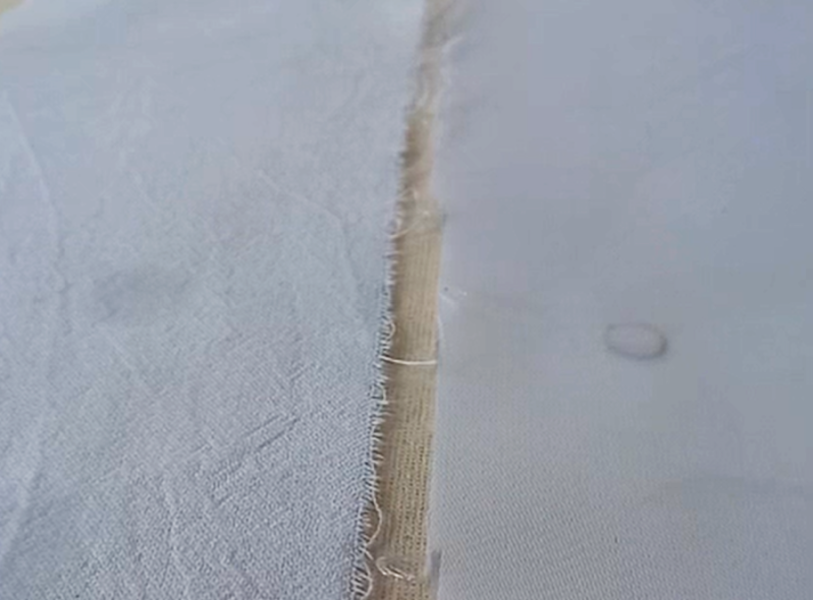
To test water absorption the students will be provided with a cup of water and a disposable pipette. The water test consists of placing a water drop on top of the fabric and observing its water absorption behaviour (figure 1). In case the drop stands on the surface, the water absorption is low. If, on the other hand, the drop is immediately absorbed by the textile, leaving behind a wet mark in the fabric, the water absorption is high.
Figure 1: Water absorption behaviour of cotton (left) and polyester (right) Image courtesy of the authors
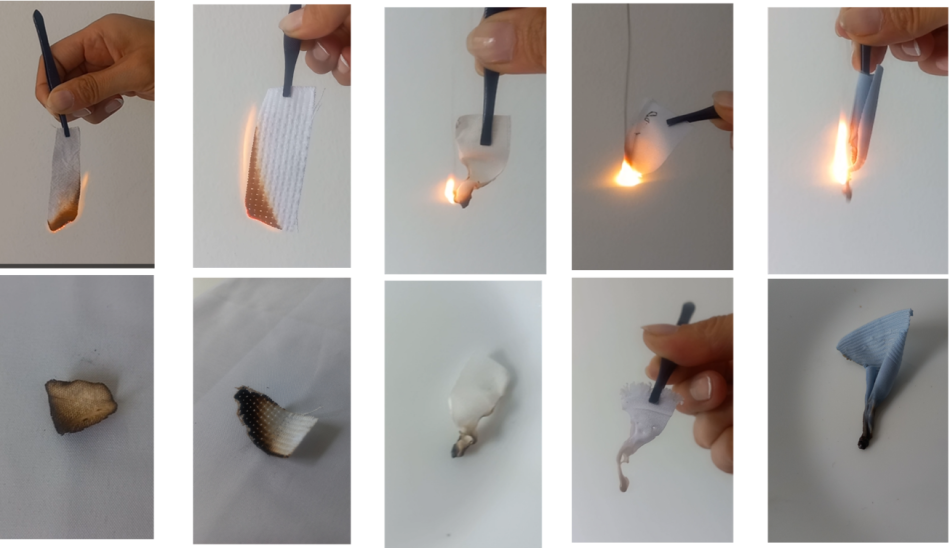
The flame test will be run as a demonstration by the teacher under a fume hood, and the students should describe the output of the experiments such as velocity of ignition, whether it melted or charred and the characteristics of the resulting ash (figure 2).
Hand out the textile info sheet to place the observation in context and set the scene for the next activity.
Figure 2: Example of ignition tests Image courtesy of the authors
Results/discussion
After observing, describing and recording the results of their experiments on the textile assessment chart, and based on the information on the textile info sheet, the students will decide whether each piece of fabric is natural or synthetic.
The teacher will then reveal the details of the composition of each piece of fabric, and the criteria for classifying them correctly will be discussed.[1] For a more complete description of the possible outputs of the experiments, including different textiles, check the chart provided in the additional resources.
It should be highlighted that, for a more advanced identification, especially of blended fabrics, laboratories use microscopic examinations, solubility tests or infrared spectroscopy.[2,3]
Use these questions to discuss the possible applications of each fabric and its environmental impact:
Which fabric is suitable for a raincoat?
Which is the best material for underwear?
Which is a good material for designing sportswear?
Which material can be used for furniture?
Which fabric is the best for a lab coat?
Are all synthetic fabrics made from fossil fuel derivatives?
Which fabric has the least environmental impact?
Which kind of clothes can be made with the most environmentally friendly fabric?
Which kind of clothes require specific properties that cannot be met with the most eco-friendly material?
This is a good moment to show students that conscious choices in our daily lives can influence the environmental impact of our habits. For example, beyond the importance of the composition of textile materials, circular practices, such as reusing, repairing and recycling existing garments, can reduce the amount of waste produced and decrease the demand for new clothing.
Activity 2: Dyeing using natural ingredients
Nature offers an incredible palette of colours. Plants, fruits, and flowers contain substances that humans have learned to use as pigments, to impart tones and shades to textiles in both painting and in fabric dyeing.[4] The coloured compounds from natural ingredients are compatible with natural fibres such as cotton. Therefore, before tackling this activity, it is essential to verify composition of the textiles, as explained in Activity 1. In addition, a preparatory step is mandatory to fix these colours to textile fibres.
This activity provides a guide to extracting naturally coloured molecules from ingredients such as avocado, onion peels and red cabbage leaves, and fixing them to natural fabrics using everyday natural ingredients and common salts.
Estimated duration: 3 h (+ one day)
Safety notes
Be careful with the hot plate, as well as the mordanting and dye baths, as they contain simmering water. The heating steps (dye extraction and mordanting) require supervision to prevent burns. The alum and sodium carbonate should be handled with care to avoid skin and eye irritation, and solutions should be prepared in well-ventilated areas. The dye baths contain low-toxicity substances with minimal environmental impact, so residues can be disposed following local regulations.
Materials
White or clear cotton fabric pieces (suitable for dyeing is preferred)
Tap water (for avocado and gold onion)
Distilled water (for red cabbage)
Potassium alum, KAl(SO4)2
Sodium carbonate, Na2CO3
Kitchen scale
Heating plate
Different pots for mordanting bath and dye solution
Bucket or basin for dye bath
Filter
Avocado (peels and seeds)
Gold onion peels
Red cabbage
Procedure
Preparing the textile (mordanting procedure)
Weigh the cotton pieces which you want to colour.
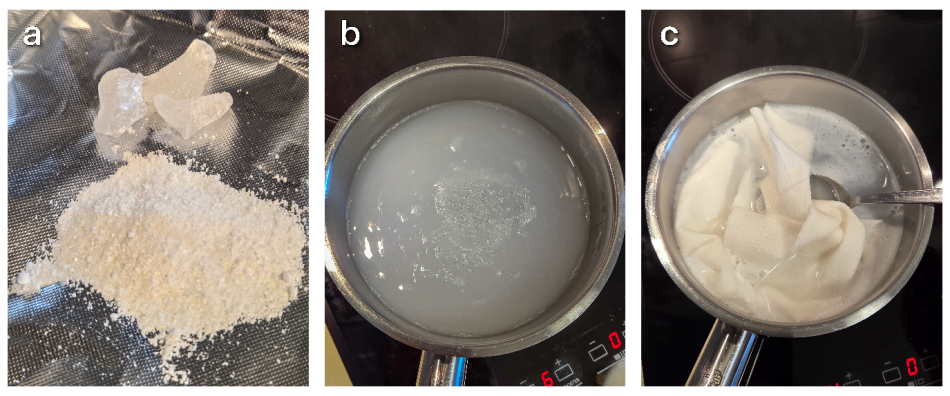
To prepare the mordanting bath, dissolve 20 g of alum and 15 g of sodium carbonate (figure 3a) in 2 L of distilled/tap water (figure 3b) for each 100 g of cotton. Calculate the exact quantities of the salt that you need depending on the real weight of the fabric pieces.
To speed up the process, soak the cotton pieces in the solution at 60°C for 30 min. Alternatively, soak the cotton textile in the solution at room temperature for 24 h. Stir the bath regularly to ensure an even distribution of the mordant across the fabric (figure 3c).
After the required time has passed, remove the pieces of cloth, wring them out, and hang them outside to dry. The textile is then ready for the dyeing process.
Figure 3: a) salts for mordanting bath; b) mordanting bath; c) mordanting of cotton fabric Image courtesy of the authors
Extraction of natural dyes and dyeing procedure
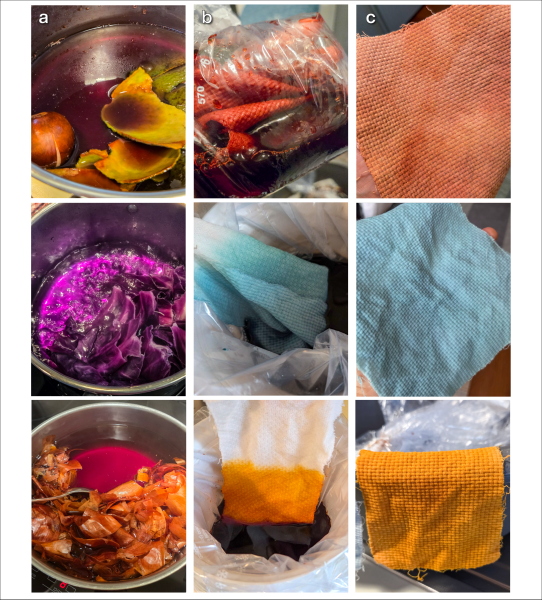
Prepare the dyeing bath as indicated in the following procedure. The details vary slightly depending on the natural dye source (ffigure 4).
Avocado: boil avocado seeds and peels in tap water for about 15 minutes (3 avocados and 2 L of water for 100 g of cotton). As the mixture heats, the colour of the water gradually changes into a deep reddish tone.
Yellow onion: boil the dry peels of gold onions in tap water for about 15 minutes (50 g of onion peels and 2 L of water for 100 g of cotton). During boiling, the water slowly turns into a rich orange colour.
Red cabbage: boil the leaves of red cabbage in distilled water for about 15 minutes (1 red cabbage and 2 L of distilled water for 100 g of cotton). As the mixture cooks, the water turns into a vivid purple colour.
After the indicated waiting time, filter the dye bath into a bucket or basin. If you wish to avoid staining the container, pour the liquid into a heat-resistant plastic bag.
Immerse a piece of the prepared fabric in each dyeing bath for 24 hours to achieve a uniform colouring.
Rinse the cotton under running water to remove any excess of dye. It is better to wash the fabric separately the first time before using it, to eliminate any remaining dye residues.
Figure 4: a) dye extraction from different ingredients: avocado (top), red cabbage (middle) and onion peels (bottom). b) Fabric immersion in the colour extract. c) Final results of the dyeing procedure. Image courtesy of the authors
Results and discussion
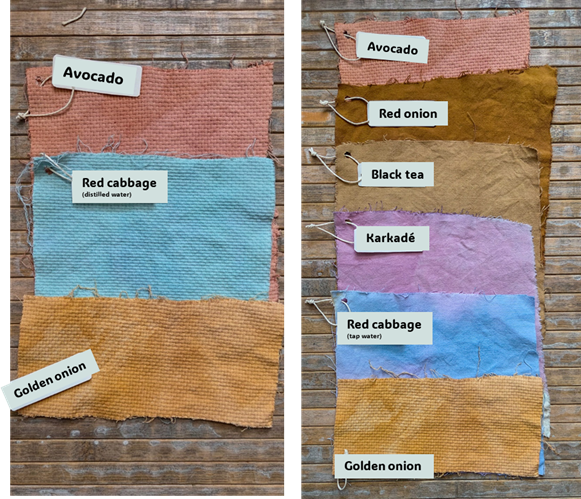
Once the teacher has put the procedures in context using the natural dye info sheet, the students will show their results to the class. In this regard, certain features can be observed (figure 5). The most noticeable feature is that the final colour varies depending on the natural dye used:
Avocado: the fabric takes on a reddish tone with salmon or pink shades;
Gold onion: the result ranges from deep yellow to orange hues;
Red cabbage: the fabric shows purplish tones with bluish highlights.
An additional experiment can be performed with red cabbage: students can drop either vinegar or a sodium bicarbonate solution onto the textile. What happens? Why do you think this happens?
The teacher can guide the discussion using the following questions:
What can you say about the colours obtained in relation to the specific dye source?
Did you expect these colours considering the starting ingredients? For instance, did you expect to obtain a purple/blue textile from red cabbage? And what about avocado?
What do you think causes the difference in colours between the ingredients and the colour bath?
Here’s another interesting feature of this process: the dye baths can be recycled and reused to colour additional fabrics, which helps to reduce waste and making the experiment even more sustainable.
Figure 5: Obtained results using different natural sources Image courtesy of the authors
Activity 3: Make your own item unique!
The procedure explained in Activity 2 can be easily adapted to other natural materials. For example, it is possible to dye fabrics using the tannins from tea, the anthocyanins from hibiscus flowers (karkadè), or those found in red onion peels, rose petals, and black tea leaves. After gaining experience with the dyeing procedure, it’s time to get creative!
In this activity, students will apply the same procedure to any old garments (T-shirt, canvas bag, scarf, ball of wool, etc.) to give them a second life. The goal is to explore the efficiency of the dyeing procedure on different textiles. In addition, students are invited to explore other sources of dyes to fully understand the potential of natural products. They can also play with the concentration of the dyes to tune the desired result.
Estimated duration: 3 h (+ one day)
See Activity 2 for safety notes.
Materials
All Materials mentioned in Activity 2, and:
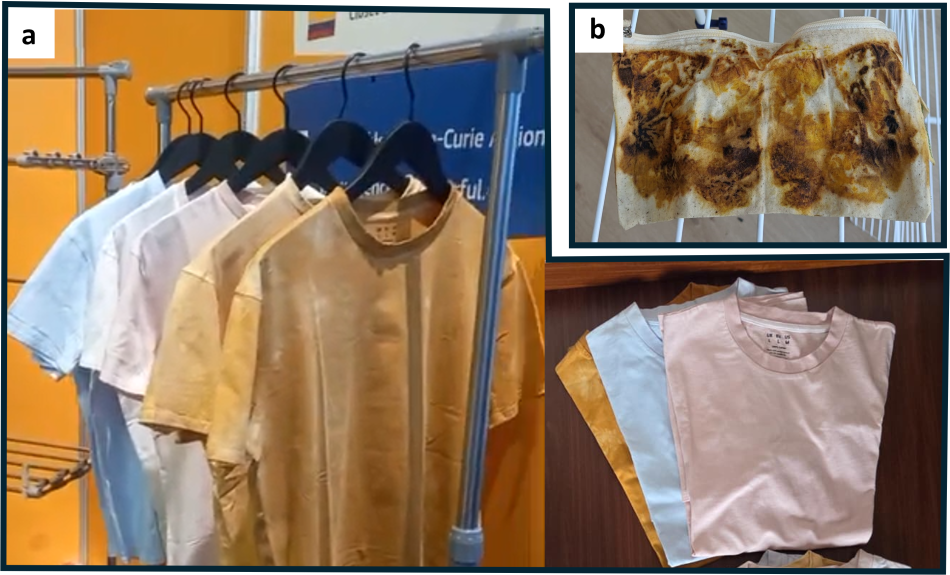
two old garments or items you want to refresh (T-shirt, canvas bag, scarf, ball of wool, etc.). It would be interesting to consider different types of textiles to explore different performances (figure 6).
at least two other natural dye sources: explore your local area and shops, collecting potential dyeing ingredients is highly encouraged. You can check the examples provided in the natural dye info sheet and in Activity 2.
Check the composition of the items you want to renew by following the procedure of Activity 1. Note your observations on the natural dyeing assessment chart.
Prepare the textiles following the mordant procedure of Activity 2. Consider the real weight of the items you want to dye to calculate the weight of salts to add to the mordant bath.
Prepare the dyeing baths by boiling the chosen ingredients in water for 15 minutes.
Follow the procedure of Activity 2 for textile colouring and rinsing.
To carry out the activity in the best way possible, change one variable at a time. For example, change the textile, but keep the same natural ingredient, or try different dyeing ingredients on the same type of textile. This helps to highlight the effect of either the natural ingredient or the textile on the final outcome of the dyeing procedure.
Figure 6: a) T-shirts coloured with natural ingredients. b) botanical printing experiment performed by steaming a previously prepared textile that is wrapped around onion peels Image courtesy of the authors
Results/Discussion
As a class, compare the results obtained and try to understand the influence of the chosen textile and natural ingredient.
After applying the procedure on different textiles and using different ingredients as source of dyes, students can draw conclusions regarding the influence of both these parameters on the dyeing process.
Does the textile have an impact on the dyeing process?
Is it the same to dye a natural fibre or a synthetic one?
Is it possible to use any coloured natural product as source of dye? Or are only some suitable for this purpose?
In what ways do you think wettability or water absorption influence the dyeing process?[5,6]
After completing all the three activities and reading the additional material, students can summarise what they have learnt starting by answering the following questions:
Which kinds of textiles are currently used to produce clothes? How is it possible to distinguish between natural and synthetic fabrics?
What happens to clothes that are thrown away? Is it possible to efficiently recycle them? What is their environmental impact?
What alternatives can be pursued to avoid throwing away old garments?
How do you think dyeing textiles with natural ingredients could help to address these issues?
What is the procedure to dye textiles with natural ingredients? How does it work at a microscopic/chemical level?
The final discussion will reflect that the acquired skills will enable students to transform old garments into unique new ones using materials they can find at home, thus giving the garments a second life. This will encourage students to reuse old clothing items instead of throwing them away and buying new ones, thereby raising awareness of circular and sustainable fashion.
Learn about the pigment indigo and have a go at extracting it at school: Farusi G (2012) Indigo: recreating Pharaoh’s dye. Science in School 24: 40–46.
Learn more about oxidizing and reducing agents through colourful reactions between lollipops and permanganate salts: Prolongo M, Pinto G (2018) Colourful chemistry: redox reactions with lollipops. Science in School 43: 41–45.
Read about the colour pink in nature and the chemistry behind it: Bettucci O (2022) Colour in nature: think pink. Science in School57.
Read about the colour blue in nature and the chemistry behind it: Bettucci O (2022) Colour in nature: true blue. Science in School 60.
Read about the science of hair dye: Guenard R (2015) Colour to dye for. Science in School 32: 10–13
Understand vision deficiencies to support affected children better: Maule L, Featonby D (2016) Fifty shades of muddy green. Science in School 35: 8–11.
Federica Marelli is a chemist from Italy. She is currently a PhD candidate in Materials Science and Nanotechnology at University of Milano-Bicocca, where she focuses on the development of coatings for anti-icing applications. Beyond her research activity, she is interested in science communication.
Davide Nunziante holds a Bachelor’s degree in chemistry and a Master’s degree in chemical sciences. He is passionate about chemistry, plants, and sustainable materials. He is also one of the coordinators of Fitosophy, a social outreach project focused on science communication about plants, natural compounds, and chemistry related to plant-based systems.
Catalina Ospina is a Colombian materials scientist and polymer researcher. She is the founder of Closet Dinámico, a project promoting a circular fashion community through textile reuse, exchange, upcycling, recycling, and conscious consumption. She is passionate about connecting materials science, sustainability, and community-driven innovation through science communication and educational outreach.
Review
Clothes and dyeing are very motivating topics for pupils. This can be used to introduce younger pupils into precise and careful experimenting with “cook recipes”. The dyeing activities, except the burning test, also suit as home experiments. Upper classes will be able to think about the chemistry behind.
The sustainability of the clothes is present in all these activities and can be discussed with respect to environmental impact and sustainability. The students learn to think about the consequences of their behaviour in everyday life.
Bernhard Sturm, Neues Gymnasium Oldenburg, Germany