Science teaching in space: the ESA teachers workshop
Meet an astronaut, cook a comet and plan a trip to Mars. Shamim Hartevelt introduces a recent teacher workshop at ESA.
Showing 10 results from a total of 1045
Meet an astronaut, cook a comet and plan a trip to Mars. Shamim Hartevelt introduces a recent teacher workshop at ESA.
Claudia Mignone and Rebecca Barnes explore X-rays and gamma rays and investigate the ingenious techniques used by the European Space Agency to observe the cosmos at these wavelengths.
Science in School is published by EIROforum, a collaboration between eight of Europe’s largest inter-governmental scientific research organisations. This article reviews some of the latest news from the EIROforum members (EIROs).
Thanks to everyone who donated to Science in School via our website; we were overwhelmed by the positive response. With your help and the support of our advertisers, we have been able to print and distribute Issue 21, as those of you who are reading this in print will realise. The battle…
Cancer and stem cells are both topical issues. But have you heard of cancer stem cells? As Massimiliano Mazza explains, this concept may revolutionise the treatment of cancer.
Crowding affects us almost every day, from supermarket queues to traffic jams. Timothy Saunders from EMBL explains why this is interesting to scientists and how to study the phenomenon in class.
Who Cloned my Cat? Fun Adventures in Biotechnology is a collection of two-page articles that briefly describe discoveries from the field of biotechnology.
Even everyday scents have the power to take us back in time, awakening half-forgotten memories. With Gianluca Farusi’s help, you can take your students 2000 years into the past, recreating and testing Julius Caesar’s perfume.
Vered Yephlach-Wiskerman introduces a classroom project to investigate the bioremediation powers of the aquatic fern Azolla.
The question that astronauts are most frequently asked is ‘How do you go to the toilet in space?’ This rather puts the cart before the horse because the next most popular questions concern the other end of the alimentary canal: ‘How do you eat in space?’, ‘What does the food taste like up…
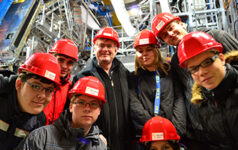
Science teaching in space: the ESA teachers workshop
More than meets the eye: unravelling the cosmos at the highest energies
Trapped by scientists: antimatter, cholesterol and red blood cells
Welcome to the twenty-first issue of Science in School
Cancer stem cells – hope for the future?
The physics of crowds
Who Cloned my Cat? Fun Adventures in Biotechnology, by Reinhard Renneberg
Smell like Julius Caesar: recreating ancient perfumes in the laboratory
A clean green sweep: an aquatic bioremediation project
The Astronaut’s Cookbook: Tales, Recipes, and More, by Charles T Bourland and Gregory L Vogt