What does becoming a Blue School look like? Three European projects show how students investigate water and ocean issues.
Across Europe, the Network of European Blue Schools[1] has grown rapidly. By 2026, 1311 schools have joined, 1095 in EU countries and 216 in non-EU countries, all committed to connecting young people with ocean and water literacy. This network contributes to the EU mission to restore our ocean and waters by 2023[2] by supporting schools that integrate water topics into curriculum-based learning.
But what does this look like in practice? Becoming a Blue School goes beyond adding a themed lesson or organising a dedicated day. It invites the whole school community to ask questions, collect real data, and make sense of what they observe in their local environment. During recent years, initiatives such as ProBleu[3],SHORE[4], and BlueLightS[5] have supported blue projects all over Europe and beyond by providing practical tools, expert guidance, and ready-to-use pedagogical resources (e.g., lesson plans, classroom activities, and protocols), as well as targeted project funding.
Oceans are important ecosystems that serve various purposes, including economic, recreational, transport and food-related ones.[6] Despite this, they have become the final destination for many toxic substances and waste, such as medicines, domestic and industrial sewage effluents, plastics and personal care products.[7]
The Blue School model is widespread throughout Europe and aligns with the Sustainable Development Goals 4 (Quality Education: aiming to improve education and learning) and 14 (Life Below Water: aiming to protect the ocean). Moreover, it aligns with the objectives of the United Nations Decade of Ocean Science for Sustainable Development (2021-2030), a UNESCO-led global initiative.[8]
Here, we present three examples to encourage more communities to become part of this network committed to caring for our waters.
ProBleu: Monitoring a shared mediterranean through citizen science
At Escola Voramar in Barcelona (Spain) and Split International School (Croatia), upper secondary students (aged 16–18) stepped onto their local beaches as young researchers, not visitors. Their joint project, LikeMySea[9] (literacy in science, know-how and education for mediterranean sea protection), was built around a core principle for Blue Schools: twinning schools to investigate shared environmental challenges from different local perspectives.
From October to June, the students monitored physical and chemical parameters (seawater temperature, pH, and salinity), building a time series in the process. They learnt how to handle the necessary equipment properly, how to standardise procedures to make meaningful comparisons, and how easily small inconsistencies can affect results. Biodiversity monitoring complemented these measurements. For example, the students documented coastal species and uploaded their observations to the MINKA citizen science platform.[10] MINKA is free to use, and its team supports teachers and schools in getting started, making it easier to implement citizen science activities into classroom teaching. Around 50 species were recorded in Barcelona in a single day, and around 60 species were recorded in Split through snorkel photography and systematic beach surveys. The difference in observed species prompted investigation into habitat structure, human pressure, and local environmental conditions.
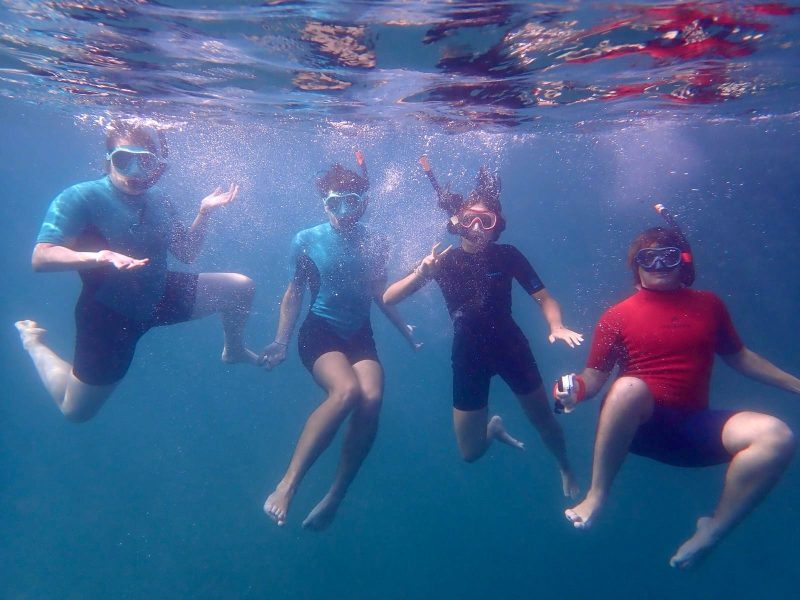
LikeMySea students during a snorkel session to record observations for the MINKA platform Image courtesy of David Tarrasón (Escola Voramar)
Monitoring marine litter added a further dimension. In collaboration with the PlasticFreeWave association,[11] students applied beach clean-up protocols, quantifying and categorising the waste they collected. The data allowed them to link biodiversity patterns with evidence of human impact rather than treating pollution as a separate issue.
Two mobility exchanges reinforced the scientific dialogue. Working alongside each other on both coasts, the students compared methods, discussed findings in English, and engaged with marine researchers from the Institut de Ciències del Mar (ICM-CSIC) in Barcelona.
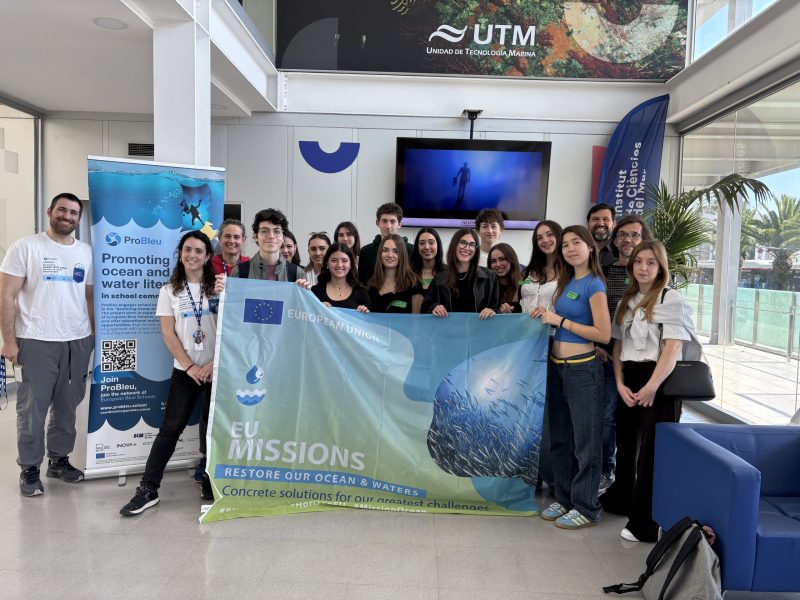
LikeMySea students during their session in Barcelona with the Institut de Ciències del Mar (ICM-CSIC) team Image courtesy of EMBIMOS ICM-CSIC
By the end of the project, students had generated, analysed, and presented their findings of their shared Mediterranean in a public exhibition.
The global use of the citizen science platform MINKA in school communities has led to remarkable scientific contributions. For example, schools involved in the ARSINOE project documented 14 invasive species that had never previously been documented in Greece, while 4th-grade students at Escola Congrés-Indians made the first recorded sightings of the Ebalina edwardsii crab and the Nerophis maculatus pipefish in Barcelona.
SHORE: Empowering youth to become agents of blue change
The SHORE initiative has proven that equipping students with scientific tools empowers them to become leaders and advocates for change. By funding almost 100 primary and secondary school proposals focused on ocean literacy, SHORE supported the transformation of classrooms into hubs of environmental advocacy.
During the project FISHOMES, students in the Italian school IC Dante Alighieri Pesaro transitioned from pupils to Piccoli Architetti del Mare (Little Architects of the Sea). By building and monitoring artificial reef sites, these young researchers demonstrated that ‘blue curricula’ can support professional passions. Across the Mediterranean region, students embraced the role of citizen scientists through laboratory analysis, sample collection and sensor installation in water and plants. At the turkish school Oymalıtepe Şehit Sedat Kaplan Ortaokulu,students simulated environmental disasters as part of the project ‘Following The Water: Explore, Protect, Share’. By specifically analysing the impact of oil spills on water evaporation rates, the students gained an understanding of the long-term climatic impacts of marine pollution. In Austria, the BlueMind project at Bundesgymnasium Zehnergasse redefined water justice. By calculating the ‘hidden water’ embedded in their clothing and food, students were able to connect local consumption habits to global droughts in the Rhine and Danube basins.
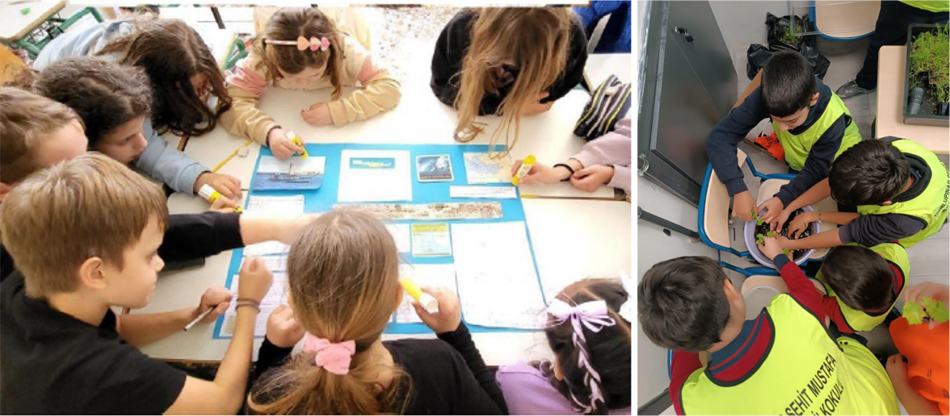
Left: Student workshop at 1st primary School of Agios Nicolaos. Right: “Digital Garden” by students at Dumlupınar Şehit Mustafa Muhammed Ak Primary School (Türkiye) Image courtesy of 1st primary School of Agios Nicolao (left) and Dumlupınar Şehit Mustafa Muhammed Ak Primary School (right)
SHORE proved what has already been known: granting students ownership over local challenges turns classrooms into laboratories for change. In these spaces, learning becomes active, collaborative, and deeply connected to the real world! This nurtures resilient minds, proving schools are the ultimate engines for environmental regeneration.
BlueLightS: Bringing blue education to life across Europe
Across Europe, BlueLightS has supported schools in turning water literacy into hands-on learning experiences that connect science, creativity, and community action. These experiences are complemented by its Knowledge Hub, which provides teachers with accessible, ready-to-use educational materials.
At Salo Upper Secondary School in Finland, students investigated the Baltic Sea through a multidisciplinary field course combining biology, geography, history, and art. During a visit to the Archipelago Research Institute on Seili Island, they collected and identified marine species, observed coastal habitats, and explored ecological restoration projects. Back at school, they presented their findings through exhibitions and digital materials, helping to share knowledge about the Baltic Sea with the wider school community.
At the Music School of Heraklion in Greece, students explored how culture can deepen ocean awareness. Focusing on the sensitive marine ecosystem of the Gulf of Elounda, the students collaborated with researchers from the Hellenic Centre for Marine Research. They conducted field observations and created a curated playlist of music inspired by the sea, spanning classical, jazz and traditional genres. Music became a creative bridge for discussing marine conservation and sharing perspectives with other Blue Schools.
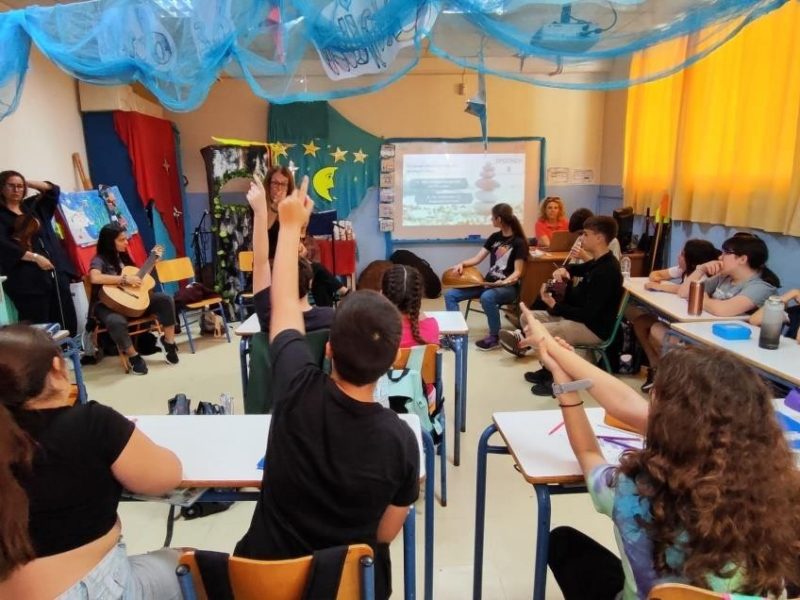
Students at the GEMMA Music School of Heraklion at a workshop Image courtesy of GEMMA Music School of Heraklion
Meanwhile, inland students at IES Francisca de Pedraza in Spain demonstrated that ocean literacy does not require proximity to the sea. Through river monitoring, experiments on microplastics and ocean acidification, and workshops on the circular and blue economy, the students explored how everyday choices influence marine ecosystems, reminding their community that “the sea starts here.”
Students of the IES Francisca de Pedraza school at a workshop Image courtesy of IES Francisca de Pedraza
A whole school approach to water literacy
Taken together, these examples show that becoming a Blue School can grow out of very different kinds of projects. Importantly, the availability of ready-made pedagogical resources such as those provided by ProBleu[3], SHORE[4], and BlueLightS[5] lowers the barrier for teachers, making it easier to translate ocean literacy into concrete classroom practices. Questions about oceans and water can be explored through physics, chemistry, biology and mathematics. But they also belong in language classes, in lessons on local history, in art studios and even in physical education when learning moves outdoors.
The Blue Schools approach is not limited to one age group. From early childhood settings to vocational education, schools across Europe adapt water literacy to their own context. Often, projects involve more than one class. Younger and older students may contribute in different ways, such as sharing results, preparing exhibitions or working together on field activities. This creates a sense of the whole school being part of the same process.
When students collaborate with local organisations, research centres, neighbourhood groups or public authorities, their work connects with real concerns. Engaging with local issues can deepen understanding, influence the surrounding environment and strengthen the wider school community.
And perhaps the best part? Schools that already incorporate water-related topics into their curriculum can apply for recognition within the European Blue Schools Network. In many cases, accreditation simply acknowledges an existing approach: inquiry and active participation.
Take a look at the “Waves of change” report containing a synthesis of best practices, activities, and results from the SHORE network’s school-led projects.
Find out about the physics at work beneath the waves with these classroom experiments: Watt S (2012) Movers and shakers: physics in the oceans. Science in School25: 28–33.
Understand the role of the oceans in climate change: Harrison T, Khan A, Shallcross D (2017) Climate change: why the oceans matter. Science in School39: 12–15.
Author(s)
Meritxell Turó Silanes is a biologist and journalist at the Institut de Ciències del Mar (ICM-CSIC) in Barcelona. She works at the intersection of marine research, citizen science, and education, coordinating European projects that promote citizen science and Blue Schools. Her expertise focuses on engagement strategies and participatory processes.
Joanna Makocka is a project manager at F6S Innovation, where she leads international projects focused on the blue economy, climate change, and AI. She has extensive expertise in funding mechanisms for diverse stakeholders, legal aspects of funding and contracting, as well as exploitation activities.
Mikaela Martirosyan is a communication and project manager at REVOLVE, where she leads communication activities for projects focused on ocean literacy and blue education, maritime shipping, water desalination, and the circular economy. She has extensive experience designing and implementing awareness campaigns, organising beach and river clean-ups, and coordinating both in-person and online events.
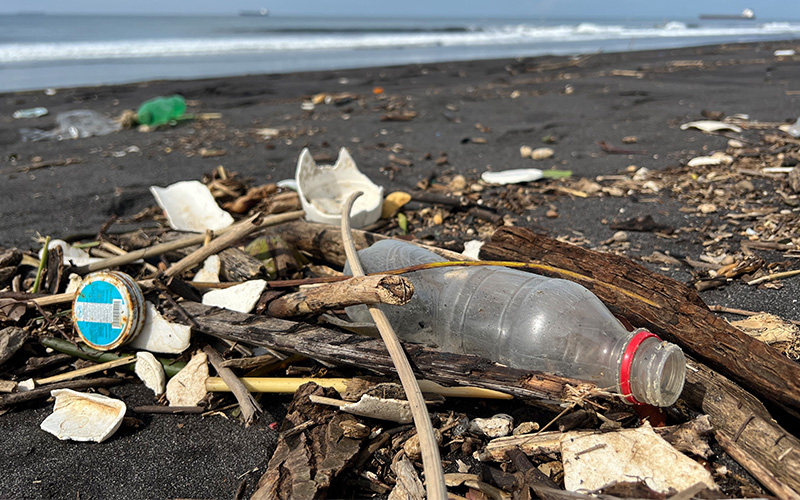
Turn a beach visit into a science adventure! Explore the animals, plants, shells, and even litter stranded on the beach to reveal the secrets of marine life and ocean dynamics.