Author(s): Guilherme N. Corte, Ninoshka López-Xalín, Martin Thiel
Every tide tells a story. Discover how waves, shells, and even litter reveal clues about marine life and our shared connection with nature.
We love visiting sandy beaches for fun and relaxation, but have you ever stopped to think about how they connect us to the vast ocean? These dynamic ecosystems are a crucial link between the land and the ocean, and they have a lot more going on than meets the eye.
What are sandy beaches?
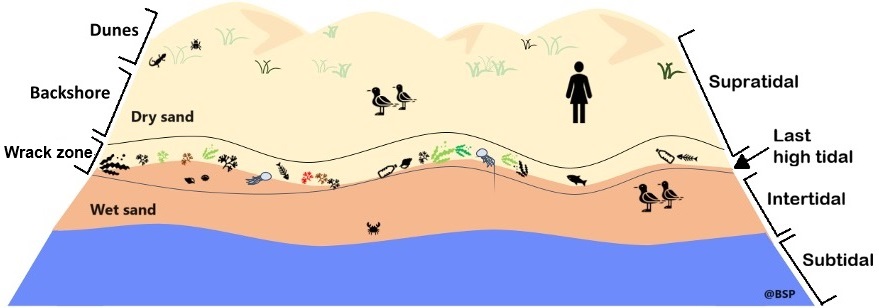
Sandy beaches are coastal areas made up of loose sand and small rocks. They comprise more than one-third of the world’s shorelines and occur from tropical islands to polar regions.[1] A sandy beach is divided into several zones (figure 1), each shaped by how often it is washed by tides and waves. Closest to the ocean is the subtidal zone, which always remains underwater. Above it lies the intertidal zone, regularly covered and exposed by waves and tides. The wrack zone marks the highest reach of the tide, where natural debris and human-made objects accumulate. Further up on the beach, the backshore is rarely touched by the ocean water and thus stays mostly dry. It connects the beach to the dune zone, where vegetation takes hold and helps stabilize the sand.
Figure 1: The main zones of a sandy beach. To learn more, watch the beach zones video in the resources section. Image courtesy of the Beach Surveyor Project, Smithsonian Environmental Research Center
Waves and tides constantly move the beach sand around, which means the beach is an ever-changing, dynamic environment. This constant motion not only changes the shape of the beach but also brings objects that provide clues about the health of the ocean and its inhabitants.
Beach stranding: the ocean’s delivery service
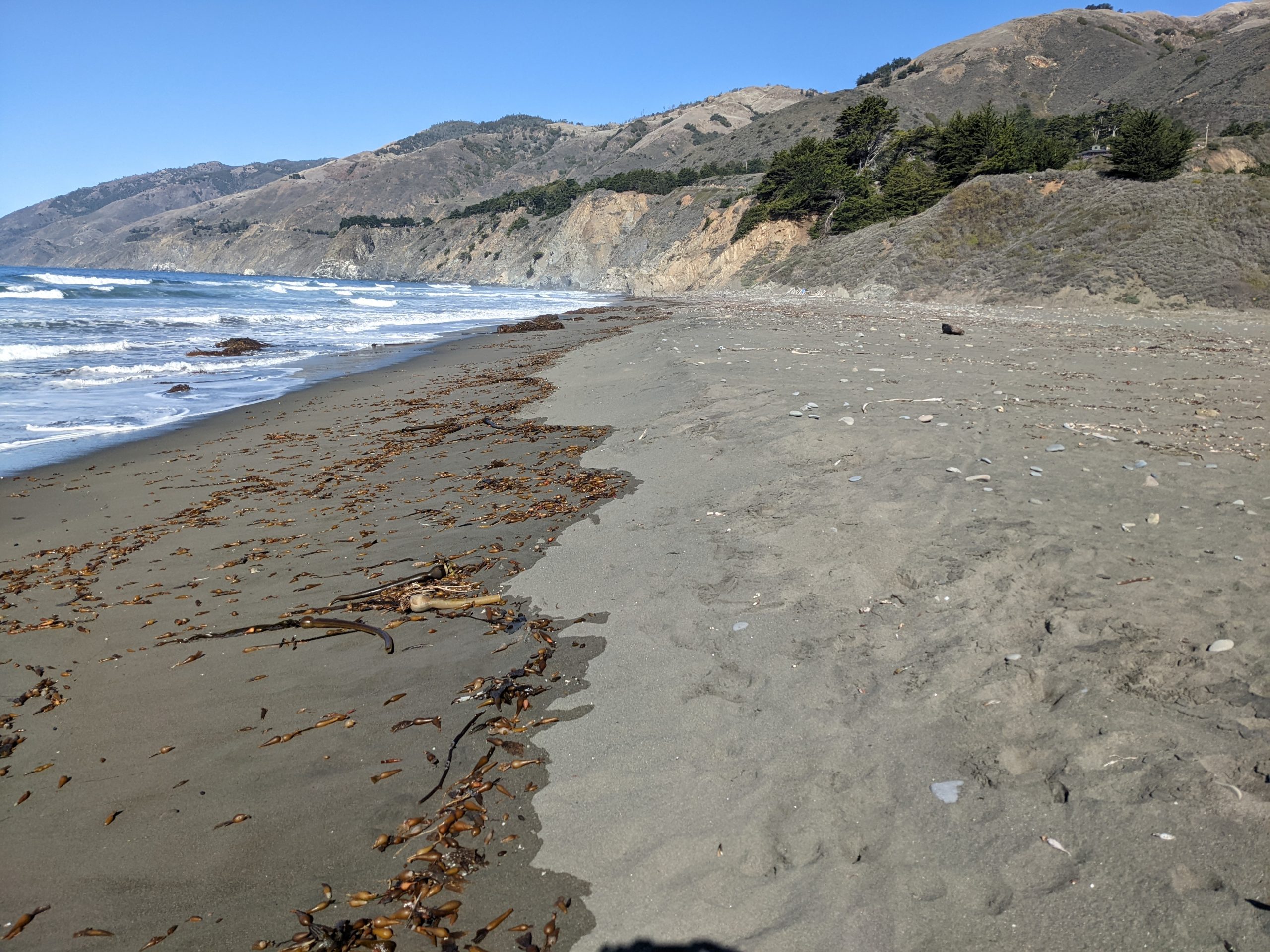
When the tide recedes, the ocean leaves behind a variety of organisms and objects. These are said to be ‘stranded’ on the beach, mainly in the wrack zone (figure 2) . During a beach walk, you might spot shells, which are the remains of mollusks that live in the intertidal zone or just below the waves.[2] Occasionally, larger organisms such as jellyfish, sand dollars, or even whales may also wash ashore. Each of these strandings provides valuable clues about marine life and ecosystems.
Figure 2: Accumulation of mollusk shells and other biogenic materials along the upper intertidal zone of a sandy beach in North Carolina, USA. The image shows the wrack and shell zone formed by recent wave and tidal action. Image courtesy of the Beach Surveyor Project, Smithsonian Environmental Research Center
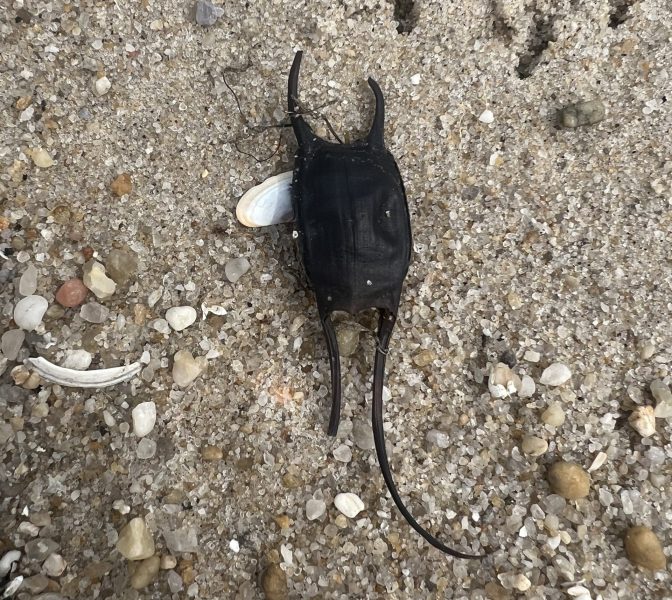
Egg capsules of sharks and rays (figure 3), for example, can reveal which fish species inhabit nearby waters and whether the area serves as an important breeding ground. Finding large amounts of seagrass may signal the presence of a nearby seagrass bed,[3] while bits of coral can indicate a coral reef in the subtidal zone in front of the beach.
Most strandings are a natural part of the ocean’s life cycle. Many of these organisms die in the water from natural causes such as old age, storms, or predation, and are carried ashore by waves and currents. Although piles of seaweeds, seagrass, or dead animals may seem unpleasant to beach visitors, these strandings are vital resources for many sandy beach organisms.
Figure 3: Mermaid’s purse: these tough, leathery egg cases, laid by sharks, skates, and rays, are often found washed ashore on beaches. Each case once contained a developing embryo that fed on a yolk sac until hatching, after which the empty purse was carried to shore by the waves. Image courtesy of the Beach Surveyor Project, Smithsonian Environmental Research Center
The importance of strandings for beach life
Sandy beaches are unstable environments, so only very few plants can grow there excluding the more stable dune zones. This means that primary productivity, i.e. the process of converting light or chemical energy into food, like photosynthesis in plants, is low. Many beach organisms therefore depend on organic material brought in by the waves, such as seaweeds, dead animals and other debris, which serve as an important food source.
When strandings become extreme
Sometimes, however, huge numbers of organisms wash ashore all at once. Scientists call these extreme events ‘mass strandings’. These mass strandings can be warning signs that something unusual is happening in the ocean, such as storms, pollution, or disease.
The number of individuals involved in mass strandings varies widely, from a few large animals, such as dolphins or whales, to hundreds of millions of small invertebrates. For example, over 100 million by-the-wind sailor jellyfish (Velella velella) were stranded on the west coast of New Zealand in 2006, likely driven by warmer temperatures (which boost jellyfish abundance) combined with stormy weather.[4]
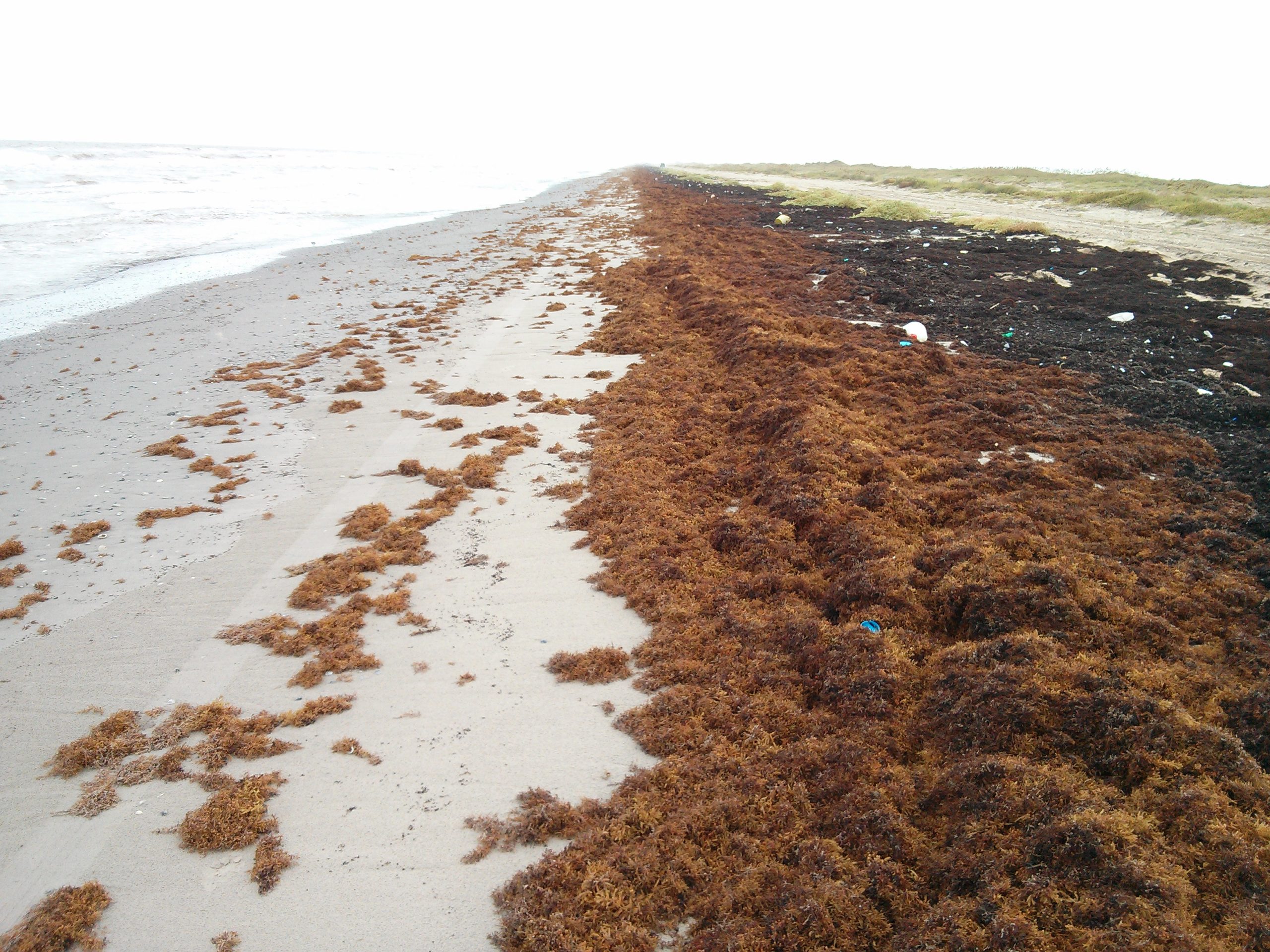
Massive seaweed strandings are becoming more common worldwide (figure 4), often linked to nutrient enrichment, climate change, and shifting ocean currents. In Europe, green tides caused by blooms of Ulva seaweeds have affected the Atlantic coasts of France since the 1970s, with annual strandings exceeding 100 000 tons.[5] In the Caribbean and the Gulf of Mexico, golden tides of floating Sargassum have blanketed beaches, burying shorelines, threatening turtle nesting sites, as well as disrupting tourism and fisheries.
Figure 4: Stranding of Sargassum spp. along the shoreline of a sandy beach in Fort Pierce, Florida, USA. Such large accumulations of this pelagic macroalga are increasingly common across the western Atlantic and Gulf of Mexico, where they significantly alter nutrient dynamics, beach morphology, and coastal fauna assemblages. Image courtesy of the Beach Surveyor Project, Smithsonian Environmental Research Center
Marine litter: an unwanted visitor
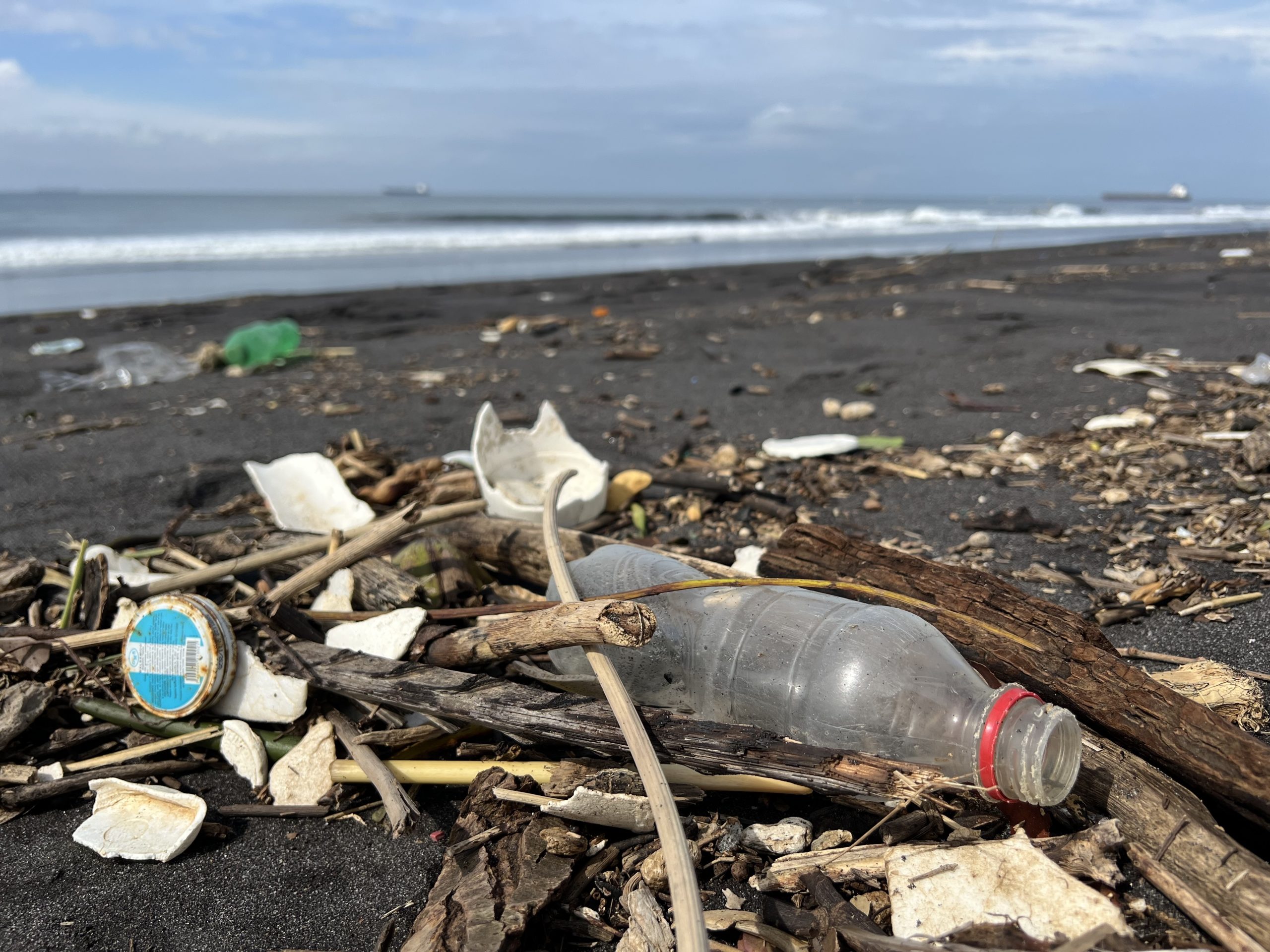
Unfortunately, not everything that washes ashore comes from nature. Almost every beach in the world now contains marine litter, which includes waste from human activities such as plastics, metals, and glass (figure 5). This is a clear reminder that what we do on land has a direct impact on the ocean.
Figure 5: Accumulation of marine litter and organic debris on a sandy beach along the Pacific coast of Guatemala. The image shows the co-occurrence of plastic waste, wood fragments, and other anthropogenic materials deposited in the high-tide zone, illustrating the strong connectivity between land-based pollution sources and the marine environment. Image courtesy of the Beach Surveyor Project, Smithsonian Environmental Research Center
Human-made litter, such as plastic and chemicals, can seriously harm beach animals that may eat or become entangled in this debris. Pollution also makes beaches less appealing to visitors and can damage local economies that depend on tourism.
Where do stranded objects come from?
For centuries, people have walked along the shore collecting objects carried by the tide, an activity known as beachcombing, which has connected cultures across continents.
Indigenous peoples in Canada and Greenland, for example, were familiar with iron long before direct contact with Europeans. The likely source of this metal was driftwood with embedded nails that had floated across the Atlantic from European shores. Long before telephones or the internet, messages in bottles also crossed oceans, sparking curiosity about distant places and people.
The distance that stranded objects travel depends on their buoyancy. Light materials, such as plastics and seaweeds (particularly Sargassum), can float for long periods and be carried great distances by ocean currents, sometimes across entire oceans. On the other hand, heavier objects such as metal, shells, and coral skeletons usually sink or move only short distances, suggesting that they originated near the beach at which they are found.
Explore the beach
Sandy beaches are much more than piles of sand or places for recreation. They are dynamic ecosystems that connect land and ocean, past and present. The next time you walk along the shore, take a closer look at what the ocean leaves behind: shells, seaweed, or even litter. Each item tells a story about life beneath the waves and the many ways humans and nature are connected. See the companion Teach article for classroom activities at a sandy beach.
Acknowledgments
This is contribution 163 from the Smithsonian’s MarineGEO and Tennenbaum Marine Observatories Network.
Explore sandy beaches with the activities shared in the accompanying article: López-Xalín N et al. (2026) Sandy beaches: the window to the ocean. Science in School76.
Try these hands-on activities to introduce your students to microplastics: Realdon G (2015) Microplastics: small but deadly. Science in School25: 32-35.
Understand the role of the oceans in climate change: Harrison T, Khan A, Shallcross D (2017) Climate change: why the oceans matter. Science in School39: 12–15.
Discover how the unique characteristics of seagrasses are vital for the health of our planet: Crouch F (2024) Seagrass the wonder plant!Science in School 67.
Guilherme Corte is an assistant professor at Texas A&M University at Galveston. He studies how climate change and human activities impact coastal ecosystems, especially sandy beaches, across the world. His work combines research, outreach, and international collaboration to support conservation and resilience in coastal environments.
Ninoshka López-Xalín is a passionate biologist of marine ecosystems from Guatemala. She has worked with participatory science for the last three years, involving schoolchildren, teachers, volunteers, and scientists around the world to collect scientific data about marine debris and marine life on beaches.
Martin Thiel is a marine biologist who has studied marine life on several continents, investigating coastal ecosystems and the organisms inhabiting them. He also has worked for many years with participatory scientists, especially school teachers and park rangers from the Pacific coast between Mexico and Chile.
Review
This article is of great interest because, starting from a generally familiar and appreciated environment (the sandy coast), it provides a useful contribution to our knowledge of this environment beyond the aspects related to tourism and leisure.
It also serves as a valuable introduction to subsequent lessons on marine environment within various disciplines (biology, Earth sciences/geography, chemistry, environmental sciences).
It can also be used to discuss socio-scientific issues related to the sustainable management of the marine and coastal environment.
Turn a beach visit into a science adventure! Explore the animals, plants, shells, and even litter stranded on the beach to reveal the secrets of marine life and ocean dynamics.