Supporting materials
Download
Download this article as a PDF



A multidisciplinary project to raise students' awareness about the importance of properly disposing and recycling materials found in mobile phones.
Mobile phones are the most widely used technological devices worldwide: their number has almost exceeded the world’s human population.[1]
Although they have become increasingly compact and powerful, their useful lifespan has shortened to about 3–4 years. After that, mechanisms that accelerate device turnover, often referred to as planned obsolescence, come into play. Software incompatibilities, hardware limitations, and high repair costs push us to buy new phones, often encouraged by the appeal of the latest models.
But what happens to the billions of phones once we replace them?
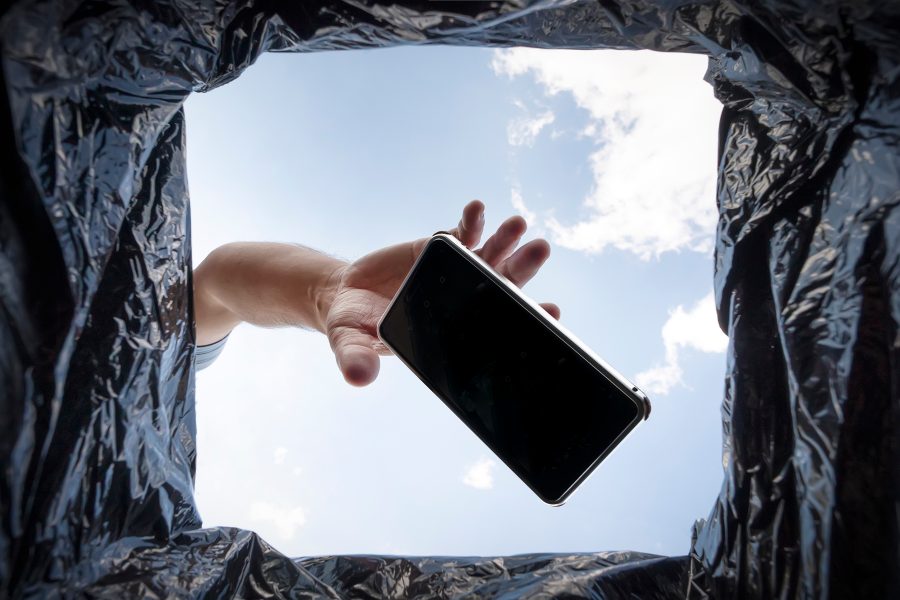
Out of the over 5 billion devices discarded globally each year, only about 20% get properly recycled. The rest suffer one of three main fates: being hoarded in home drawers, sitting in toxic landfills, or being illegally shipped to developing nations for dangerous dismantling.[2]
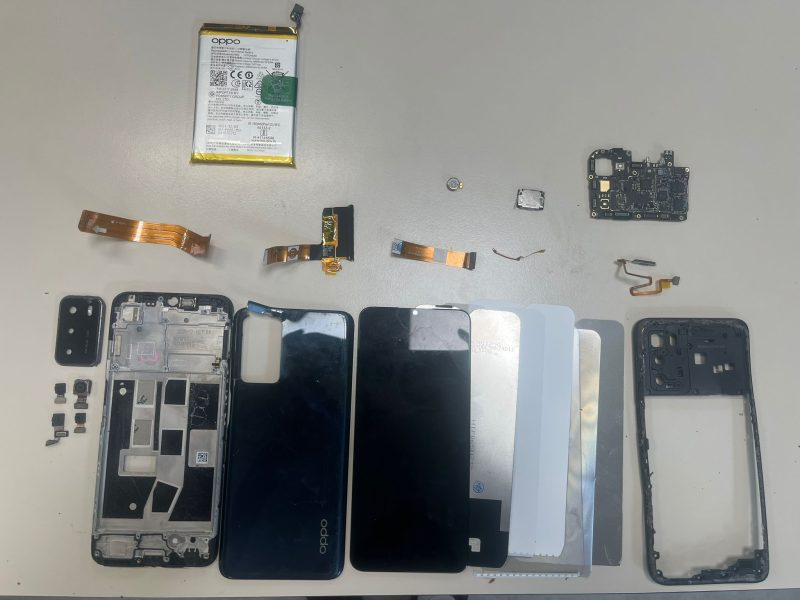
From the display and casing to the battery and electronic components, our mobile phones contain more than 50 chemical elements that enable their operation.[3,4] The raw materials come from different countries and need to be extensively extracted, processed, and transported before the device can be assembled and sold. A new smartphone generates between 55 and 80 kg of CO2 equivalents over its life cycle, with a staggering 70–80% of its total carbon footprint being produced before the device is being turned on for the first time.[5]
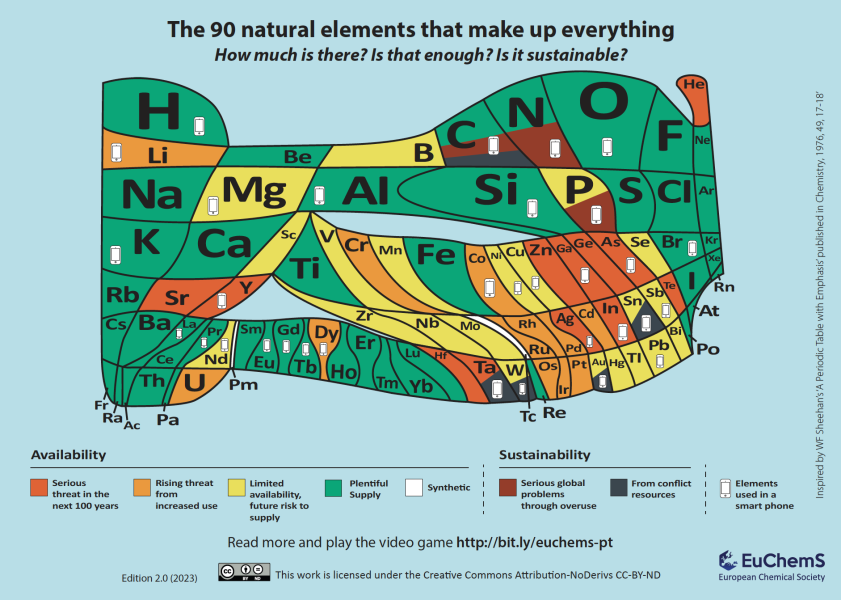
The issues related to the continuous extraction of these resources are well illustrated by the periodic table of abundance,[6] which warns of the approaching reduction of critical elements used in modern technology and everyday consumer goods. According to the Royal Society of Chemistry, without radical changes, the known primary supplies of many critical and rare-earth metals could face significant supply shortages and depletion within about 50 to 80 years. This highlights how limited and non-renewable mineral resources actually are.[7]
The mining of raw materials causes widespread deforestation and loss of habitat for several species. At the same time, the rapid rise of electronic waste – the world’s fastest-growing waste stream – leads to the development of large landfills.[8]
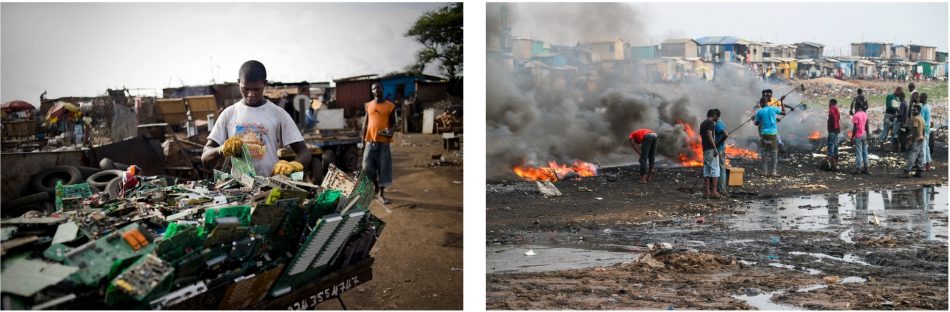
This becomes very apparent when we look at what is happening in Ghana at one of the world’s biggest informal e-waste dumping sites, where locals search through discarded electronics for valuable metals to resell. In some cases, materials are burned to separate metal from plastic, releasing toxic substances that pollute the air, soil, and water and pose serious health risks to workers and communities nearby.[9]
Remember that even the cell phone you’ve kept in your drawer is considered electronic waste, because it contains valuable and finite resources that can be reused if it is recycled appropriately!
The initiative Recycle Your Mobile Phone To Save The Planet is carried out by a network of schools created by the National Association of Natural Sciences Teachers Pavia (ANISN) and benefits from the collaboration of the Jane Goodall Institute Italy (JGI). Since 1998, the institute promotes Jane Goodall’s values through practical actions for people, animals and the environment, actively collaborating on various projects in Africa within the JGI’s worldwide network. This project specifically aims to promote the proper disposal of mobile phones and tablets in order to protect chimpanzee habitats and support education in Tanzania.
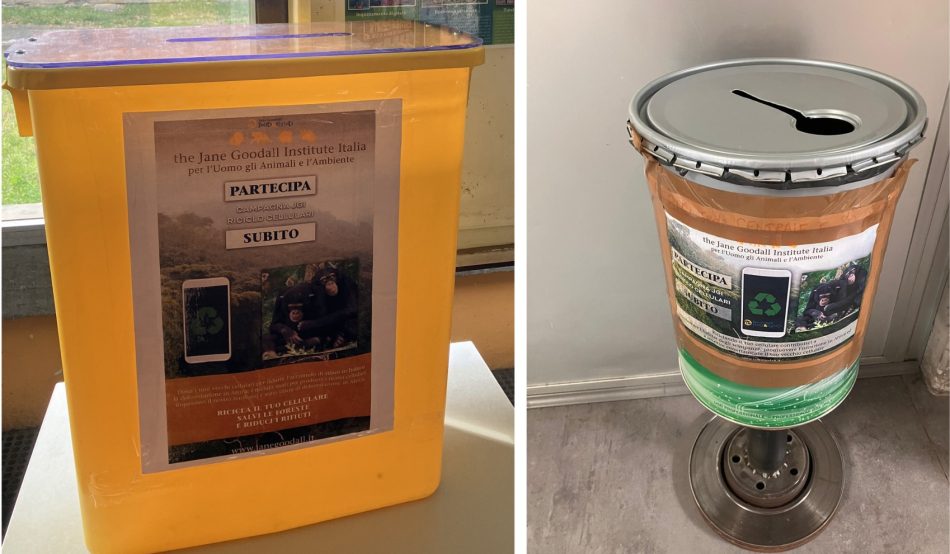
Inspired by the Jane Goodall Institute’s international youth programme Roots & Shoots,[10] the students learned about the e-waste problem and took action by organizing an awareness campaign to collect used phones and tablets at their school. At our school, the Istituto Tecnico Industriale Statale (IT IS) G. Cardano, we implemented the project with two eleventh-grade classes from the computer science track. They managed the entire promotional strategy, designing flyers, posters, and a website to spread the word to all the students. After this initial outreach, they launched a collection point by placing two bins at the main entrance of the school.
The initiative was later successfully extended to four fifth-grade classes at the Angelini primary school in Pavia where our students delivered a two-hour lesson, preparing all the necessary materials (including a PowerPoint presentation and games) to make the content accessible for the younger children.
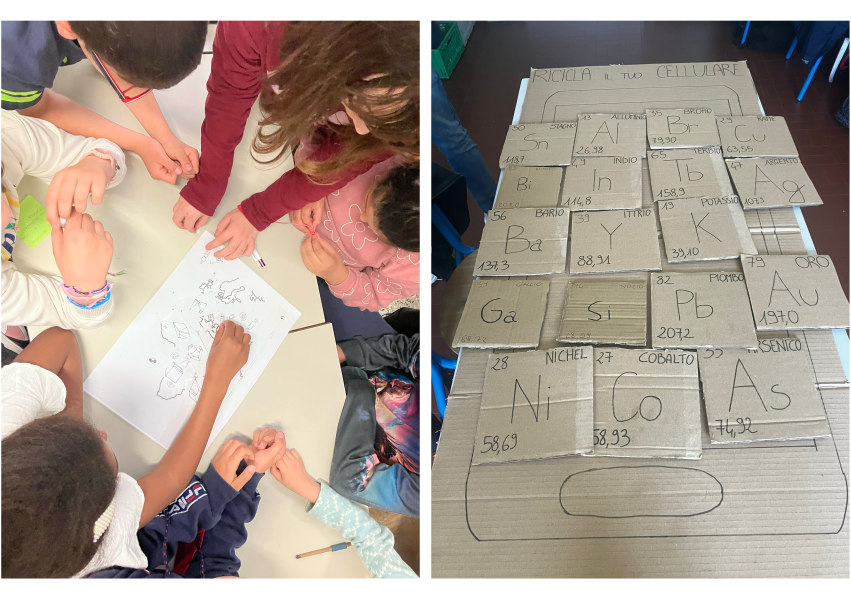
Our school has been carrying out this project for three years and by now has become a collection point for old electronic devices for the entire city of Pavia.
Once 10 kg of material have been collected, the cell phones can be picked up and sent to a specialized company, a JGI Italy partner, who refurbishes them or recycles their components. In return for their profit from the precious materials the company then makes a donation to JGI Italy, which uses the funds to support the Sanganigwa Children’s Home, an orphanage in Tanzania.
As illustrated in the content map below, this initiative offers teachers the chance to work as a team and involve different subjects.
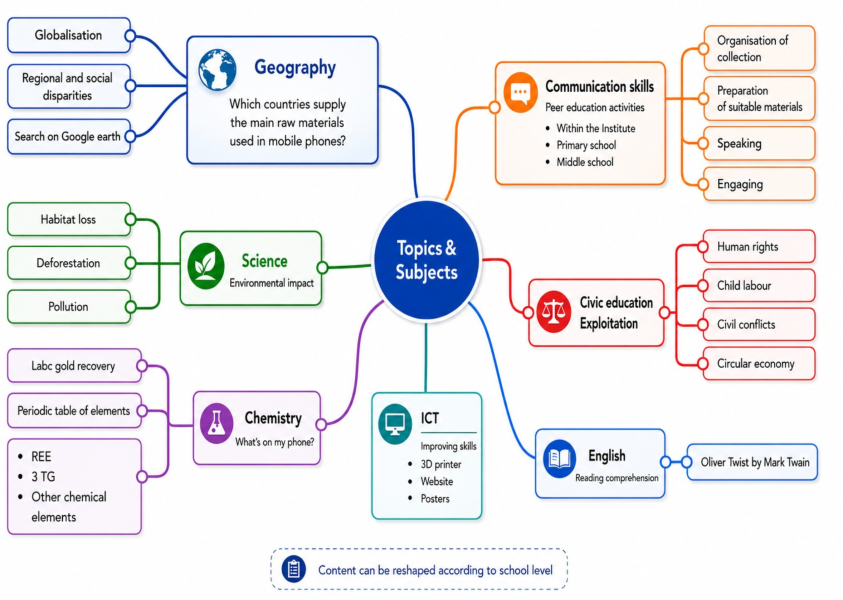
We integrated the project into the civic education curriculum, where a flexible schedule throughout the year allowed each teacher to introduce their specific module at the most appropriate time and with independently created materials. Generally, the theoretical content was covered from October until February, before moving on to the operational phase during the second and final part of the school year. The largest block of consecutive hours was dedicated to organizing the collection campaign and preparing the educational materials for the primary school. Around 15 hours were necessary to finish the website, which was also translated into English.
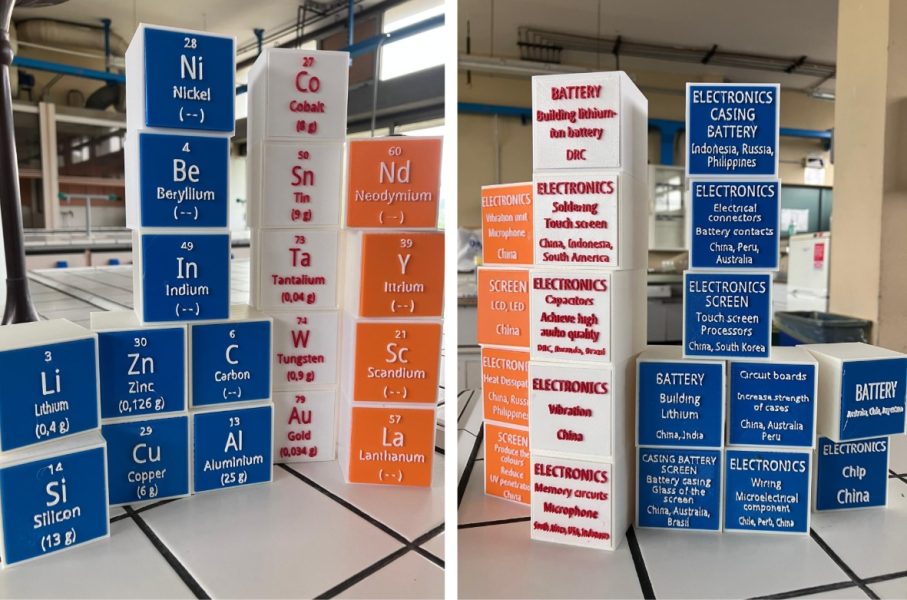
As part of the project, students also learnt how to design for and use a 3D printer. The idea was to represent some elements from the periodic table that are found in our mobile phones as small cubes. For each one, they noted the atomic number and the amount in grams present in a typical phone; by turning the cube, you could discover its role in the device and the countries with the largest reserves.
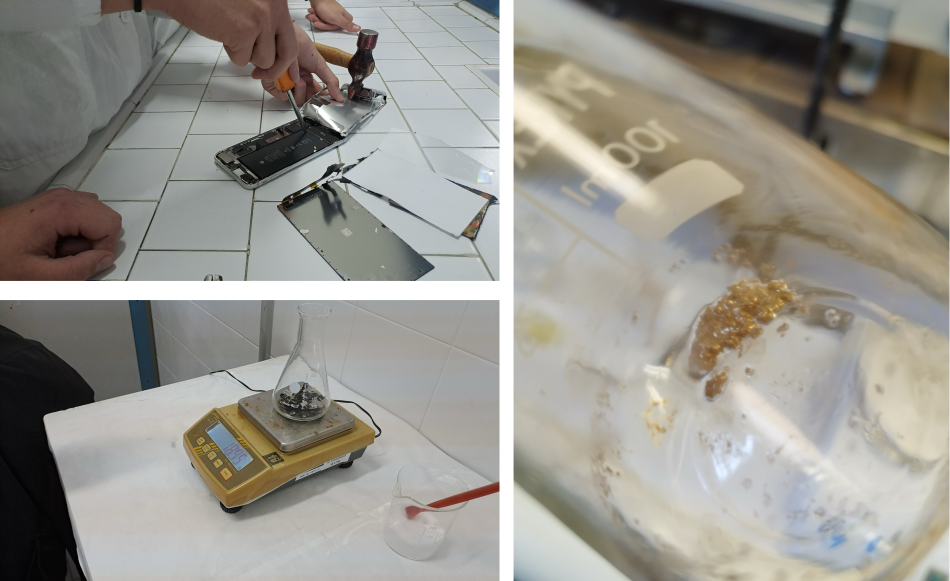
As part of the whole project, students also extracted gold from electronic circuits of three old smartphones. Find the full teaching resource in the complementing teach article.
This project shows how a simple action, collecting unused mobile phones, can become the starting point for a much broader learning experience. Although the campaign is currently only active in Italy and France, the project described here can inspire teachers elsewhere to address the numerous issues related to the production and use of mobile phones. We hope we could motivate you to do a similar initiative in your local context by collaborating with local recycling companies, environmental organisations, or municipal waste services to collect and recycle smartphones and empowering students to become responsible citizens who spread good practices throughout their local area.
Prof. Nicola Muto, Computer science teacher – use of 3D printer
Prof. Alberto Marchetti, Chemistry teacher – gold recovery protocol
Dr.ssa Mariada Mucciaccia – The Jane Goodall Institute Italy
Prof.ssa Angela Colli – President of ANISN Pavia
All students in these three years of work
[1] Article on smartphone abundance: https://explodingtopics.com/blog/smartphone-stats
[2] How many phones end up in waste each year: https://www.envirofone.com/en-gb/buy/advice-centre/how-many-phones-end-up-in-waste-each-year-and-what-can-we-do
[3] The chemistry behind smartphones: https://www.acs.org/content/dam/acsorg/education/resources/highschool/chemmatters/documents/smartphones-smart-chemistry.pdf
[4] The chemical elements of a smartphone: https://www.compoundchem.com/2014/02/19/the-chemical-elements-of-a-smartphone/
[5] The carbon footprint of a smartphone: https://www.tier1.com/the-hidden-environmental-impact-of-our-smartphones/
[6] EuChems periodic table: https://www.euchems.eu/euchems-periodic-table/
[7] Learn which elements used in smartphones could run out in the next century: https://www.bbc.com/news/science-environment-61350996
[8] Global E-waste monitor 2024: https://ewastemonitor.info/the-global-e-waste-monitor-2024/
[9] Ghana’s E-waste landfill: https://www.bbc.com/news/articles/c4gvq1rd0geo
[10] The Roots & Shoots Model: https://rootsandshoots.org/our-model/four-step-formula/
Books:
Pitron G (2022) Inferno Digitale. Luiss University Press. ISBN: 9788861058774
Download this article as a PDF