Supporting materials
Download
Download this article as a PDF



Wondering how to extract gold from mobile phones in a school lab? Explore one of the activities from the project Recycle Your Mobile Phone To Save The Planet.
In the era of so-called ‘digital capitalism’, it is becoming increasingly vital to raise awareness about the responsible use of smartphones and the necessity of recycling the raw materials they contain.
In this hands-on activity, students will chemically explore the recovery of gold from their smartphones. This resource is part of the multidisciplinary project ‘Recycle Your Mobile Phone To Save The Planet’, which is a joint effort between various schools in Italy and the Jane Goodall Institute Italy.[1] You can read more about the project in the accompanying Inspire article.
Students will…
Suggested age range: 14–19 years old
Before students dive into the gold extraction experiment, it is a good time to explore certain chemical, environmental and social aspects of the object that almost all students own and love: the smartphone.
There are currently more than 7 billion smartphones in circulation. Yet, when students are asked to estimate how many chemical elements are present inside a smartphone, it turns out that almost all of them are unaware of the number. It is more than 50 elements![2]
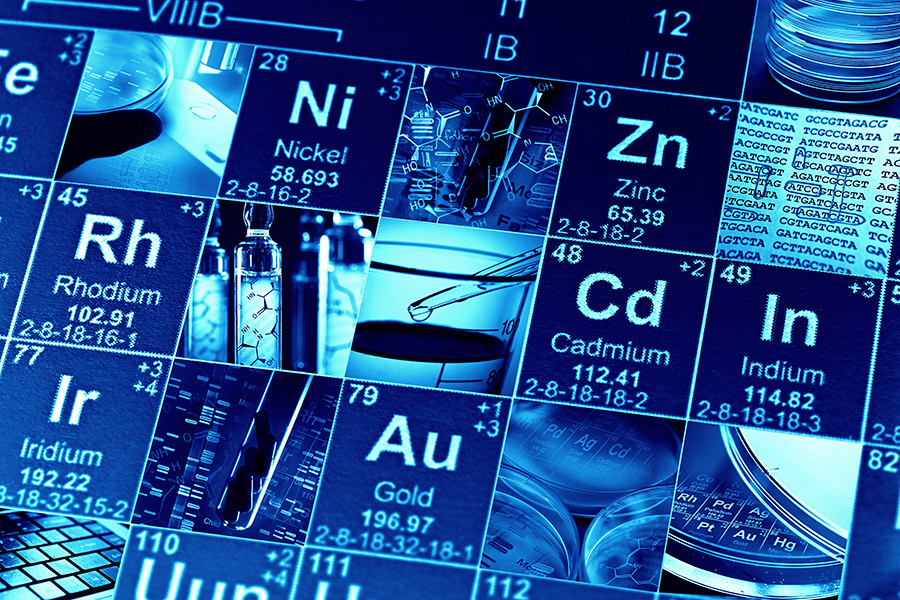
It is a good practice for students to locate the elements on the periodic table, to classify and learn about the properties of metals and non-metals, as well as to explore their position and function within devices.
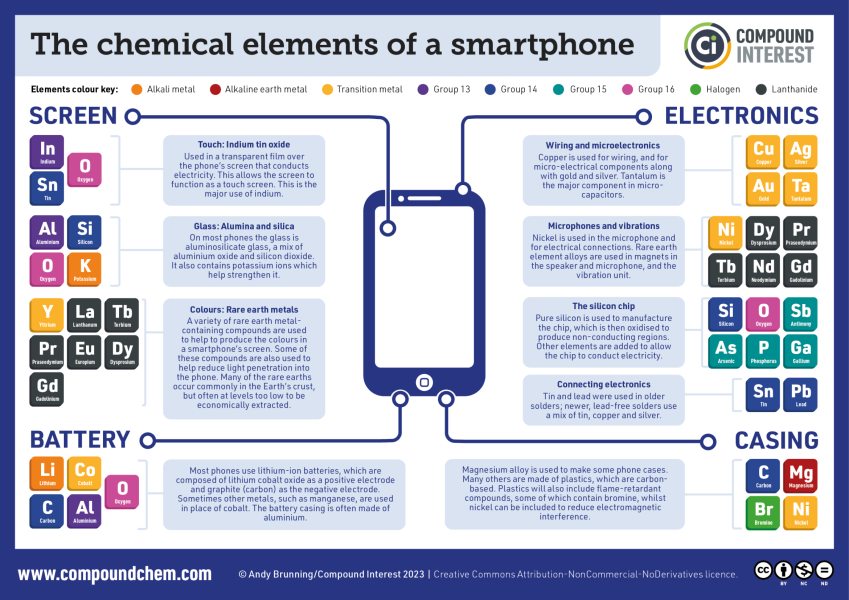
It is particularly useful to focus on critical materials, such as rare earth elements and the 3TG (tin, tantalum, tungsten, and gold), which are essential for the construction of all the technological devices we use daily. All of them are finite resources and, behind their extraction, lie stories of exploited young workers, habitat destruction and pollution of local lands.[3]
It is estimated that, in Europe alone, demand for critical minerals used in green technology and advanced electronics is forecast to quadruple by 2040.[4] Moreover, WEEE (waste from electrical and electronic equipment) is the fastest-growing waste stream in the world. As you can see in the image below, a record 62 million tonnes of e-waste was produced in 2022, and it is on track to rise another 32%, by 2030.[5] As a natural consequence of this, we need to shift the focus onto recovering and reusing these raw materials.
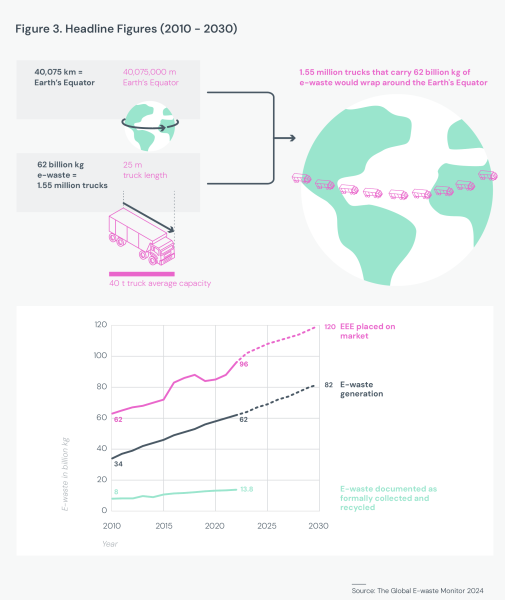
However, less than one quarter (22.3%) of the year 2022’s e-waste mass was documented as having been properly collected and recycled. The rest ends up in illegal landfills, where the materials are often burned or informally recycled, which leads to water, air and soil pollution, as well as bearing health risks for local populations and workers.
We have prepared an information sheet for students (see supplementary materials) covering the most important points of the topic.
Alongside the student information sheet, a teacher guide for optional activities on these points is provided, which helps students to grasps the importance of smartphone recycling.
In this activity, we use a method for recovering gold from obsolete mobile phones through a process of oxidation followed by reduction, striving to use substances with the lowest possible environmental impact.
The procedure described here – from the selection of the circuit boards to melting the gold and recovering the final product – takes approximately three days of work given that some reactions last up to 12 hours. It would be best to conduct the experiments over three consecutive days.
Given the hazardous nature of some reagents, the experiment must be conducted exclusively by the teacher in a suitably equipped chemistry laboratory. Acidic solutions and chemical reagents must be handled safely using appropriate personal protective equipment (PPE), including acid-resistant gloves, heat-resistant gloves, an acid-resistant lab coat and safety goggles. Furthermore, fume hoods must be used during a significant portion of the experiment to minimize exposure to hazardous substances.
Great care must be taken when handling hydrogen peroxide, concentrated acid and potassium permanganate, due to their high reactivity.
Many reactions (e.g., the preparation of an acid–hydrogen peroxide mixture, the addition of potassium permanganate or, alternatively, manganese dioxide) can be highly exothermic. As a precaution, cool the reaction environment using an ice-water bath. If you want to increase the cooling effect of the water-ice bath you can add sodium chloride (NaCl) to decrease its temperature a few degrees.
Below, you can find a short description of the procedure. A more detailed procedure is given in the teacher guide in the supplementary materials.
For 1 g of recovered circuitry, the following are required:
always add the acid to the water, never the other way around!
Reagents for alternative routes:
Obtain circuit boards only from smartphones that have already been assessed as irreparable. You may also obtain unusable circuit boards from electronics repair shops, workplace or school IT departments, or second-hand online marketplaces.
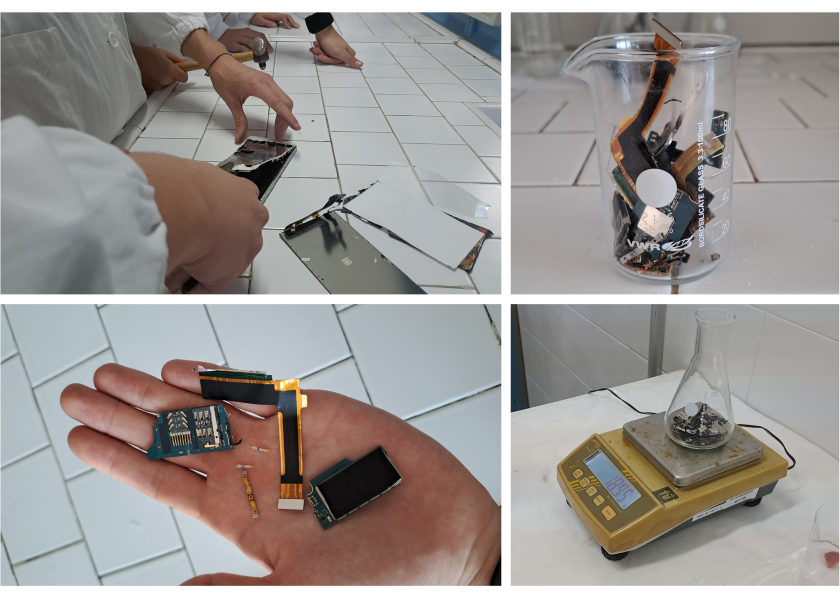
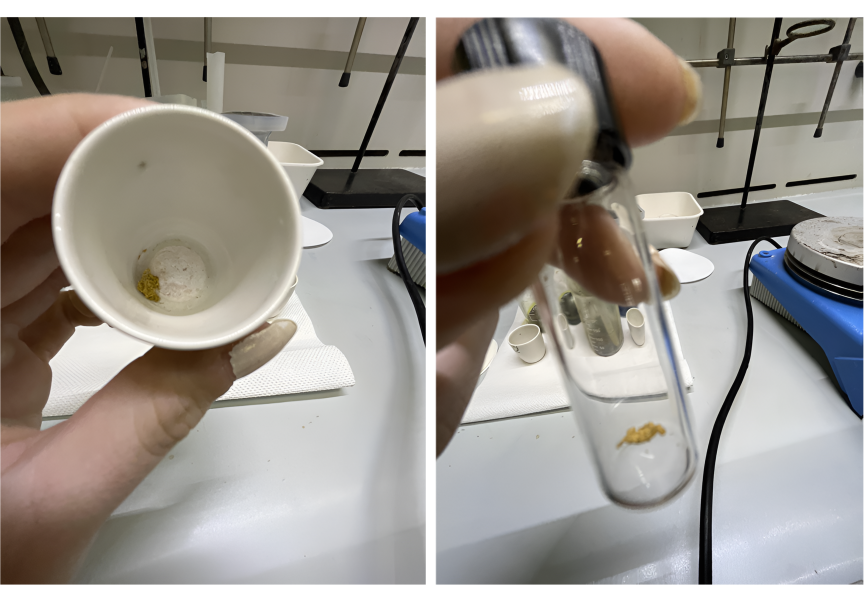
For the detailed procedure, please refer to the Teacher guide.
The final product consists of small gold nuggets or a black/brown powder.[7] The yield of the two reactions depends on the amount of gold present in the selected printed circuit boards and is therefore highly variable, making it impossible to determine an exact value beforehand. Consequently, careful selection of the printed circuit boards is crucial for effective gold recovery.[8]
To round up the experiment, a discussion can be initiated by dividing the class into groups to address the following topics. Example answers to the questions can be found in the supplementary materials.
Extracting gold from discarded smartphones is an essential educational tool that addresses critical global challenges.
In a world rapidly approaching the depletion point of raw materials, raising awareness on this topic becomes essential: without a circular management of resources, even the future availability of the smartphones we use every day could be at risk.
This educational activity fits perfectly into the framework of the UN Sustainable Development Goals (SDGs), particularly SDG 10 (Reduced Inequalities) and SDG 12 (Responsible Consumption and Production), by allowing students to link mining and consumption directly to global ecological and socio-economic impacts.
Furthermore, holding a physical piece of recovered gold provides students with a vivid and memorable image of the valuable resources in a phone, thereby highlighting the importance of recycling.
[1] The Jane Goodall Institute’s mobile phone collection campaign: https://www.janegoodall.it/index.php/azione/cellulari/
[2] Critical minerals powering your smartphone: https://www.sfa-oxford.com/knowledge-and-insights/critical-minerals-in-low-carbon-and-future-technologies/critical-minerals-in-electronics/critical-minerals-in-smartphones/
[3] The EU conflict minerals regulation: https://policy.trade.ec.europa.eu/development-and-sustainability/conflict-minerals-regulation/regulation-explained_en
[4] Europe’s electronic waste crisis: https://www.reuters.com/sustainability/society-equity/europes-electronic-waste-crisis-holds-key-supply-security-if-we-act-it–ecmii-2026-08-24/
[5] The global E-waste Monitor 2024: https://ewastemonitor.info/the-global-e-waste-monitor-2024/
[6] How much gold is in a cell phone: https://learn.apmex.com/learning-guide/science/how-much-gold-is-in-a-cell-phone/
[7] What causes the colours of metals like gold: https://www.webexhibits.org/causesofcolor/9.html
[8] Gold recovery efficiency: https://www.thesilvermountain.nl/en/gold/how-much-gold-is-in-a-phone
This activity is meaningful as it connects the idea of sustainability to chemistry experiments. The lab itself is interesting and offers insights to teachers who are enthusiastic in planning new experiments.
Hong Yu Kiu, Hong Kong
Download this article as a PDF
When talking of finite resources, the chemical elements themselves are often overlooked. Learn more about elements in…



Spinning a yarn: explore the chemistry of wool and use it as a raw material for biobased products through simple hand-on activities.
A multidisciplinary project to raise students' awareness about the importance of properly disposing and recycling materials found in mobile phones.