
Do you know your water footprint?
Fresh water is a scarce resource on our planet – but how many of us are aware of how much water is needed to make the foods we eat every…
Biology, Chemistry, Earth science, Health, Science and society





Project Earth supports students to innovate for the planet with expert advisors and ‘Pitch for the Planet'. Take part!

Project Earth is a charity to support young people and their teachers to genuinely contribute to tackling the climate and biodiversity crisis.[1] It connects young people with a network of expert advisors[2] who provide support and advice to help their ideas progress.
Vision: Every young person has the knowledge, creativity, and ability to drive climate-positive change. The project shows students the potential of engineering solutions, and together with the AI Project Earth assistant, it helps them develop their project, research and presentation skills, and explore career options.
Mission: The project supports accessible, engaging, and high-quality sustainability experiences that empower students to take meaningful action and contribute to a sustainable future. Their creativity, fearless thinking and commitment will result in innovative ideas, hopeful optimism and insights into green careers and futures.
I had written to ask Prince William if he might establish a youth version of the Earthshot Prize, a global prize awarding 5 people each year for their exceptional contributions in the categories ‘restoration and protection of nature’, ‘air cleanliness’, ‘ocean revival’, ‘waste-free living’ and ‘climate action’. He had replied in a really supportive way but was rather too busy to take it on himself, so I established Project Earth. We are partnered with the Earthshot Prize, and there is no doubt that some of the wonderful ideas students come up with could be finalists for the Earthshot Prize in future. Here are a few of the ideas generated in the pilot:
Students who engage in Project Earth feel energised and less anxious about the future because they are genuinely contributing to a more sustainable world and having their voices heard. Participation grew rapidly in the pilot in 2024 to 2025. This year, we are expanding our reach across the world and supporting thousands more students.

Project Earth provides schools with a structured yet flexible framework that guides students to…
There are many ways that Project Earth can run depending on how your curriculum works. You can run it as a club, as an enrichment activity, or as part of a research or climate lesson. It is designed to allow students to work very independently.

A key and unique feature of Project Earth is the huge team of advisors. When a student submits a project on the website to get advice we connect them with a suitable advisor to help develop their project. If we don’t have a suitable advisor, we find one to help. We have three main areas we support and encourage:
Technological innovation: We aim to provide a platform through which young people can present innovative technological concepts that can be harnessed to combat environmental challenges.
Social transformation: We aim to provide young people with the opportunity to develop and share ideas on how social and behavioural change can be utilised as a tool to help combat climate change.
Cultural exchange: We aim to empower young people to use creative storytelling to explore and share their cultural heritage in relation to the environment, thus facilitating a better understanding of how climate change is variously affecting communities around the world.
We have a bespoke AI Project Earth assistant called Scout to help students. Unlike AI tools that do the work for students, Scout builds their capability to think critically and solve problems independently. It also highlights green careers and opportunities. The brilliant thing is that it can answer in a huge number of languages, making Project Earth accessible across Europe and the world.
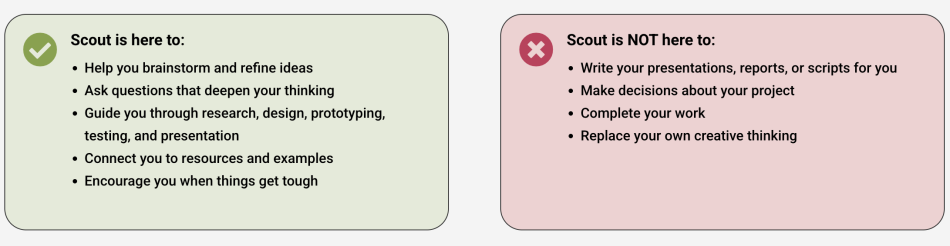
Students who have tested it have said:
“This is a brilliant tool to help improve your project by talking it through and receiving questions that you can use to develop your project further.”
We are hosting a major international showcase at the Royal Institution on 26 June 2026. It will bring together 300 students in person and thousands virtually. It provides a platform for the next generation of climate leaders and innovators, linking them with experts, advisors and investors. We aim to have such a showcase each year and also to showcase work on our website.
The deadline to submit projects for Pitch for the Planet 2026 is 2nd April 2026. Join and submit your project here!
Thanks to all the advisors, supporters and students for their phenomenal work to help make Project Earth happen. To quote Sir David Attenborough: “Seize this moment, for it will not come again.”
[1] All information on Project Earth and Pitch for the planet: projectearth.global
[2] Information about the Project Earth advisors: https://projectearth.global/advisors/
Fresh water is a scarce resource on our planet – but how many of us are aware of how much water is needed to make the foods we eat every…

A species of dandelion is leading the way towards sustainable rubber. Find out how, by growing this unusual plant yourself and extracting the rubber…


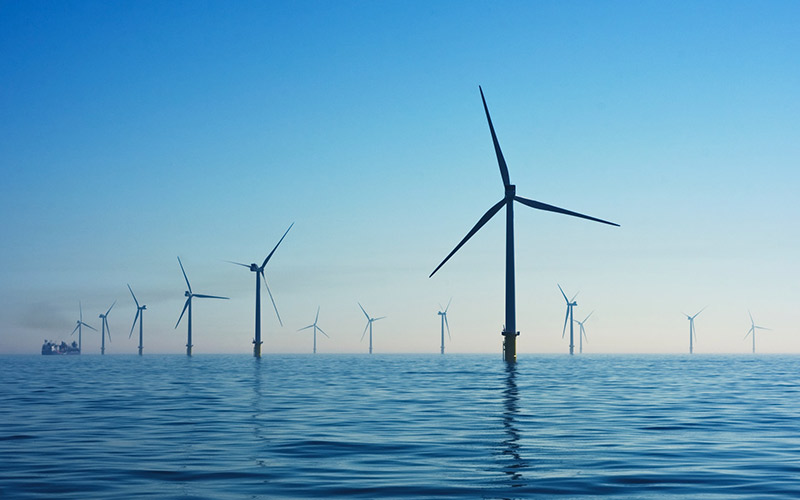
Can we meet all our energy needs with renewables? How can energy models help us to explore the future of energy? And how can we all become part of…
