For fusion researchers, light is far more than a symbol, it is an essential tool.
Each year on 16 May, scientists and innovators celebrate the International Day of Light, marking humanity’s progress through the science of light.
Across EUROfusion laboratories, light-based technologies are helping to probe, heat, and understand the plasma – the ultra-hot, light-emitting state of matter where fusion occurs. From laser diagnostics that identify fusion fuels, to microwave and gyrotron systems that inject powerful electromagnetic waves into tokamaks (donut-shaped machines that confine plasma using magnetic fields; also called torus)[1] to heat the plasma, light in all its forms is helping Europe bring fusion energy closer to reality.
Lasers that ‘taste’ the fusion fuel
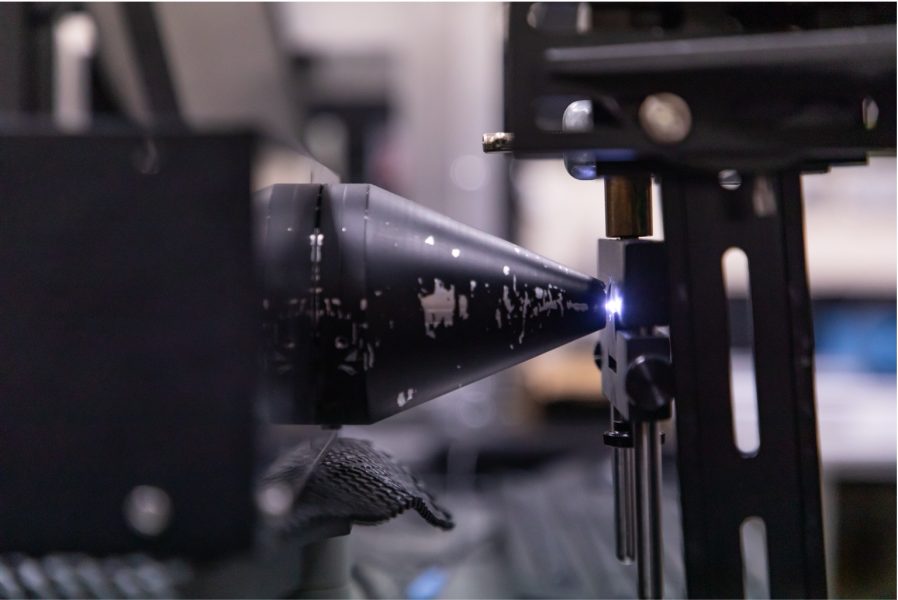
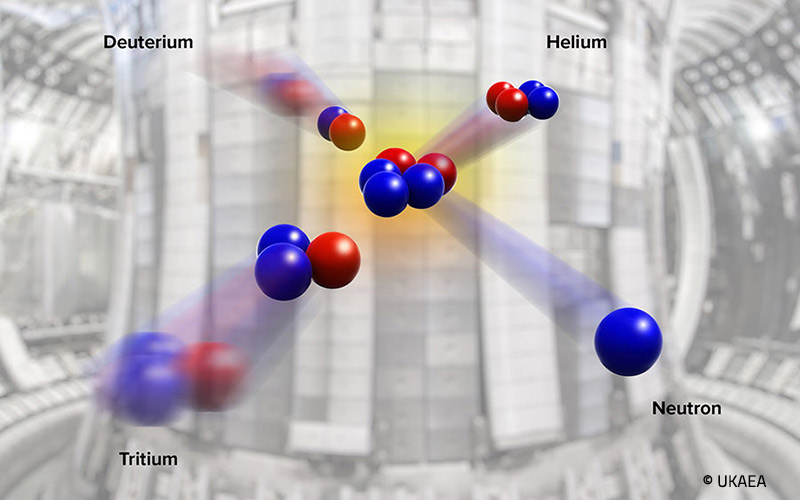
One of the most striking examples is the recent laser demonstration on the Joint European Torus (JET),[2] the largest magnetic confinement fusion device capable of operating with tritium. Tritium is a radioactive isotope of hydrogen that has two additional neutrons. Using a technique called Laser-Induced Breakdown Spectroscopy (LIBS), scientists analyse how much fusion fuel – namely, deuterium (an isotopy of hydrogen with one additional neutron)[3] and tritium – remain trapped in the materials lining the tokamak’s inner wall.
In LIBS, a short, powerful laser pulse is focused onto the surface of a material. The intense light instantly vaporises a tiny amount of that surface and creates a small, glowing plasma plume. As this laser-made plasma cools, it emits light at very specific colours, or wavelengths. By measuring this light with a spectrometer, researchers can identify which elements are present and in what quantities – a bit like reading a barcode made of colours. In the JET experiments, LIBS allowed scientists to detect traces of deuterium and tritium directly on plasma-facing components, providing valuable information on how fusion fuels are retained inside the machine.[4]
For future power plants, keeping track of tritium will be essential for both safety and efficient fuel use. Demonstrating that lasers can perform these measurements inside a complex device such as JET is therefore an important step towards routine fuel inventory control in tomorrow’s fusion reactors.
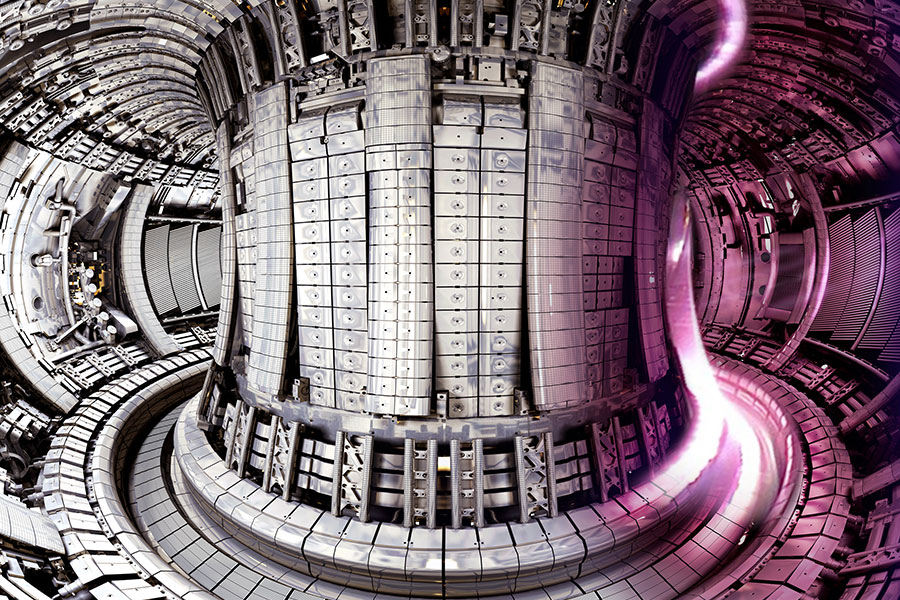
Laser-Induced Breakdown Spectroscopy (LIBS) used on the Joint European Torus (JET), the largest magnetic confinement fusion device capable of operating with tritium Image courtesy of UKAEA
Taking the plasma’s temperature with light
Other laser systems do not look at the reactor walls, but shine straight through the fusion plasma itself.[5] A flagship technique is Thomson scattering, where a very bright, very short laser pulse is fired across the plasma. As the beam crosses the hot gas, some of its photons are scattered by the electrons. The scattered light is collected by optical systems and analysed.
Two key pieces of information are hidden in this scattered light:
Electron temperature: The hotter the electrons, the faster they move. This motion slightly broadens the spectrum of the scattered light. By measuring that broadening, physicists can determine how hot the plasma is.
Electron density: The more electrons there are in the laser’s path, the more light is scattered. The overall intensity of the scattered signal reveals how many electrons, and therefore how much plasma, is present along the line of sight.
Modern Thomson scattering systems can take measurements at multiple locations across the plasma and at high repetition rates, giving researchers a kind of ‘temperature and density map’ that evolves during a plasma experiment. This data is crucial for both understanding the physics of fusion plasmas and controlling many advanced experiments in real time.
Another powerful technique uses Electron Cyclotron Emission (ECE) to measure the temperature of the fusion plasma by detecting microwave radiation emitted by electrons spiralling around magnetic field lines. As the emission frequency depends on the local magnetic field, which varies across the plasma, ECE provides high-resolution, localised temperature profiles in real time.
Gyrotron microwaves: heating electrons with precision
Light does not only diagnose the plasma, it can also heat it. In many EUROfusion devices, powerful microwave beams generated by specialised tubes called gyrotrons are used to warm the plasma to the temperatures required for fusion.
In a gyrotron, an electron beam is produced and guided by a strong magnetic field.[6] Electrons spiral around the magnetic field lines at a very specific frequency known as the cyclotron frequency. Inside a resonant cavity, these electrons transfer their energy to a microwave field at the same frequency. The result is a highly focused, high-power microwave beam which often delivers hundreds of kilowatts, or even megawatts, of power.
When this microwave beam is injected into the tokamak, its frequency is tuned to match the natural cyclotron motion of the electrons in a specific region of the plasma. Due to this resonance, the electrons absorb the microwave energy very efficiently, heat up, and then pass some of this energy on to the ions via collisions. This process is known as Electron Cyclotron Resonance Heating (ECRH).
High-power microwave beams can be used to study plasma fluctuations by scattering the radiation of electrons, which is influenced by the surrounding ions. This allows for measurements of turbulence and the ion velocity distribution, including non-thermalised ion populations.
A key advantage of gyrotron-based heating is precision: the beams can be steered and focused to deposit their power exactly where it is needed, for example, to stabilise instabilities or shape the current profile. This makes gyrotrons a central technology for both current experiments and future machines like ITER (Latin for ‘the way’), the world’s largest fusion experiment under construction in Cadarache, France, which is currently being built as a collaboration between 34 nations.[7] Accurate control of the burning plasma will be essential for this project.
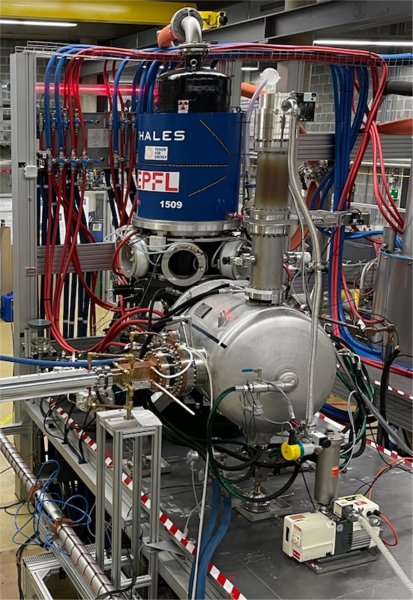
The Thales TH1509U gyrotron is a very powerful microwave source for heating fusion plasma. It was designed for ITER and DTT (Divertor Tokamak Test) fusion device, and it is currently being tested at EPFL’s Swiss Plasma Center in Lausanne. Image courtesy of Alberto Leggieri
Watching the plasma with colours and shadows
Light also enables precision in other, more familiar forms. Spectroscopy uses the colours of light emitted by the plasma to reveal its composition and temperature.[8] Each chemical element emits light at a unique wavelength when excited. By measuring these emission lines and analysing how they broaden or shift, scientists can identify impurities in plasma, such as oxygen, nitrogen, or metals from the wall, and estimate the temperature of different regions of the plasma.
On the other hand, laser interferometry measures how much a coherent laser beam is delayed as it passes through the plasma.[9] The electrons in the plasma change the refractive index along the beam’s path, which slightly shifts the phase of the light. By comparing this shifted beam with a reference beam, researchers can determine the line-integrated electron density with very high precision. This approach is widely used in devices ranging from JET to ITER-relevant diagnostics.
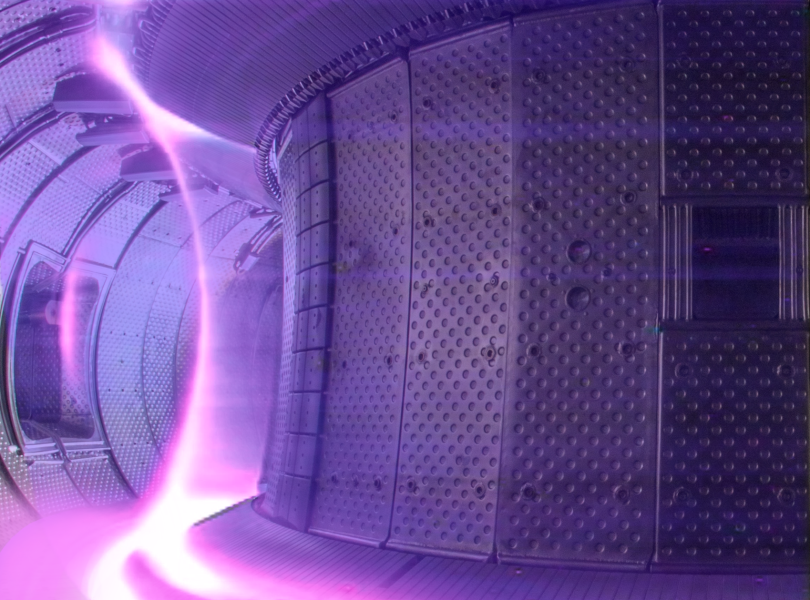
High-speed optical cameras add yet another layer of insight.[10] Operating at hundreds of thousands of frames per second, they capture the rapid flickering of plasma filaments and edge instabilities. When combined with laser and microwave systems, these optical tools provide a comprehensive understanding of how plasma behaves over time.
WEST tokamak plasma, made with optical visible camera Image courtesy of CEA
As EUROfusion researchers continue to explore the limits of light-based science – from identifying fuel on reactor walls to steering microwave beams deep inside the plasma – the message for 2026 is clear: light guides us not only in laboratories, but also on our shared journey towards clean, abundant fusion power.
Explore some of the science behind our efforts to harness fusion energy: Tischler K, de Vries G (2023) The everyday science of fusion. Science in School 63.
Read about fusion and how it aims to produce energy by reproducing solar conditions: Warrick C (2022) JET sets new fusion energy record. Science in School 57.
Find out more about the difference between fusion and fission: EUROfusion (2021) Fusion vs fission. Science in School51.