Sandy beaches: the window to the ocean Teach article
Author(s): Ninoshka López-Xalín Guilherme N. Corte, Maria Elisa Aguilera Valenzuela, Claudia Berea, Alison Cawood, Anna Davis, Katelyn DiBenedetto, Holly Durham-Guckian, Martha Loizeaux, Katie Strait, Gustavo Valencia Tello, Yolande Williams, Rodrigo Zárate, Martin Thiel
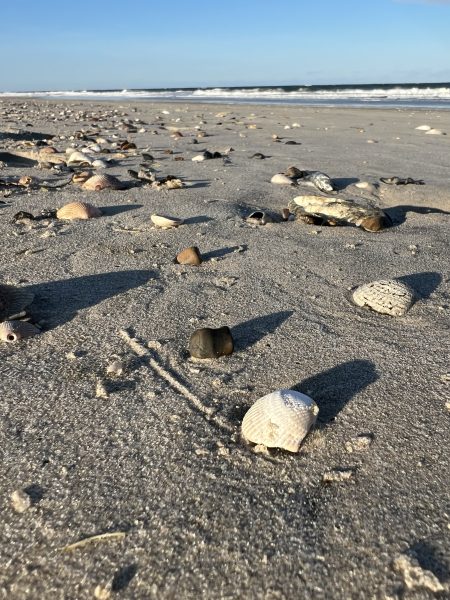
Turn a beach visit into a science adventure! Explore the animals, plants, shells, and even litter stranded on the beach to reveal the secrets of marine life and ocean dynamics.
Image courtesy of the Beach Surveyor Project, Smithsonian Environmental Research Center
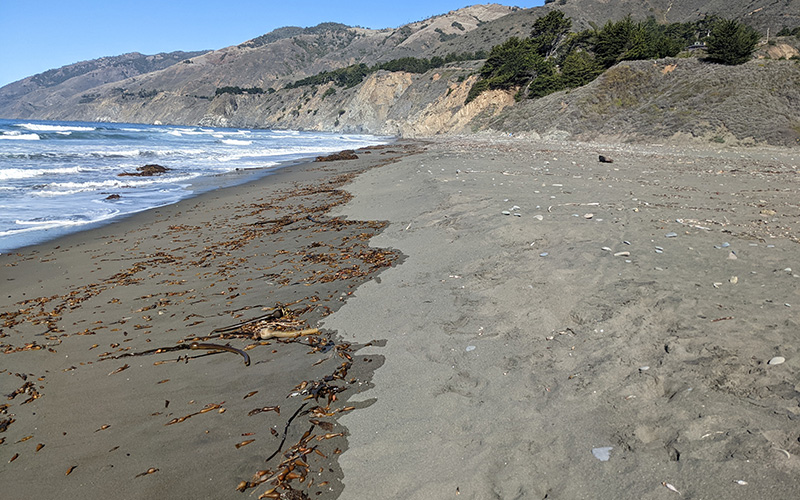
Sandy beaches make up more than one-third of the world’s coastlines[1] and are among the most cherished natural environments on our planet. Beaches also serve as our window to the ocean, offering valuable insights into the organisms that inhabit it and the processes that shape it. Yet, many people think of them only as recreational sites, overlooking their vital role as dynamic coastal ecosystems.
Here, we propose hands-on activities to be carried out on the beach, enabling students to explore marine biodiversity and the connections between land and ocean. These activities are part of marine education materials fostering ocean literacy among students who explore how human activities, climate change, and natural processes interact along the coast. Repeating these activities in annual courses will produce long-term observations that promote a deeper understanding of local changes and critical thinking in the students. An informed and engaged person is needed for making sound decisions about coastal management, conservation, and sustainability in a rapidly changing world.
Beaches are dynamic environments exposed to sun, wildlife, and waves. To ensure a safe and enjoyable experience:
Choose a beach with easy access (if possible, select one with low human use).
Ensure students have access to drinking water and are well protected from the Sun (do not forget sunscreen and a hat!).
Always have a responsible adult or teacher supervising the group.
Students should stay away from large dead or living animals, or dangerous human-made objects such as medical waste, sanitary waste, or food waste.
Students should not enter the water.
Before you start: Divide students into groups of two or three and assign each group a number. They will work together on the four activities.
Activity 1: Beach overview
On sandy beaches, many objects can be found washed ashore. In this activity, students will learn how to record fieldwork metadata – an essential part of scientific research – and explore the variety of natural objects stranded on the beach (approximately 20 minutes). Let’s see what you will discover!
Each group records the following information (metadata) in data table 1:
Beach name
City (and state, if applicable)
Country
Beach coordinates (use Google Maps to find the latitude and longitude)
School name
Group number
Date and time of visit
Temperature (use the weather application on your phone)
Walk around the beach for 10 minutes to explore the area. As you go, look for and mark the objects you find using data table 1.
Activity 2: Collecting small natural objects on the beach
People have long collected objects stranded on the beach, an activity known as beachcombing.[2] Beachcombing offers valuable clues about the biodiversity in nearby marine habitats and about changes occurring in the ocean. In this activity, students will collect small natural objects stranded on the beach to infer the diversity of marine life in surrounding waters (approximately 25 minutes).
Materials
Pencil
Permanent marker
Timer
Gallon resealable bag
Data table 2: small natural objects collected on the beach
Procedure
Assign each group an area (approximately 25 m) along the beach.
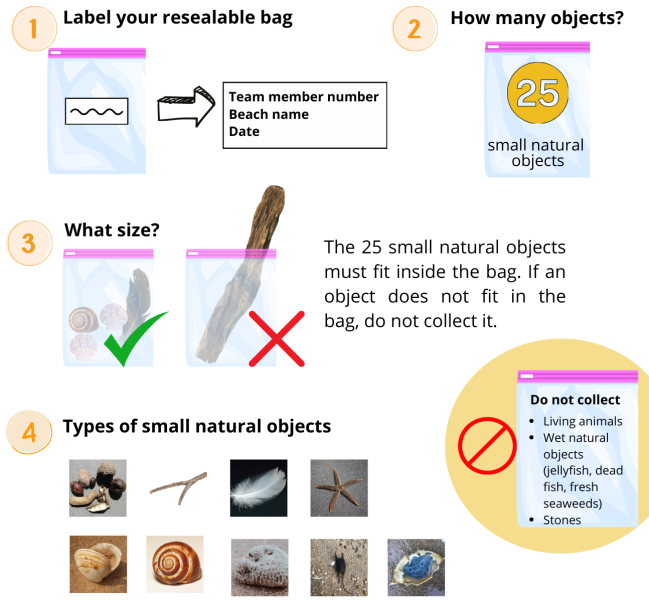
Instruct the students to walk in a zigzag pattern along the beach, between the wrack line and the end of the backshore, and search for small objects for two minutes. The objects must fit in a resealable bag (figure 1).
Figure 1: Instructions on how to collect objects for activity 2 Image courtesy Ninoshka López-Xalín, Smithsonian Environmental Research Center
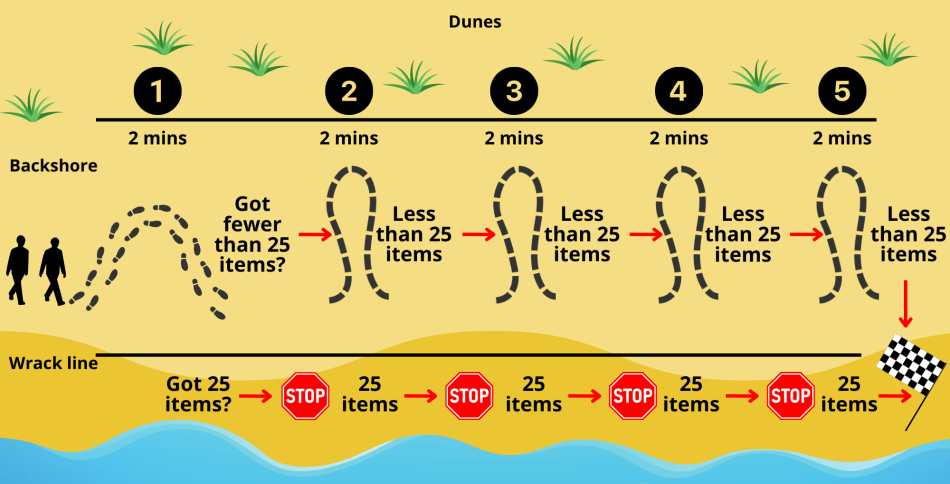
If the group does not collect 25 small, natural objects, walk in the same direction and repeat the search for another two minutes. Continue until either the group has collected 25 objects or five 2-minute cycles have been completed, whichever comes first (figure 2).
Figure 2: Instructions for carrying out activity 2 Image courtesy Ninoshka López-Xalín, Smithsonian Environmental Research Center
Organize the objects collected. Refer to data table 2 for the main types of natural objects.
In data table 2, record the total number of people in the group and the number of 2-minute cycles completed.
Record the number of objects in the column ‘Number of objects (My data).
When all groups are finished, gather the class and record the total number of natural objects for each type of object in the column ‘Number of objects (Entire class)’. You should sum the number of objects collected by each group.
Place all collected objects in the resealable bags.
Activity 3: Human-made (litter) objects
Unfortunately, not all objects found on beaches are natural. Most beaches now contain marine litter such as plastics, metals, paper, glass, and processed wood.[3] This pollution can harm animals and affect tourism.[4, 5]
In this activity, students will assess the amount of marine litter stranded on the beach (approximately 25 minutes).
Students will work in the same area assigned before.
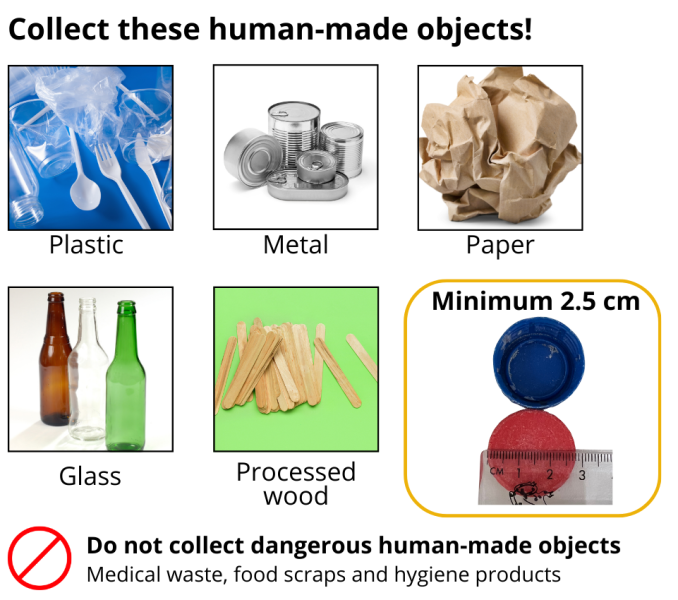
Collect all the human-made objects (figure 3) following the same methodology as used for small natural objects (figure 2).
Figure 3: Instructions for carrying out activity 3 Image courtesy Ninoshka López-Xalín, Smithsonian Environmental Research Center
Organize the objects collected. Refer to data table 3 for the main types of human-made objects.
In data table 3, record the total number of people in the group and the number of 2-minute cycle completed.
Record the number of objects in the column ‘Number of objects (My data)’.
When all groups are finished, gather the class and record the total number of human-made objects for each type of object in the column ‘Number of objects (Entire class)’. You should sum the number of objects collected by each group.
Store all human-made objects in plastic bags.
Activity 4: Buoyancy test
Objects found on the beach, whether natural or human-made, can either float or sink in seawater. Those that float have positive buoyancy and may have travelled long distances with the ocean currents,[6, 7] while those that sink have negative buoyancy and likely come from nearby areas.
In this activity, students will evaluate the buoyancy of the collected objects and discuss whether they originated from nearby or distant locations (about 30 minutes).
Materials
The small natural objects collected in activity 2
The human-made objects collected in activity 3
Bucket
Labels for buoyancy test (made by hand)
Data table 4: buoyancy of small natural objects collected on the beach
Data table 5: buoyancy of human-made objects collected on the beach
Procedure
Gather the whole class to test the buoyancy of the collected objects.
Prepare a bucket of sea water and a labelled sorting mat to organize the objects.
Each group selects two small natural objects and two human-made objects: one common and one rare object from each category.
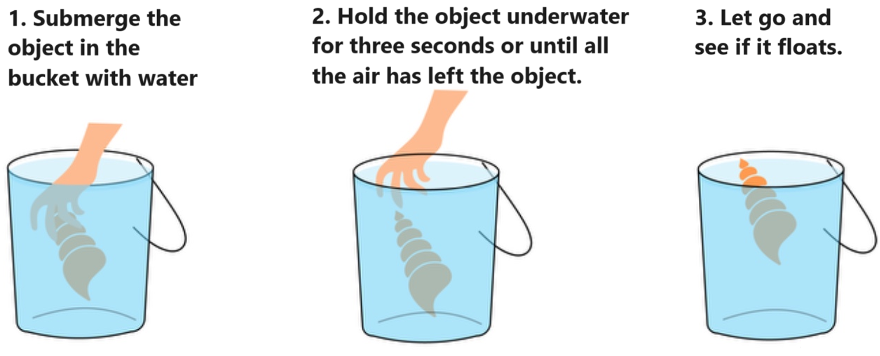
Test the buoyancy of the four objects as described in figure 4.
Figure 4: Instructions for carrying out activity 4 Image courtesy Ninoshka López-Xalín, Smithsonian Environmental Research Center
Place these objects on the sorting mat according to the test results (figure 5).
When all groups are finished, record the class results in data table 4 (natural objects) and data table 5 (human-made objects).
Figure 5: The left image shows a mat for small natural objects, and the right image shows a mat for human-made objects. Image courtesy Ninoshka López-Xalín, Smithsonian Environmental Research Center
Discussion
Students had the opportunity to explore and carefully observe the objects washed ashore on their beach. This may spark curiosity and encourage them to see beaches as dynamic ecosystems, not just recreational destinations. Use this opportunity to guide a discussion about their findings.
Example questions:
What type of objects (natural or human-made) where more frequent on the beach?
How might objects stranded on the beach benefit or affect the organisms living there?
Did you notice any sign of a mass stranding event?
How can human-made objects affect marine life and beach ecosystems?
Where might these natural and human-made objects come from?
Is your beach well preserved or highly impacted by human activities?
Students may notice large numbers of the same natural objects, which could indicate a mass stranding event. They may also observe living organisms using natural stranded objects for food or shelter. Conversely, finding many human-made (litter) objects suggests a beach affected by pollution. After the buoyancy test, students can discuss how different objects might have travelled and what this reveals about the beach’s connection to the wider ocean.
Acknowledgments
This is contribution 163 from the Smithsonian’s MarineGEO and Tennenbaum Marine Observatories Network.
Try these hands-on activities to introduce your students to microplastics: Realdon G (2015) Microplastics: small but deadly. Science in School25: 32-35.
Understand the role of the oceans in climate change: Harrison T, Khan A, Shallcross D (2017) Climate change: why the oceans matter. Science in School39: 12–15.
Discover how the unique characteristics of seagrasses are vital for the health of our planet: Crouch F (2024) Seagrass the wonder plant! Science in School 67.
Ninoshka López-Xalín is a passionate biologist of marine ecosystems from Guatemala. She has worked with participatory science for the last three years, involving schoolchildren, teachers, volunteers, and scientists around the world to collect scientific data about marine debris and marine life on beaches.
Guilherme Corte is an assistant professor at Texas A&M University at Galveston. He studies how climate change and human activities impact coastal ecosystems, especially sandy beaches, across the world. His work combines research, outreach, and international collaboration to support conservation and resilience in coastal environments.
María Elisa Aguilera Valenzuela is a teacher in natural sciences with a specialization in chemistry and a master’s degree in education. She works as a teacher and STEM lead at Liceo Bicentenario Indómito de Purén in Chile. Her work focuses on environmental issues, particularly plastic pollution, which she investigates through citizen science alongside her students.
Claudia Berea is a biology teacher from Yucatán, México, involved in citizen science initiatives that foster curiosity, critical thinking, and active student participation in ecosystem conservation.
Alison Cawood is the associate director for public engagement at the Smithsonian Environmental Research Center. She works to connect science with community needs through participatory science, education, and collaboration.
Anna Davis is a public engagement program manager at the Smithsonian Environmental Research Center (SERC). She is a marine scientist by training with a passion for science education. Her work at SERC centers on developing educational resources and running educator professional development trainings that focus on environmental literacy.
Katelyn DiBenedetto is a program manager with the Marine Global Earth Observatory (MarineGEO) program, supporting coordination across its collaborative, global research network. Trained as an anthropologist, her research spans diverse topics, including the Neolithic, human-sea interactions, land and water management strategies, and the societal value of higher education.
Holly Durham-Guckian is a passionate teacher of math and marine and natural sciences at Spring Street International School in Friday Harbor, Washington, USA. She helps her students connect to and explore the natural world through hands-on, inquiry-based science, immersed in the oceans, out in the field, and in the classroom.
Martha Loizeaux teaches marine science at Ocean Studies Charter School, Florida, USA. She has a B.A. in Zoology, M.A. in Biology and is a PADI ppen water scuba instructor. She uses project-based learning to guide her students to directly contribute to environmental conservation at local and global scale.
Katie Strait teaches marine science, biology, and immunology at Baxter Academy for Technology and Science in Portland, Maine, USA. She has a B.S. in Biology and a M.S. in Zoology. Her teaching philosophy centers on experiential learning – immersing students in authentic, hands-on scientific inquiry that connects classroom concepts to the living systems, data, and discoveries of the real world.
Gustavo Valencia Tello is a secondary school science and mathematics teacher at the Maria Parado de Bellido public school in Casma, Peru. He currently develops educational projects in the areas of cultural heritage and environmental preservation. He and his students are also involved in important citizen science projects.
Yolande Williams is a dedicated 7th-grade science teacher at Gwyn Park Middle School in Prince George’s County, Maryland, and a former science curriculum writer for Prince George’s County Public Schools. She is passionate about fostering students’ curiosity and helping them explore the wonders of science through engaging, hands-on learning experiences.
Rodrigo Zárate is a Chilean biologist and teacher at the Antofagasta British School and at the Santo Tomás University in Antofagasta. He integrates science and environmental education into his classes, promoting scientific experiences for children and young people. Rodrigo is currently pursuing a doctorate in science education in Spain.
Martin Thiel is a marine biologist who has studied marine life on several continents, investigating coastal ecosystems and the organisms inhabiting them. He also has worked for many years with participatory scientists, especially school teachers and park rangers from the Pacific coast between Mexico and Chile.
Review
Apart from beach cleaning events, sandy beaches are not particularly popular in scientific and environmental education projects.
This article, instead, proposes a series of diverse and consistent activities aimed at learning about this environment and its connections with the ocean and with human activities.
The proposed tasks do not require specific equipment, allow for connections with various STE(A)M disciplines, and are easy to manage, apart from transportation for schools located in inland areas.
The topic of beaches and their tourist exploitation is also well-suited for socio-scientific discussions aimed at promoting environmental awareness and active citizenship.