Supporting materials
Download
Download this article as a PDF



Following Rutherford’s steps to see inside the atom.
This activity is aimed at students aged 14–19 years old. In this activity, students learn to:
The structure of matter and the development of atomic models are standard topics in science curricula. In many classrooms, however, atomic models are introduced mainly through a historical sequence – Dalton, Thomson, Rutherford, Bohr – and later developments are presented one after another, often as a story of successive discoveries. Research on the nature of science has emphasised that students should understand scientific knowledge as evidence-based, tentative and model-dependent, rather than as a fixed body of facts.[1,2] However, when historical episodes are presented only as linear narratives of discoveries, they may oversimplify the way scientific knowledge is actually produced.[3]
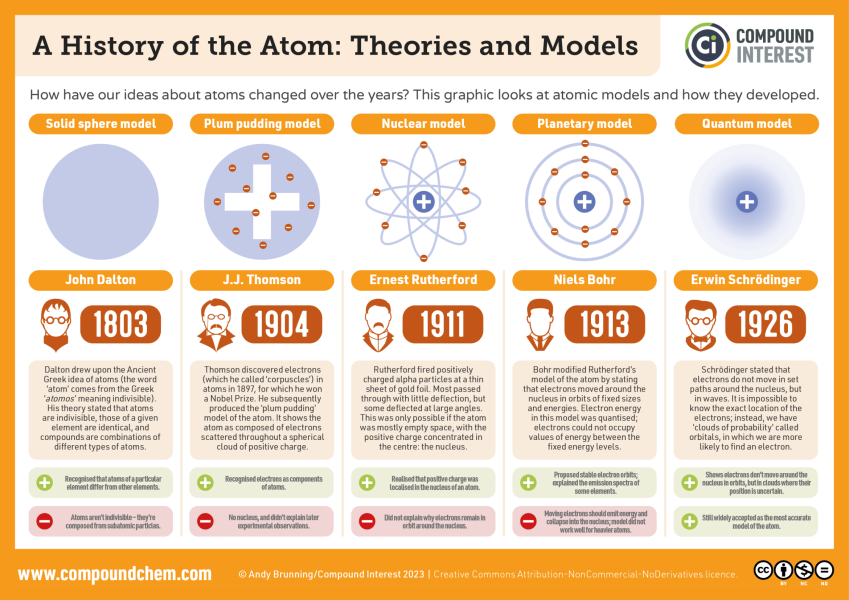
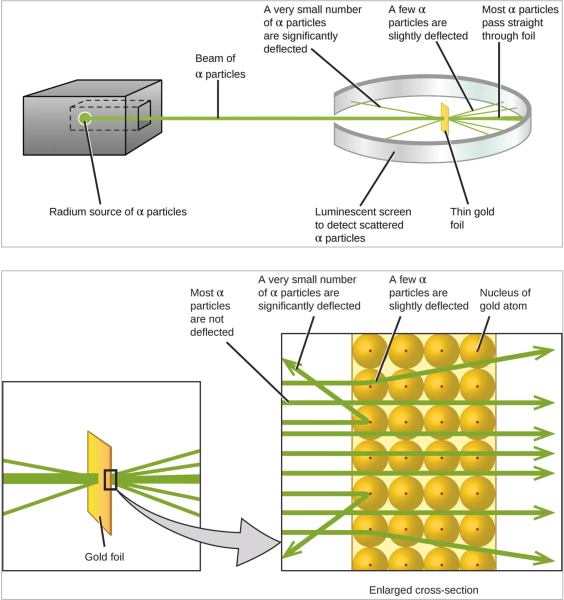
This can make it difficult for students to understand the role of models in science. Atomic models are not direct pictures of atoms, but theoretical constructions that organise observations, make predictions and can be challenged by new data. In the case of Rutherford’s atomic model, for example, the key issue was not simply that a new model appeared after Thomson’s model. Instead, Rutherford proposed a mathematical description for the scattering of charged particles, and this description was later confronted with experimental measurements obtained by Geiger and Marsden (more information on this experiment can be found here).
The activities presented are designed to help students experience this process. First, they investigate a macroscopic ‘mystery tube’ whose internal mechanism cannot be directly observed. By proposing, testing and revising possible explanations, students encounter the idea that a model can be useful even when the underlying system is hidden from view.
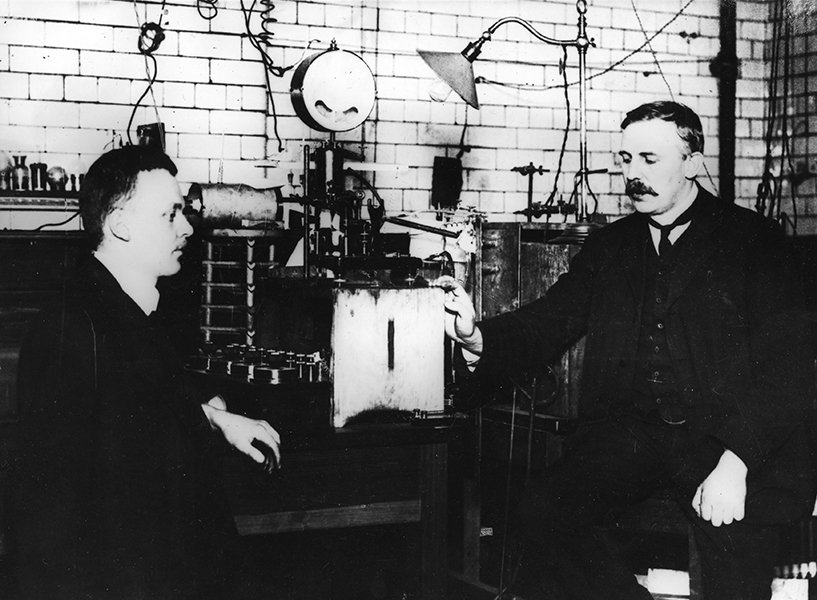
In the second activity, they analyse original data from Geiger and Marsden’s alpha-particle scattering experiments and discuss how evidence can support, constrain or challenge a proposed model of atomic structure. This approach invites students to engage with the practices of science such as observing, modelling, representing and analysing data, as well as arguing from evidence and recognizing the limitations of any explanation. The aim is to shift the focus from ‘what Rutherford discovered’ to ‘how evidence can be used to make sense of something we cannot see directly’.
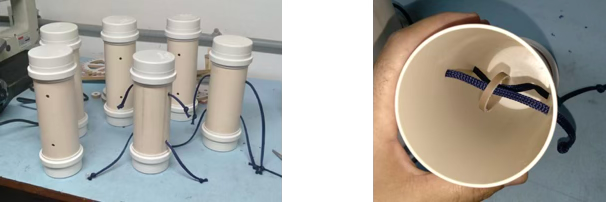
In Activity 1, students investigate tubes constructed as described in reference [4] and try to understand how they are built and why they react the way they do when the strings are pulled. As can be seen in the pictures below, the tubes are sealed with end caps and cannot be opened. Inside them, the cords are connected in different ways.
The objective of this activity is to make the students experience the processes of science: observing nature, trying to explain it, testing models, comparing results, revising the hypotheses and working together.
This activity is most suitable for students aged 13–18.
Preparations before class:
During the class:
A good set of roles has been suggested by Elisabeth G. Cohen in the book Designing Groupwork: Strategies for the Heterogeneous Classroom:[5]
Suggested sequence:
In Activity 2, the students analyse the original data collected by Geiger and Marsden to draw conclusions about the structure of the atom.
The objective of this activity is to make the students work with data and learn ways to interpret it. They will use graphs, mathematics and group discussions to understand what messages the data brings up.
This activity is most suitable for students aged 15–18.
Preparations before class:
During the class:
Note for teachers: Some groups may choose to analyse the raw data using a calculator to evaluate how values decrease with the angle (table 1) or vary with atomic weight (table 2) rather than creating a plot. If they can justify it, accept this analytical approach. However, if no group attempts to plot the data, use the final plenary discussion to highlight the visual and analytical advantages of graphical representations.
Ask groups to debate the following question: Were you doing science during this activity?
Challenge students to identify differences between their classroom work and authentic scientific inquiry. In this activity, students could ultimately consult a reference or textbook to find the ‘correct’ answer. In real-world science, however, researchers operate at the frontier of knowledge, where absolute answers do not yet exist.
Suggested sequence:
[1] Schwarz CV et al. (2009) Developing a learning progression for scientific modeling: Making scientific modeling accessible and meaningful for learners. Journal of Research in Science Teaching 46: 632–654. doi: 10.1002/tea.20311
[2] Lederman NG (1992) Students’ and teachers’ conceptions of the nature of science: A review of the research. Journal of Research in Science Teaching 29: 331–359. doi: 10.1002/tea.3660290404
[3] Allchin D (2004) Pseudohistory and pseudoscience. Science & Education 13: 179–195. doi: 10.1023/B:SCED.0000025563.35883.e9
[4] Instruction to build the mystery tubes: https://undsci.berkeley.edu/lessons/mystery_tubes.html
[5] Cohen EG, Lotan RA (2014) Designing Groupwork: Strategies for the Heterogeneous Classroom 3rd edition. Teachers College Press. ISBN: 978-0-8077-5566-2
[6] Rutherford E (1911) The Scattering of α and β Particles by Matter and the Structure of the Atom. The London, Edinburgh, and Dublin Philosophical Magazine and Journal of Science 21: 669–688. 10.1080/14786440508637080
[7] Geiger H, Marsden E (1913) The Laws of Deflexion of α Particles Through Large Angles. The London, Edinburgh and Dublin Philosophical Magazine and Journal of Science 25: 604–623. doi: 10.1080/14786440408634197
[8] Article on the discovery of the nucleus of the atom: https://history.aip.org/exhibits/rutherford/sections/alpha-particles-atom.html
This article offers a refreshing way to engage students with the development of scientific ideas and the role of evidence in shaping scientific knowledge. By using inquiry-based activities, it encourages students to think about how models are constructed, tested, and refined, rather than viewing scientific models as fixed facts.
The activities could be particularly useful for physics teaching, while also supporting broader discussions about the nature of science and the relationship between evidence, experimentation, and explanation. The links with data interpretation and graphical analysis also provide opportunities to integrate mathematical skills into science learning.
Umaimah Muffy, Pakistan
Particle physics is often seen as something only for huge research institutes, out of reach of the general public. Francisco Barradas-Solas and…


Discover how hands-on experiments can introduce students to light and particles through the lens of space exploration.
Identify tracks of subatomic particles from their ‘signatures’ in bubble chamber photos – a key 20th century technology for studying particle…