Girls Go STEM: teachers shaping girls’ STEM journeys Inspire article
Author(s): Silke Müller
Teachers are central to any effort to get more girls interested in STEM. Yet supporting them often comes second to supporting the students.
Ask any woman who works in science, technology, engineering or mathematics about the moment she first felt she belonged there. More often than not, the story involves an educator. Research consistently confirms this: teachers are among the most significant influences on whether girls feel they belong in STEM or come to believe it isn’t for them.[1–3] Sometimes it’s a secondary school physics teacher who stayed late to help with a problem set. Or a primary school educator who simply said, “You’re good at this.”
When Girls Go STEM recently asked its community of students and teachers to name the women in STEM who had inspired them the most, some mentioned well-known scientists or entrepreneurs. However, a striking number pointed to a teacher, often one from years or even decades ago.[4, 5] A good teacher will often leave a lifelong impression.
It’s a simple observation with an essential implication: if teachers shape who enters STEM, what happens when we genuinely invest in them?
What is Girls Go STEM?
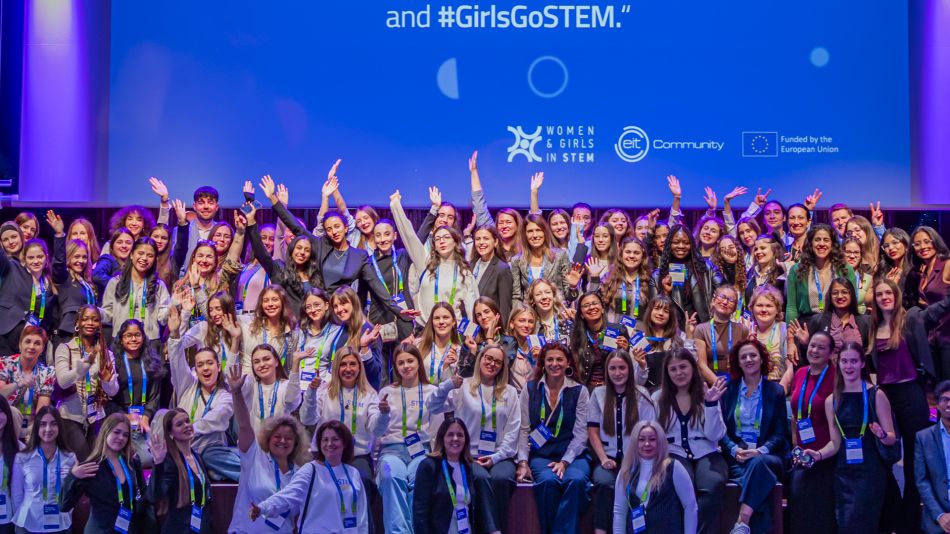
Women and Girls in STEM Forum 2025 Image courtesy of Girls Go STEM
Girls Go STEM, formerly Girls Go Circular, is an initiative led by the European Institute of Innovation and Technology (EIT), coordinated by EIT RawMaterials and supported by the European Commission. Since 2020, it has empowered over 78000 girls aged 14–19 with digital, green, and entrepreneurial skills through interactive, challenge-based learning and hands-on activities.[6] Through a free learning platform, it offers 30+ online courses in all EU languages, with certifications covering circular economy, deep tech and entrepreneurial competencies for students and teachers.
The programme has always focused on sparking girls’ interest in STEM subjects. Its backbone, however, is engaged teachers – educators who bring courses in the classroom and support students in solving real-world challenges. This raises the question: how can those teachers be better supported?
Girls Go STEM Teacher Ambassador Cohort 1 Image courtesy of Girls Go STEM
Since 2024, Girls Go STEM has been expanding its community efforts with an engaged network of ambassadors, both students and teachers, who carry the initiative’s mission into their schools, cities, countries and beyond.
The two ambassador programmes are deeply connected by design. Teachers and students share events, motivate and mentor each other, and together form a community of advocates for gender equality in STEM.
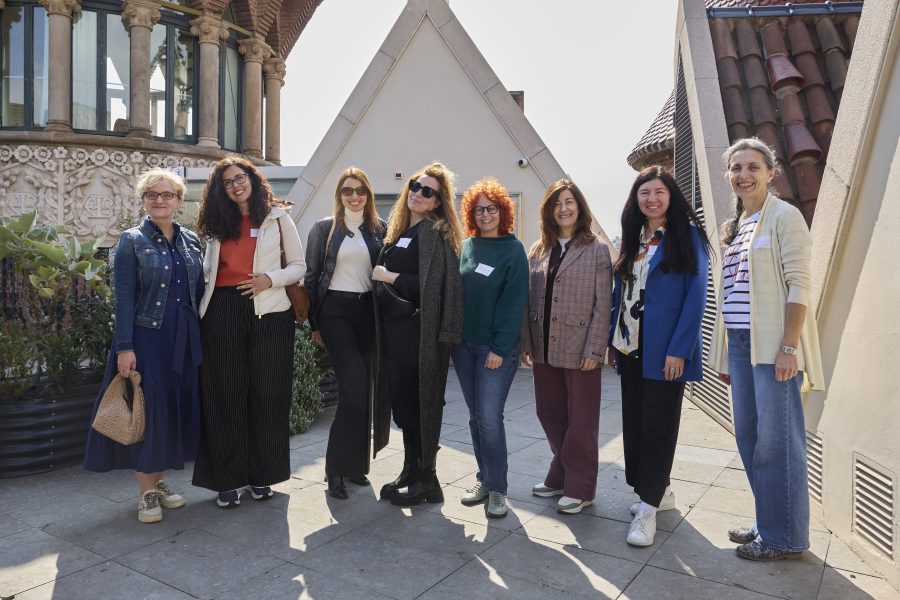
Student and teacher ambassadors in Barcelona Image courtesy of Girls Go STEM
That connection came to life in Barcelona earlier this year, when student and teacher ambassadors met in person for the first time. The gathering was a working demonstration of the purpose of our ambassador programmes: to build a community of people who support each other as they navigate STEM subjects, leadership roles and the challenges that come with being a role model in their community. Ambassadors explored gender dynamics and power structures in STEM and practised public speaking.
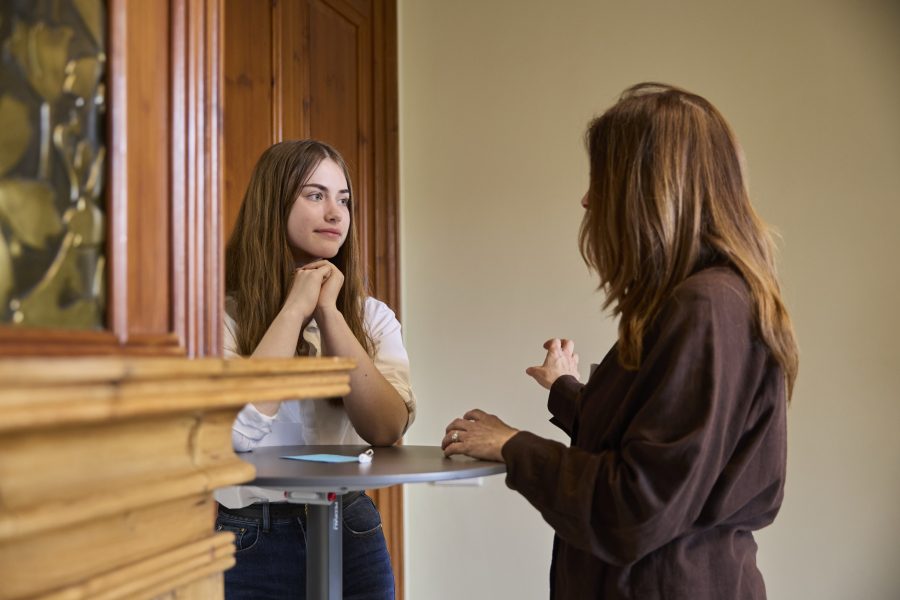
What stayed with many participants was the unexpected depth of the student-teacher exchange. As one teacher reflected on her favourite moment:
“The highlight was a personalised mentoring session with an exceptionally gifted student. We explored innovative ways to overcome her specific challenges, shifting her perspective on problem-solving.”
Four ways teacher ambassadors make an impact
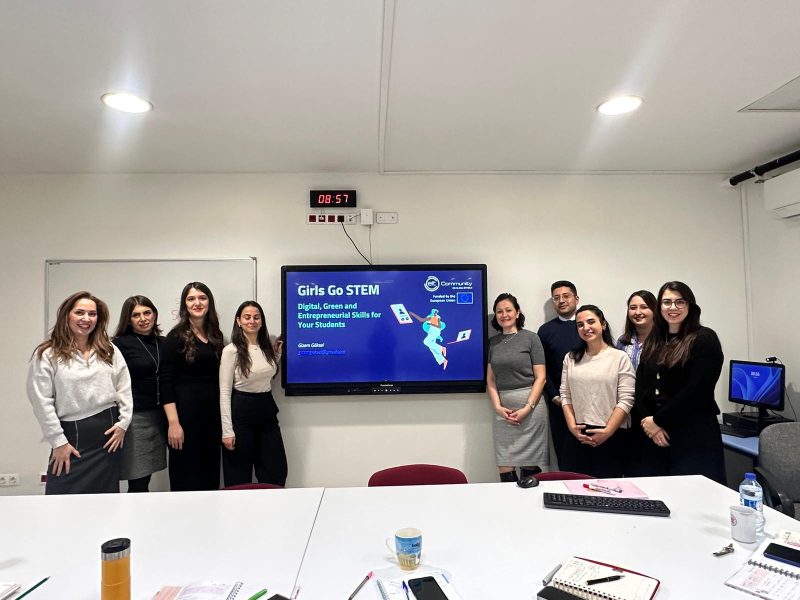
Training session for teachers in Turkey Image courtesy of Gizem Göksel
The Teacher Ambassadors Programme selects at least 10 educators from across Europe each academic year. Their role spans four areas:
Promoter: Ambassadors run information sessions for colleagues, encourage students to take part in the annual Student Challenge and the annual flagship event, as well as represent the programme at local, national and European events.
Trainer: Each ambassador completes a dedicated Train-the-Trainer course and receives an official Girls Go STEM Trainer certificate. Ambassadors then pass this training on to at least seven other teachers during their mandate.
Connector: Ambassadors help build national teacher alumni groups online and link the programme with accreditation bodies in their country, helping Girls Go STEM meet local curriculum and certification needs.
Advisor: Through focus groups and co-creation workshops, they bring the teacher’s perspective directly into the programme’s development.
Alongside their responsibilities, ambassadors gain access to a range of professional and personal opportunities.
More than a title: the benefits of being an ambassador
For many, the greatest draw is the community itself: a pan-European network of like-minded educators, with the chance to visit a fellow ambassador in another country, co-plan a lesson and put it into practice together. Professionally, ambassadors benefit from dedicated workshops, mentoring sessions and the Train-the-Trainer course. In some countries, the Girls Go STEM Trainer certificate counts toward mandatory upskilling requirements. Their voices and experiences are shared publicly through the initiative’s channels, and they may be invited to speak at events or serve as jurors at student challenges. Finally, as co-creators, they receive early access to new content and play an active role in shaping how the programme develops.
All these opportunities, from learning resources to international exchanges, are fully funded.
One teacher, 600 girls, and a Maker Lab
Katarina Veljkovic, Girls Go STEM teacher ambassador from Serbia Image courtesy of Girls Go STEM
Katarina, a teacher ambassador in the current cohort from Serbia, offers a glimpse of what sustained engagement with Girls Go STEM can look like. Over two years, she led the integration of the programme into her school’s computer science classes. During this time, she coordinated the implementation across 10 teachers and enabled more than 600 girls from all year groups to participate.
“One of the proudest moments of my involvement is the fact that, thanks to our participation in the programme, the school received a Makers Lab, an innovative space where students and teachers collaborate, experiment, and connect with the wider community. For me, Girls Go STEM was much more than a project: it was an opportunity to bring real change to my school, to open new opportunities for girls, and to create a culture of collaboration and innovation that will last for years to come.”
Could this be you?
The Teacher Ambassadors Programme is open to secondary and vocational education and training (VET) school teachers across Europe who are already using the Girls Go STEM platform. Applications for the 2026–27 cohort will open soon, as the 2025–26 cohort is drawing to a close.
If you are interested in running Girls Go STEM courses with your students, encourage them to take on the challenges or simply found yourself thinking this initiative should reach more schools, we want to hear from you.
This year’s Girls Go STEM Student Challenge invites girls aged 14–19 to tackle one of the most pressing issues in modern space exploration: orbital debris. Teams redesign a space component so that, if it fails, it produces as little harmful debris as possible. No prior knowledge of space is needed: the challenge is built around our free online courseSpace Debris: From Orbital Chaos to Sustainable Space, which gives students everything they need to get started. As a teacher or mentor, you can register with a team, guide their process and, if selected as a national winner, join them at the annual Girls Go STEM event this autumn to present on stage in front of an international audience of students, experts and innovators. Submissions close 27 July at 13:00 CET.
Free professional courses for educators
While the main course content is designed for students aged 14–19, Girls Go STEM also provides a dedicated space for educators. Teacher-specific courses are available to any educator who joins the free platform, each with full classroom materials such as worksheets, lesson plans and rubrics. The current offer includes:
Digital literacy for the classroom: tackling disinformation
Meaningful AI pedagogy: think critically, teach creatively
Intellectual property for educators: from copyright to creativity
Entrepreneurial thinking in education: spark ideas, shape futures
All teacher courses are currently available in English, with more languages and new content on the way.
Girls Go STEM is an initiative led by the European Institute of Innovation and Technology (EIT), coordinated by EIT RawMaterials and supported by the European Commission.
Build a simple setup to convert the energy from water waves into electricity (2025) Electricity from sea waves. Science in School72.
Learn how scientists are studying pea-protein foams in order to develop better plant-based food alternatives: Matsarskaia O (2025) Pea-based foams for a greener cappuccino. Science in School72.
A waste of space: years of human activity in space have left thousands of objects in orbit around the Earth. Learn more about the risks they pose and what we can do about it.
Astronomy / space, Earth science, Engineering, News from the EIROs, Physics, Science and society