
Forecasts from orbit
Aeolus – a new laser-equipped satellite – is designed to give meteorologists the comprehensive wind data they need for better weather…
News from the EIROs, Astronomy / space, Earth science, Engineering





Over 15 000 satellites are currently orbiting Earth. Do you know what it takes to keep them up there?
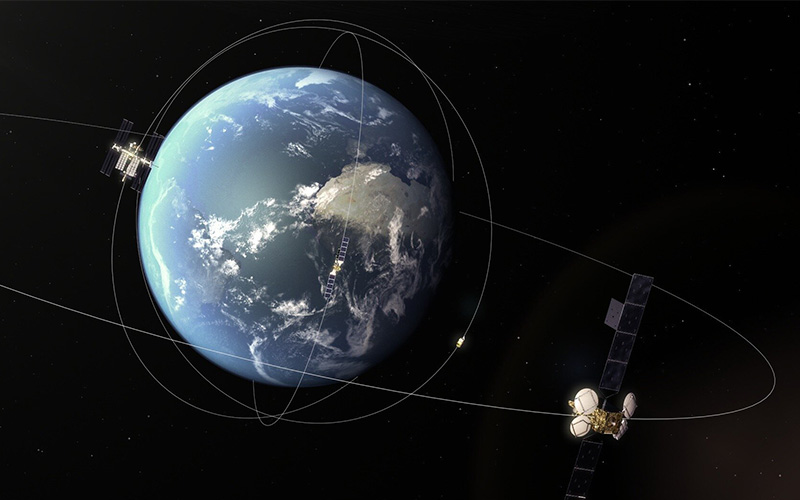
Satellites inform us about the weather and earthquakes and enable us to watch films and talk to friends from almost anywhere on the planet. They are also super-fast messengers for phone calls, TV shows and internet signals from one side of the world to the other in real time.[1] They even allow us to explore the vast unknown of space while helping to protect our planet with their crystal-clear view above the clouds.[2,3]
So, we really need those helpers up there in space, where harsh conditions prevail. To keep them on their steady path in orbit, engineers use regular fuel. However, in an effort to find more efficient and sustainable energy sources, teams are looking to other research areas for solutions, such as fusion research. Read on to find out what it takes to reach for the stars.
Have you ever asked yourself how a satellite is able to orbit Earth?
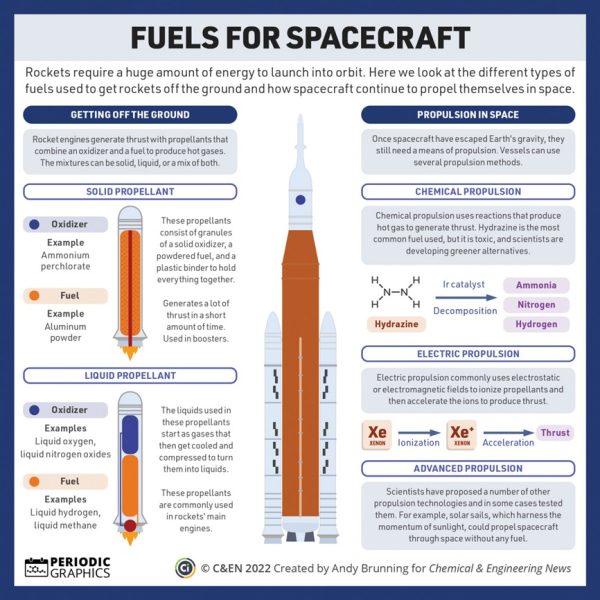
Humankind launches these satellites into space on powerful rockets. These rockets are mainly fuelled by chemical propellants that are burned in a combustion chamber to create a very high thrust, like cars or planes that burn fuel to move.[4] Over the past decades, scientists have developed many different propulsion techniques. These ensure that satellites can move along their orbits around Earth and perform small manoeuvres to avoid collisions or correcting drift caused by gravitational pulls or atmospheric drag.[4,5] Common propulsion techniques use chemical fuels or compressed gas to create thrust when released through a nozzle.[6] While these methods reliably generate large amounts of energy, there is an important limitation: engineers can only load a limited amount of fuel or gas onto a spacecraft. As a result, satellites sometimes become inoperable not because their main systems no longer function, but because they have run out of fuel.[7]
A more sustainable technique would be electric propulsion, as this wouldn’t require fuel. But how can we produce the electricity needed to power our satellites in space? One solution that is already quite common involves solar panel-powered ion thrusters.[6] The electricity from the solar panels is used to create an electric field that accelerates ions and thereby generates thrust. The ions get expelled at a high velocity and propel the satellite into the opposite direction. Although this solution is more efficient than chemical propellants, it is still limited by fuel availability. It requires ion gas to create thrust, so it runs out of energy as soon as all ions have been used up. It’s also not an ideal solution for quick manoeuvres in space: a satellite using these electric propulsion systems produces only a very gentle push at any given moment. Therefore, manoeuvres – even ones that end up moving the satellite a long way – take a long time to complete compared to those using chemical thrusters.[8]
A new propulsion technique developed by the German company TOMO aims to overcome these limitations by using a unique system that creates thrust through magnetic fields.[9] Electric currents like those produced by solar panels create a magnetic field that interacts with the forces generated by the Earth’s magnetic field and a satellite’s inertia. The energy generated by this interaction is directly converted into propulsion, eliminating the need for fuel or any mechanically moving parts in the system. Not only is this system more durable due to its independence of fuel, it is also much lighter.
To take this one step further and ensure the efficient generation of these magnetic fields from electricity, researchers are looking at a neighbouring field: fusion research.
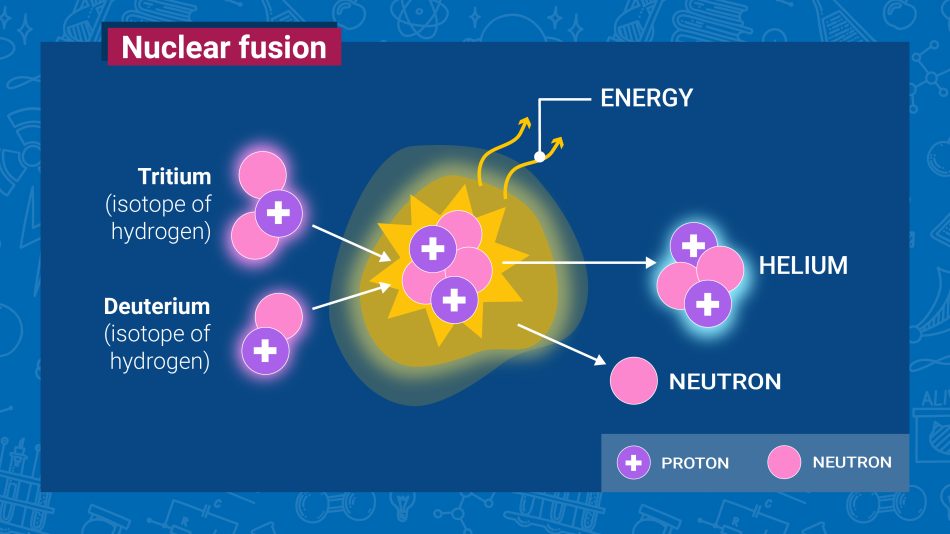
Fusion research aims to mimic the processes that happen in the core of our Sun, where immense amounts of energy are produced.[10] The thing is: the Sun’s core has a temperature of 150 million degrees Celsius.[11,12]To achieve similarly high temperatures, scientists heat gas by, for example, creating an extremely high electric current to form plasma (for more information about plasma, check out our articles on what it is and how it can be produced). To make sure that this system can withstand high temperatures, engineers use incredibly powerful magnets to keep the plasma in place and prevent it from touching the walls of the fusion reactor. The technology developed to create this ultra strong magnets, designed to confine plasma as hot as the Sun, has now found an unexpected application in satellite propulsion.
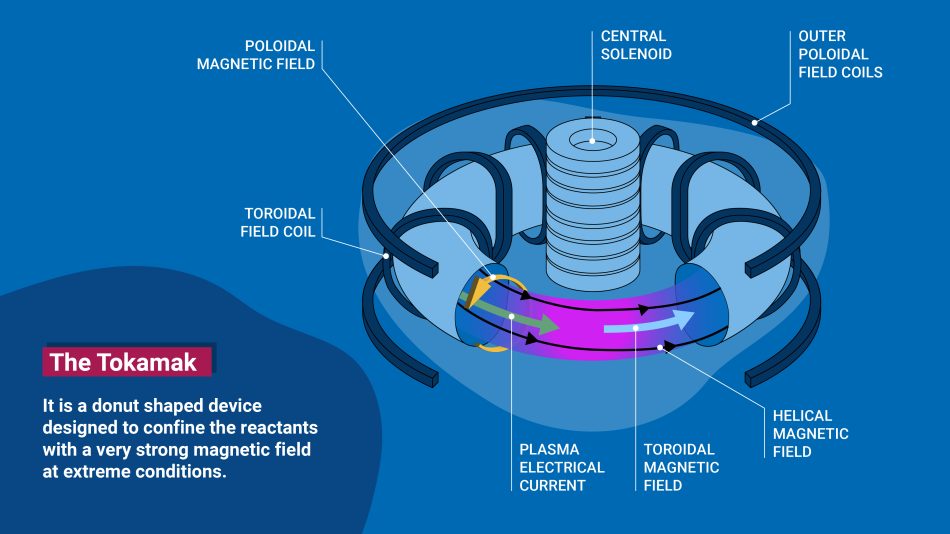
Magnets used in fusion research have coils which can be made from a special high-temperature superconducting wire. At very low temperatures, superconducting materials can conduct electric currents without any resistance. That means they can carry a massive amount of electricity – needed to create that strong magnetic field confining the plasma – without losing any energy as heat. Scientists in fusion research perfected these special wires, shaping them into coils called inductors.
Working together with Vision-Elektrik, TOMO has implemented these superconductive inductors into their satellite propulsion technique. At very low temperatures, the superconductive inductors can achieve a much stronger magnetic field and thereby a higher thrust. This could be a game changer in satellite propulsion.

The benefits of applying this new idea to propulsion systems are already real, but the conditions to make it work are a bit complicated.
The coils can only work their magic when they are supercooled. This is important to ensure that the electricity flowing through them meets almost no resistance and no energy is wasted as heat. However, keeping the coils that cold, especially in space, isn’t simple. Space is a vacuum and it isn’t always cold like most of us think. A satellite facing the sun can warm up significantly,[13] so keeping the coils steadily cold enough requires dedicated cooling hardware, adding weight and complexity to the satellite.
The superconducting inductors also need a high current in order to generate a strong, stable magnetic field, which is an additional challenge on top of the cooling. Delivering hundreds of amps precisely without disturbing the delicate cold, low-resistance state of the coils, isn’t something an off-the-shelf power source can do. To make this happen, the precise current is provided by custom-developed batteries, capable of delivering up to 500 A at a very low voltage (0.5–2 V). This is a technology researchers borrowed directly from fusion research, where similar power supplies drive the magnet systems in fusion reactors.
TOMO’s system hasn’t flown in space yet, but engineers will test it over the next two years. Tests based on Earth, however, are already showing promise. In a test-run in Germany, the inventors demonstrated that using superconducting inductors can increase the thrust of their propulsion system 26-fold!
If they achieve this, that means the system would be strong enough to move satellites across orbits, quickly avoid collisions and even deorbit a satellite.[14] This new system could also achieve great thrust. Estimates show it could achieve a thrust of 1 newton, which is 5 to 100 times higher than current electric propulsion systems, all from a machine that weighs less than your school backpack.[6,14]
So now you know! The next time you make a video call, check the weather or see wildfire warnings on the news, remember that there are thousands of satellites quietly keeping that information flowing.[15] Each one is fighting the same battle: staying on course with a limited supply of precious energy. TOMO’s magnetic propulsion system, built on ideas borrowed from scientists trying to recreate the Sun on Earth, might be what keeps the next generation of satellites flying farther and longer than ever before.
Deorbiting a satellite means that the satellite is slowed down and thereby gets kicked off the orbit it was on.[16]It re-enters Earth’s atmosphere, where it burns up safely. When a fast satellite hits our atmosphere, the air around it gets compressed. This compression heats up the air and thereby burns the satellite up. Satellites are usually discarded like this when they reach the end of their mission, or they cannot operate safely anymore.
[1] Pratt T, Allnutt JE (2019) Overview of Satellite Communications. Satellite Communications pp 11–14. John Wiley & Sons. ISBN: 1119482178
[2] Kidd C et al. (2009) A review of satellite meteorology and climatology at the start of the twenty-first century. Progress in Physical Geography: Earth and Environment 33: 474–489. doi: 10.1177/0309133309346647
[3] Information on the Hubble Space Telescope from ESA: https://esahubble.org
[4] Remissa I et al. (2023) Propulsion systems, propellants, green propulsion subsystems and their application: a review. Eurasian Chemico-Technological Journal 25: 3-19. doi: 10.18321/ectj1491
[5] Yoon YT et al. (2023) Navigating a large satellite constellation in the new space era: An operational perspective. Journal of Space Safety Engineering 10: 531-537. doi: 1016/j.jsse.2023.10.006
[6] Miller S et al. (2020) Survey and Performance Evaluation of Small-Satellite Propulsion Technologies. Journal of Spacecraft and Rockets 58: 222-231. doi: 2514/1.A34774
[7] What causes satellites to become inoperable: https://www.weforum.org/stories/technological-innovation/space-satellites-debris-orbit-repairs/
[8] Satellite propulsion’s past, present, and future: https://newspaceeconomy.ca/2025/08/26/satellite-propulsion-past-present-and-future/
[9] The new propulsion system by TOMO: https://tomo-systems.com/en/technology/
[10] What fusion research is: https://euro-fusion.org/fusion/
[11] Fusion on the Sun: https://euro-fusion.org/fusion/fusion-on-the-sun/
[12] Fusion on Earth: https://euro-fusion.org/fusion/fusion-on-earth/
[13] Temperatures in space: https://www.amu.apus.edu/area-of-study/science/resources/why-is-space-not-always-cold/
[14] Technology transfer between fusion science and space exploration: https://euro-fusion.org/eurofusion-news/propellant-free-satellite-propulsion-gains-a-boost-from-fusion-superconductor-expertise/
[15] Number of satellites orbiting Earth: https://www.discovermagazine.com/about-15-000-satellites-are-circling-earth-and-they-re-disrupting-the-sky-48550
[16] Janovsky R (2003) End-of-Life-de-Orbiting Strategies for Satellites. 54th International Astronautical Congress of the International Astronautical Federation, the International Academy of Astronautics, and the International Institute of Space Law. doi: 10.2514/6.IAC-03-IAA.5.4.05

Aeolus – a new laser-equipped satellite – is designed to give meteorologists the comprehensive wind data they need for better weather…

Renewable, clean, unlimited energy – how can it be achieved? Christine Rüth from EFDA introduces the tokamak, the most advanced fusion…


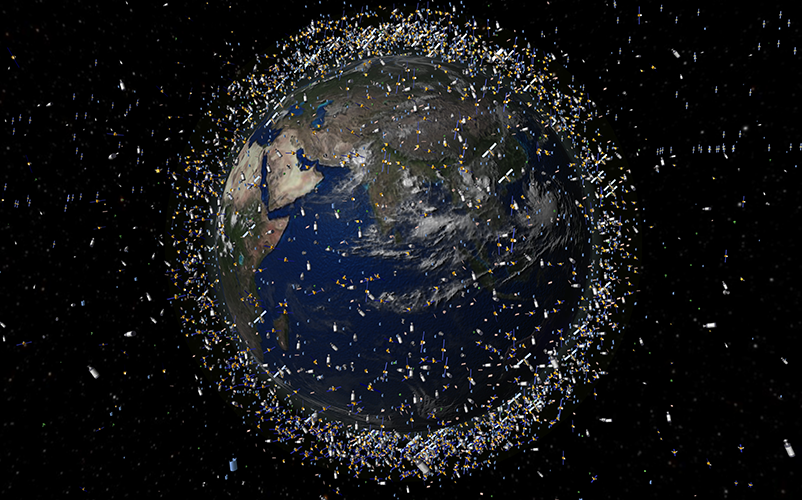
A waste of space: years of human activity in space have left thousands of objects in orbit around the Earth. Learn more about the risks they pose and what we can do about it.
