Dive into the microscopic realm: exploring plankton with your students Teach article
Author(s): Teodora Dobreva, Melanie Brauny
Turn your classroom into a marine science station and step into the lively world of plankton – tiny aquatic dancers under the microscope that quietly power food webs and even Earth’s ecosystems.
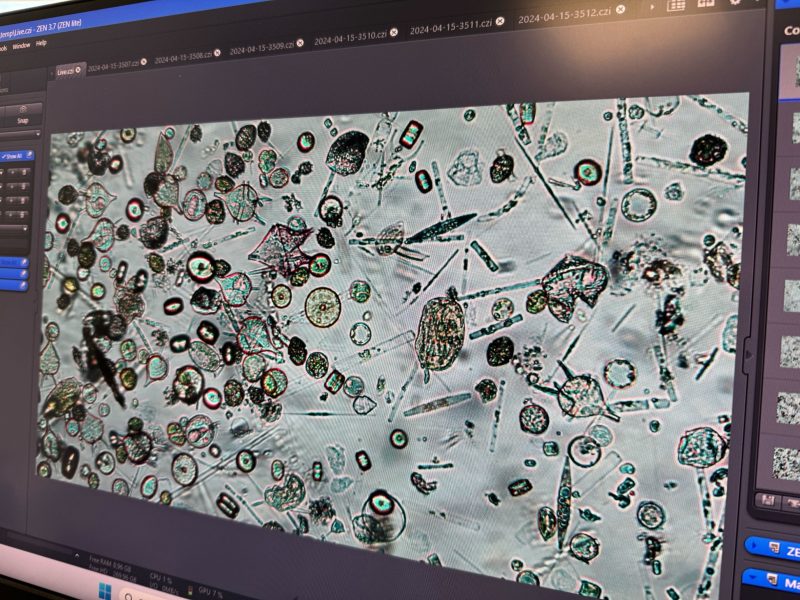
Plankton, the tiny drifters and swimmers of the ocean, are found in all aquatic ecosystems, yet they remain invisible to the naked eye.[1] Despite their microscopic size, plankton play a fundamental role in global ecosystems. They form thefoundation of aquatic food webs as well as photosynthetic plankton (phytoplankton), producing a significant proportion of the Earth’s oxygen by absorbing carbon dioxide through photosynthesis, thus contributing to climate regulation and the global carbon cycle.[2] Developed by the European Molecular Biology Laboratory (EMBL) as part of the BIOcean5D project co-funded by the European Union, this resource allows you to bring these fascinating organisms into your classroom, sparking curiosity about biodiversity, microscopy, and the interconnectedness of life.
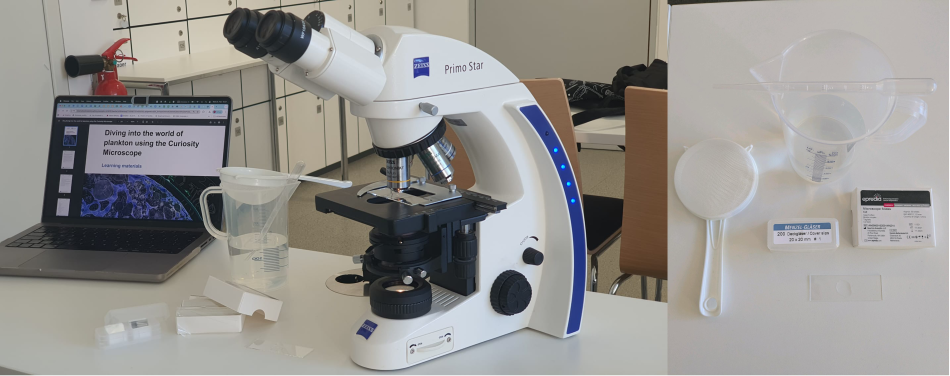
Diving into the world of plankton using the Curiosity microscope is a ready-to-use classroom resource designed for secondary school teachers to introduce students to aquatic diversity and the microscopic world using the Curiosity microscope, a portable digital microscope with adaptable optics.[3] However, all resource activities can be executed with a standard light microscope as well! The lessons, which can be completed in two to three class periods, connect scientific observation with ecological concepts, making them perfect for biology or environmental science lessons.
Why plankton?
Plankton are an ideal topic for engaging learners because…
…they are easily obtainable as they are found in every aquatic ecosystem.[1]
…they are highly diverse,[2] colourful and thus visually striking under magnification.
…they link biology with ecology and global environmental processes.[2]
…they can be used to introduce authentic scientific practices, such as observation, classification, and data interpretation.
Using real samples and a digital or light microscope gives students a window into an unseen world. This strengthens their scientific thinking skills and fosters knowledge acquisition and discussion about our oceans. It can also serve as a source of creative inspiration.
The resource consists of worksheets for the students, an answer sheet, and fact sheets, containing information on plankton.
Curriculum connections
This resource supports several key learning objectives in biology and environmental science curricula, including:
biodiversity and ecosystems,
scientific observation and classification, and
the use of scientific tools in data collection.
It also offers opportunities to discuss human impacts on aquatic ecosystems and the role of microorganisms in global processes.
Lesson overview
Setting the scene: what is plankton?
Begin your class with a short introduction to plankton – what they are, where they are found, and why they matter. Prompt students to think about how such tiny organisms could influence entire ecosystems.
Possible discussion prompts are:
How much life do you think you can find in a drop of water?
What do you think lives in there?
How might life at microscopic scales be different from the macroscopic world?
This opening prepares students to make meaningful observations and frames the activity within real scientific questions.
Activity 1: Sample preparation for observations
In this activity, students are provided with water samples from different sources (e.g. ponds, streams, or even (purchased) bottled plankton samples if local field collection is not feasible). They then prepare the samples for microscopy, using either the Curiosity microscope[3] or a light microscope to examine them. While doing so, students recall the most important parts of a light microscope and record their observations onto a worksheet.
Safety notes:
Emphasise safety and hygiene when handling wet samples and microscope slides.
Collect plankton from a nearby pond or stream using a very finely meshed sieve or plankton net. If you do not have a plankton net, you can make one yourself. There are plenty of online tutorials and protocols on how to do this.
Place a drop of water on a clean microscopy slide and carefully cover it with a coverslip.
Place the slide under a microscope and adjust focus and lighting to visualise plankton.
While students observe, encourage them to sketch what they see or to capture images using the microscope’s camera. Students are asked to pay particular attention to colour, shape, movement and colony-forming abilities of the observed plankton and to record their answers in the worksheets. Recording observations helps them articulate the observed differences and better understand the classification into zoo- and phytoplankton.
Once students have gathered their observations, guide them through a simple classification exercise. They might sort organisms by size, movement type (e.g. gliding vs. rotating), or morphological features.
Ask students to answer questions such as:
Which sample had the most diversity?
What features helped you distinguish one organism from another?
Why different water sources have different plankton communities?
This reinforces classification skills and connects observation with scientific reasoning.
Activity 2: The role of plankton in ecosystems
For a deeper exploration of how plankton is impacted by and impacts ecosystems, students can execute resource activity 2, focusing on:
Identifying plankton as primary producers, oxygen producers and CO₂ absorbers of oceans, and
discussing the reasons behind and effects of changes in plankton concentration.
This worksheet-based activity guides students through an exploration of the ecological importance of plankton.
Section 1: Students investigate the role plankton plays in marine food webs and are provided with structured opportunities to discuss how changes in plankton populations can ripple through ocean ecosystems and affect higher-level consumers.
Section 2: Students are introduced to real satellite images showing areas of high plankton productivity. Hereby, the students…
…identify phytoplankton as the source of these blooms.
…link plankton abundance to regions of ocean upwelling, where nutrient-rich waters support rapid growth.
…deepen their understanding of phytoplankton as foundational primary producers in the marine environment by connecting these productive zones to areas with large fish populations.
Section 3: In the final section, the focus broadens to a global scale, examining the role of plankton in absorbing atmospheric CO₂ and exploring how human activities, such as offshore drilling, can disrupt this vital process.
Additional activities (not included in the resource), helping students to deepen their knowledge connected to this part, could include:
Comparing plankton diversity across samples taken from sites with different conditions (e.g. still vs flowing water) in order to analyse environmental factors.
Creating posters, presentations or art to showcase their findings and explain the importance of plankton.
Results/Discussion
This resource aims to deepen the understanding of the role of plankton in aquatic environments. By first observing samples from nearby bodies of water, students learn that plankton is not something only found at specific faraway locations, but in their everyday life and in every aquatic ecosystem.[1] Further observation reveals the diversity and different classes of plankton and their function, ultimately leading to understanding their immense importance for our ocean ecosystem and planetary health.[2]
By the end of these lessons, students will be able to…
…use a digital or a light microscope to make and record observations.
…identify different types of plankton and describe the diversity of microscopic life.
…classify organisms based on observable traits.
…link microscopic biology to broader ecological and environmental concepts.
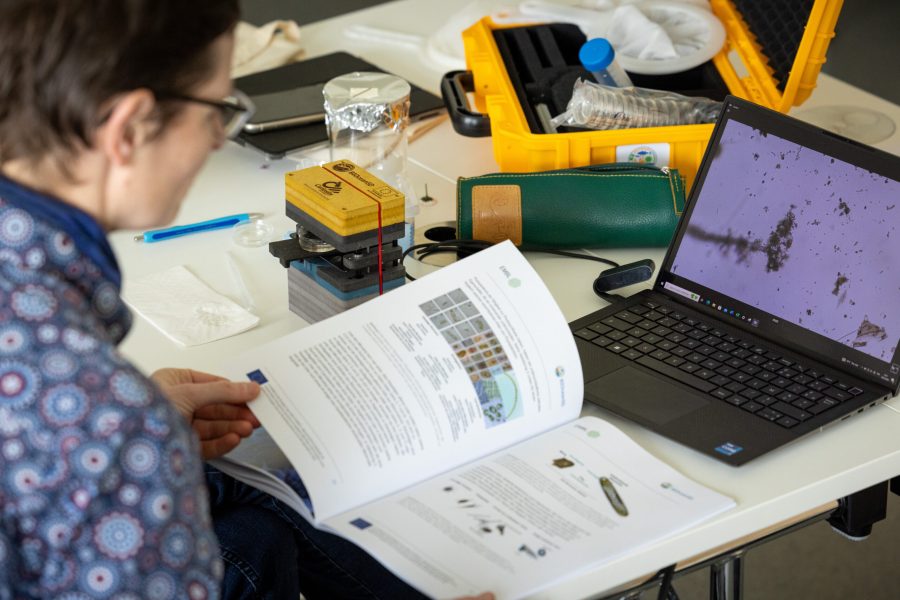
Teachers testing the resource in one of the teacher workshops at EMBL Heidelberg. Image courtesy of EMBL Photolab/Stuart Ingham @EMBL
Practicalities and tips
The core activities can be completed in two lessons (45–60 min each).
The resource comes with an extensive Teacher’s guide, including answer sheets and example lesson plans.
Provide students with information and worksheets to help structure their observations and reflections. Fact sheets are provided to give students all the important information they need to work on the resource exercises.
Check out the EMBL teaching resource Nexus Island, which focuses on the interaction between organisms, non-living environmental factors and humans, as well as their interdependencies and adaptation strategies.
The SEOS website brings marine science closer by focussing on the characteristics of the ocean and its role in sustaining life.
Explore the world of plankton organisms and create your own through the Great Plankton Sink Offactivity.
This short read introduces you to the world of plankton organisms and explains why they are important.
Explore life at hydrothermal vents and discover how communities form deep in the ocean without sunlight through the Dive and Discover
Find out about the circadian rhythm of plankton and how it is similar to that of humans: Kling I (2016) How planktons get jet-lagged. Science in School 36: 8−11.
Learn about the role of the oceans in climate change: Harrison T, Khan A, Shallcross D (2017) Climate change: why the oceans matter. Science in School39: 12–15.
After discovering her passion for science communication during her studies, Melanie Brauny, M.Sc., joined the Science Education and Public Engagement Office at the European Molecular Biology Laboratory – first as a trainee and later as an education officer. She is driven by a love of sharing science and especially enjoys helping diverse audiences to better understand, appreciate, and connect with scientific discovery.
Teodora Dobreva holds an M.Sc in Biotechnology. In her role as an education and training manager at EMBL’s Science Education and Public Engagement Office, she supports teachers and students in engaging with STEM. She is passionate about empowering educators by strengthening their scientific competence and soft skills, helping them inspire the next generation of learners.