Heavy metals are…heavy. But why? And why is the particular metal tungsten an integral part of the process of ‘spallation’?
Pick up a tungsten brick, and you might be surprised at how heavy it is compared to other metals. Tungsten feels heavy because it is a dense material – 1.7 times denser than lead – meaning that it packs a large mass into a relatively small volume.[1] Its density means tungsten gets used in some interesting ways: Tungsten is sometimes added to golf clubs, as the extra weight makes for a better swing;[2] it is used for sinking fly lines in fly fishing to ensure they sink quickly and accurately;[3] and C strings of some violas and cellos are made from a tungsten alloy, which produces a richer sound without the string diameter becoming too large.[4]
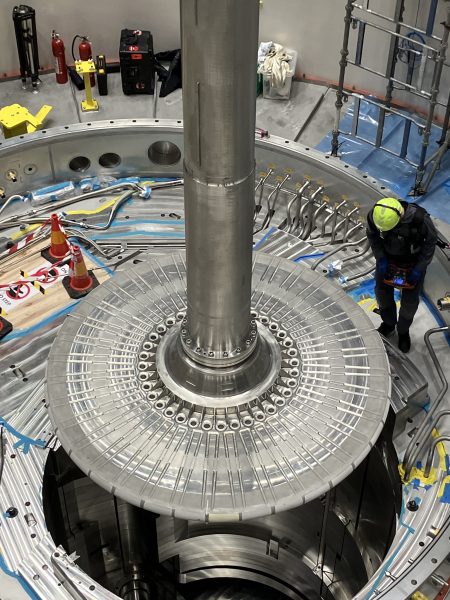
Tungsten is also used to make the target wheel at the European Spallation Source – a giant machine, designed to generate neutrons for scientists to use to study materials.[5]
ESS target wheel being installed Image courtesy of the author
What’s so special about tungsten?
Tungsten, an element with the symbol W, has an atomic number of 74 and an atomic mass number of 183.85.[6]
Let’s calculate the number of neutrons: 184–74 = 110 neutrons
So, a typical tungsten atom has about 110 neutrons in its nucleus. That is a lot of neutrons and one of the properties that make tungsten a good metal for ESS’s target wheel.
As well as being 1.7 times denser than lead, tungsten has the highest known melting point of all elements, at 3422°C, and the highest boiling point, at 5930°C.[7] Given the large amount of heat produced during neutron production at ESS, this is another useful property for the ESS target wheel.
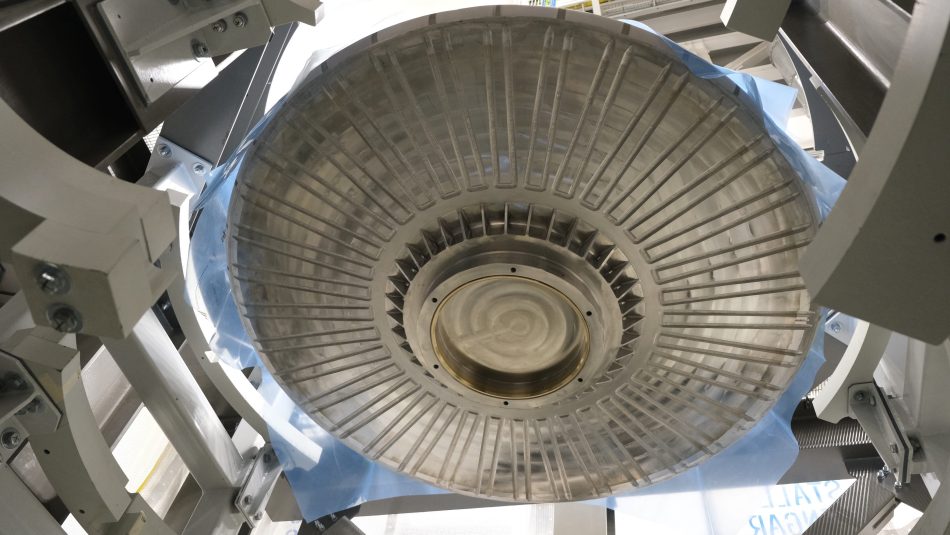
While the wheel was being tested the individual segments are can be seen. Image courtesy of Ulrika Hammarlaund, ESS
Comparing density
Take some items of similar dimensions and compare their densities.
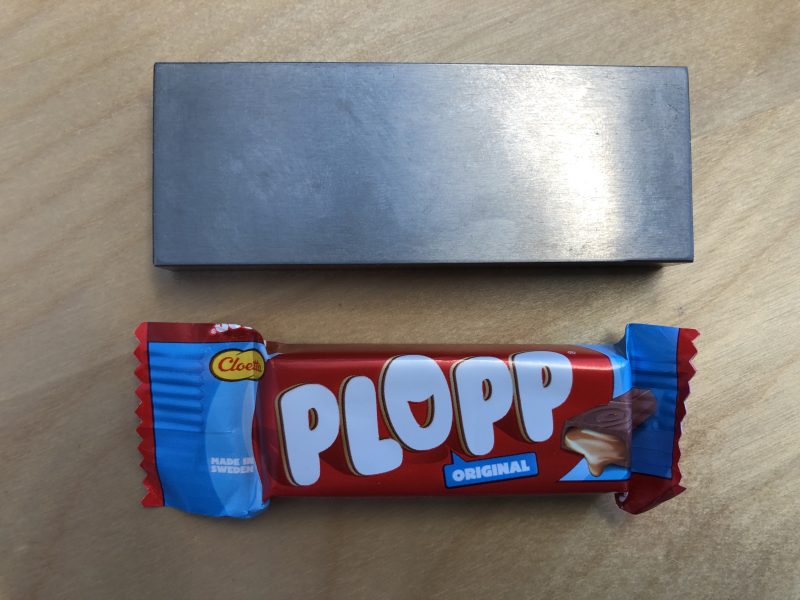
For example, here is a brick of tungsten as used in the ESS target wheel. It is similar in size to a small Plopp chocolate bar but at 450 g it weighs nearly 38 times as much. The target wheel contains nearly 7000 of these bricks and weighs almost 5 tonnes!
A single brick of tungsten is similar in size to a 12 g bar of Plopp, but it is about 38 times heavier. Image courtesy of the author
What is spallation and why is Europe building a spallation neutron source?
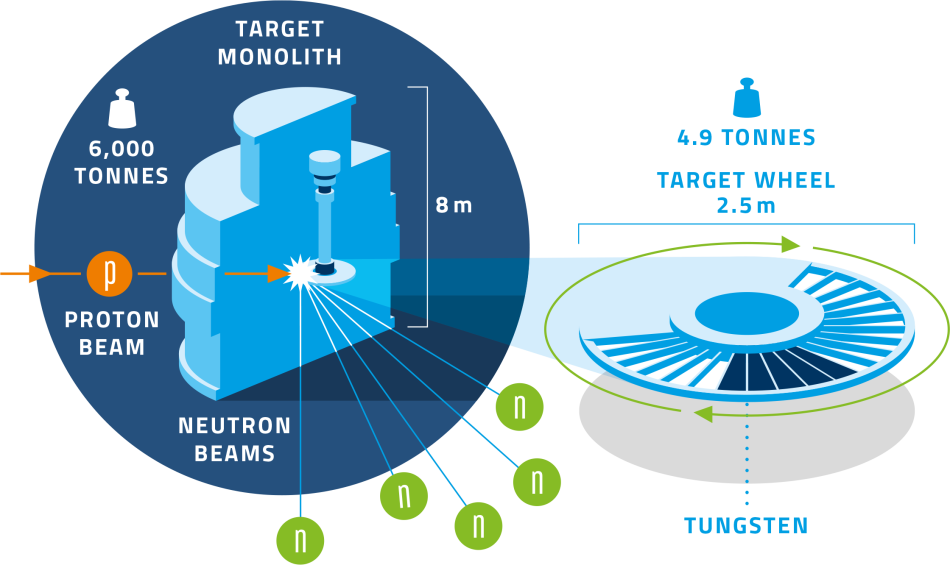
Spallation is a method of large-scale neutron production. All spallation neutron sources use a particle accelerator to fire high-energy particles at a heavy metal target to release neutrons.[8] A new spallation source – the European Spallation Source (ESS) in Lund, Sweden – is getting ready for operations. ESS will be one of the world’s brightest neutron sources, producing an enormous number of neutrons (1018) per second.[8,9] ESS has a linear accelerator that accelerates a pulsed beam of protons up to 96% of the speed of light, which then strike the tungsten target with enough energy to make the neutrons ‘spall off’.[10]
In early 2027 protons from the accelerator will be steered into the target wheel for the first time, creating the first neutrons at ESS. These allow all the newly-designed instruments to be ‘hot commissioned’ (ie, tested with neutrons), ready for operations to begin at Europe’s newest neutron source from 2028.
About the ESS
ESS is a research facility where neutrons are produced for science. Researchers from around the world will use these neutrons to study materials in fields like energy, medicine, engineering, chemistry and biology.
You can think of ESS as a giant microscope. However, instead of using visible light, neutrons are used to scatter off the samples – changing direction as they interact with them. By measuring this scattering, researchers probe deep inside materials and understand how their atoms are arranged, move and interact.
Neutron sources are complementary to synchrotrons, which accelerate electrons to produce high energy X-rays. X-rays provide precise measurements at the atomic scale, but the heavier atoms scatter X-rays very strongly and can dominate the measured signal, making it hard to see the signal from lighter atoms.
Neutrons, however, are particularly effective at determining the positions of the light elements such as hydrogen. This makes neutron scattering a crucial extra step in understanding, for example, how biological molecules function (which always contain hydrogen), how hydrogen is stored in materials and how lithium atoms behave in lithium-ion batteries. As a result, researchers will often use both types of facilities to build a detailed set of data about the structure and dynamics of their samples.[11]
Scientists might study anything from batteries and aircraft materials to proteins, medicines or food. Much like a microscope, neutrons of the right wavelength can be tuned to create very precise information about the atomic structure of samples, including high-resolution images, similar to a CT scan.
When it is in full operation, ESS will be one of the world’s most powerful accelerator-based neutron sources. It is being built as a collaboration between 13 European countries, with Sweden and Denmark as host nations.
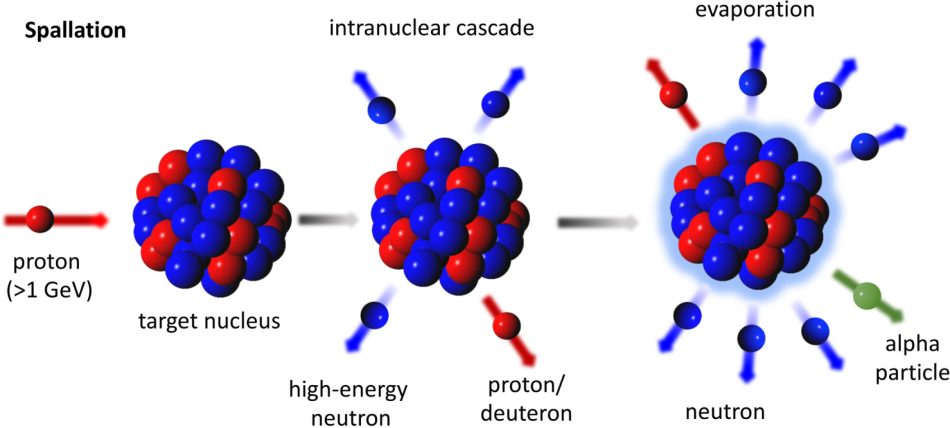
Illustration of the spallation process, showing the sequence of reactions – from the intranuclear cascade to the evaporation Image adapted from Ref. [12], used with kind permission
The ESS target is actually a rotating steel wheel filled with nearly 7000 individual bricks of tungsten arranged in 36 segments. As the wheel rotates, each pulsed beam of protons hits a different segment, allowing time for each segment to cool down before it is hit by a new beam of high-energy protons.[13]
Let’s calculate the speed at which the tungsten wheel rotates:
How long does it take the ESS target wheel to make one full rotation?
Proton pulse = 14 Hz.
36 segments
Each pulse hits a different segment of the wheel.
Answer: 36/14 = 2.57
It takes 2.57 seconds to do a full rotation, which is 23.3 revolutions per minute (RPM).
The 4.9-tonne target wheel is suspended inside a large monolithic vessel and can be rotated by a motor located at the top. Image courtesy of ESS
Want to know more?
To read more about ESS and what it will be used for, take a look at ess.eu/explore and the ESS YouTube channel. To keep up to date on the progress of ESS and when it will be switched on follow it on Instagram: @ess.neutron
[3] Pickering NC (1991) The Bowed String: Observations on the Design, Manufacture, Testing and Performance of Strings for Violins, Violas and Cellos. Amereon.
[4] Jackson J (2001) The Modern Guide to Golf Clubmaking: The Principles and Techniques of Component Golf Club Assembly and Alteration 5th ed. Hireko Trading Company. ISBN: 9780961941383
Find out how neutrons help providing important structural information: Blakeley M (2015) Fighting HIV with neutrons. Science in School31. 11–13.
Institutions
Author(s)
Jo Lewis is communications and public engagement officer at European Spallation Source ERIC (ESS). She has a background in biochemistry and an MSc in science communication. Before moving to Sweden and ESS in 2020 she worked for ten years at STFC Rutherford Appleton Laboratory in the UK, a site that houses a number of large facilities, including its own neutron spallation source, called ISIS, that is almost the same age as Jo.
Accelerate Your Teaching is a free online course for high-school teachers. Discover how particle accelerator stories can bring a range of STEM topics to life.
Biology, Chemistry, Earth science, Engineering, General science, Health, Physics, Science and society, Resources
Build a linear accelerator to demonstrate spallation – the source of high-energy neutrons used by the new European Spallation Source being built in Sweden.