The pull of the Moon: unlocking the mystery of tides
Most people know that the Moon and the Sun cause the tides, but few understand why we get two high tides each day, or why a tidal bulge forms on the opposite side of the Earth from the Moon.
Showing 10 results from a total of 13
Most people know that the Moon and the Sun cause the tides, but few understand why we get two high tides each day, or why a tidal bulge forms on the opposite side of the Earth from the Moon.
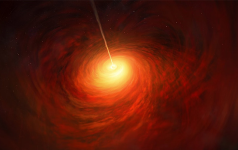
This is the story of how scientists created an image of the region around the black hole at the centre of our galaxy by combining many telescopes into one virtual telescope the size of the Earth.
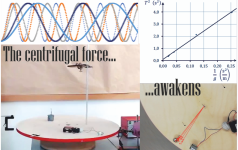
In a spin: use a rotating platform to explore how gravitational acceleration affects a simple pendulum.
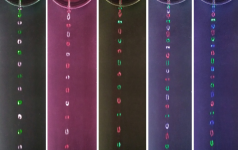
Seeing science in a new light: build your own stroboscope and use it to create beautiful optical illusions with water!
How do physicists study very small objects (like molecules, atoms, and subatomic particles) and very large objects (such as galaxies) that cannot be directly observed or measured?

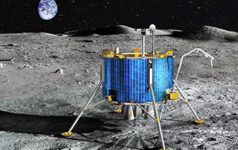
Your mission: to land an intrepid egg-naut safely on the surface of the Moon and learn about classical mechanics along the way.
Prepare for lift-off with these simple activities that demonstrate some of the key principles of space science.
Gravitational waves were predicted by Einstein – but where do they come from, and what different types might there be out in the cosmos?
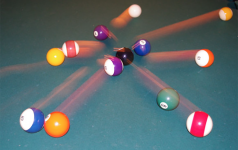
Intrigue your students with some surprising experiments – it’s a great way to challenge their intuitions and explore the laws of mechanics.
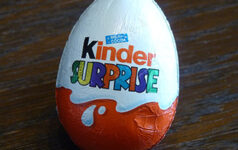
These simple physics experiments add an extra surprise to your Kinder Surprise chocolate eggs.
The pull of the Moon: unlocking the mystery of tides
How global teamwork revealed the mystery at the heart of our galaxy
The centrifugal force awakens
‘Defying’ gravity with a simple stroboscope
Exploring the universe: from very small to very large
Landing on the Moon – planning and designing a lunar lander
Rocket science made easy
Gravitational waves: a taxonomy
When things don’t fall: the counter-intuitive physics of balanced forces
Kinder eggs and physics?