Science is becoming increasingly open. In this article, we show you how to make use of this and bring authentic research into the classroom.
Every March, thousands of high-school students across six continents spend a day as particle physicists. At the Dresden University of Technology in Germany, 17-year-olds analyse collision data from one of CERN’s Large Hadron Collider experiments. On the same day at the University of São Paulo, students work with data from a different Large Hadron Collider (LHC) detector. At the University of Constantine, Algeria, others explore entirely different physics, hunting for exotic particles in heavy-ion collisions. They are all taking part in the International Particle Physics Masterclasses,[1] a program organised by the International Particle Physics Outreach Group (IPPOG).[2] Students don’t just read about frontier physics. They work with real research data, interpret genuine experimental evidence, and experience how modern science works: collaborative, cross-checked, global and thrilling.
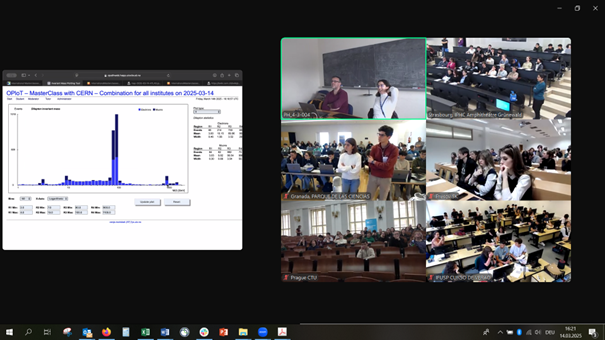
This is a screenshot of the videoconference held at the end of an international masterclass on 14 March 2025, which connected student groups in Strasbourg, Prešov, Prague, Granada and São Paulo. On the left, you see the combination of the results that the student groups reached independently. Image courtesy of Uta Bilow (Dresden University of Technology)
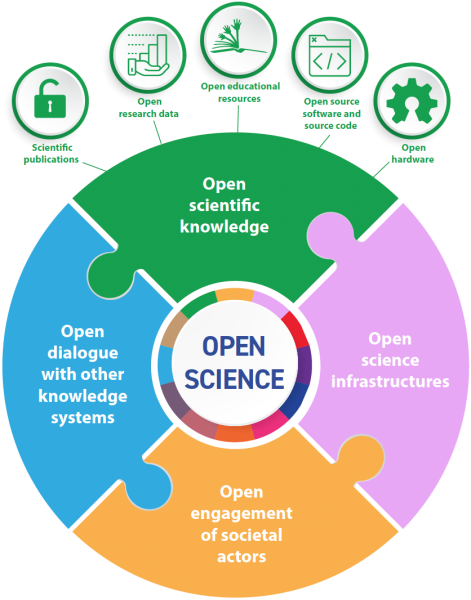
What makes this possible? Open science.
Thanks to open science, we live in a world where research outputs are increasingly freely available.
Perhaps you have already encountered open science in your teaching, even without naming it. When you find a recent scientific paper and read it without hitting a paywall, that is open access at work. When you use a teaching resource from Science in School for your classroom, you are drawing on open educational resources. And when your students take their first steps in programming with Python, they are benefiting from an open-source software.
What is new, and what makes the masterclass experience possible, is that the raw materials of research are becoming more accessible. Nowadays, you can investigate many research outputs yourself. For example, European research organisations make the following available: The collision events from CERN’s LHC are available through the CERN open data portal;[3] ESO publishes data from its telescopes;[4] ESA maintains an open science catalogue for Earth observations,[5] ESRF releases the experimental data from their facility.[6]
While this sounds great in theory, it must be acknowledged that real research data is very difficult to understand for anyone not working with it on a daily basis. Without substantial work to break down the analysis steps, develop visualisation tools and explain the intricacies, the data would remain inaccessible for educational purposes. The masterclasses work because IPPOG members and the LHC experiments have invested years in developing and refining simplified event displays, age-appropriate analysis tasks and supporting materials that turn raw physics into something a 17-year-old can meaningfully engage within an afternoon. Open science provides the foundation, but the bridge from research data to classroom learning still needs to be built.
Where do you start?
The good news is that there is a spectrum of resources which cater to a variety of audiences and educational backgrounds.
The most accessible entry point is open educational resources. CERN’s Educational Resources database[7] offers a wide range of teaching materials for teachers and students alike, suitable for students as young as 5 years old. The collection includes short, hands-on activities such as analysing real research data adapted for the classroom using pen and paper, or even building your own particle accelerator from scratch. At the other end, Digital Learning Modules and multi-episode YouTube courses cover particle physics in greater depth. You don’t need to become a particle physicist over the overnight to use these resources; you can browse, pick what fits your lesson, and adapt it freely.
Open data
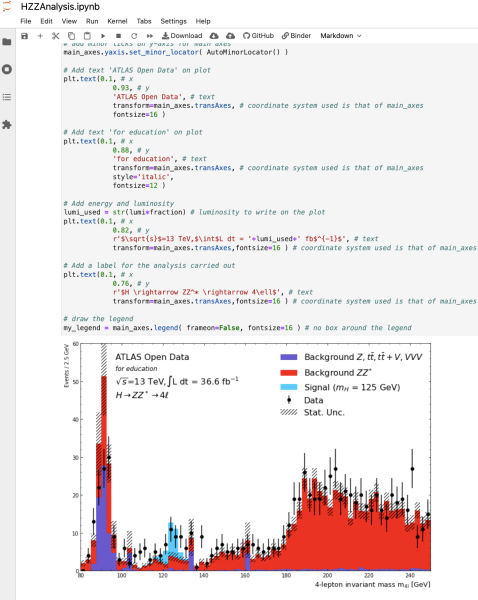
Open data from the experiments at the Large Hadron Collider (LHC) offers a step deeper into authentic research:[8-11] actual collision data from the LHC is accompanied by educational tools offering several levels of guidance. These include a visual event analyser[12] where students can inspect real collisions in their browser; a histogram analyser[13] where they can visualise aggregated data; a classroom app[14,15] that introduces the underlying physics; and full-fledged spreadsheets[16] or Jupyter Notebooks[17,18] (see info box) that offer a glimpse into real research workflow. The graduated structure enables you to adapt the activity to both your students’ level and your own. Both the CMS and ATLAS collaborations have organised workshops on how to use their open data for education. You can find much more information in the workshop materials.[19,20]
Jupyter
Jupyter Notebook is a web application that allows you to run easily interactive Python scripts, for example on a remote server. That means that there is no need to install software packages individually on everyone’s computer.
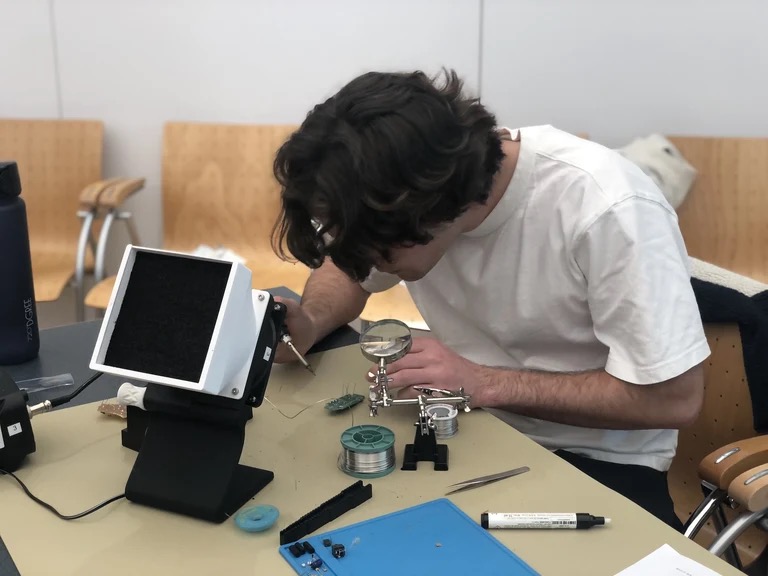
Open science does not stop at data. For teachers willing to push further, there is open hardware. Hardware enthusiasts have developed ways to enable students to build a functioning silicon detector based on the same technology that sits at the heart of big particle detectors, and use it to detect cosmic rays or radioactive sources in the classroom.[21–24] Open hardware turns the traditional open science narrative on its head because, in this case, students are not consumers of research outputs, but also builders of the instruments which they can use to make their own observations.
At the University of Bonn, the local node of the German Netzwerk Teilchenweltorganises workshops where high-school students can build their own particle detectors and get familiar with building electronic components.[24] Image courtesy of Sebastian Laudage (University of Bonn)
Why is it important?
Why does any of this matter beyond the obvious appeal of a more engaging lesson? Open science is, at its core, a recognition that the scientific process works best when it is transparent, collaborative, and accessible.[25,26] When research data, methods and tools are shared openly, other scientists can verify findings, build on them, and spot errors faster.
For your students, this matters in a more direct sense. When they engage with real data and real tools and are asked to interpret, defend and compare their findings rather than simply following a set of instructions, they are learning not only physics, biology or chemistry, but also what it means to do science, with all the uncertainty, iteration and collaboration that this entails.[27] They realise that science is not a finished body of knowledge handed down from textbooks, but rather a living, contested and evolving practice in which they can participate. This is a valuable lesson regardless of whether they pursue a scientific career.
Finally, I have a small request for anyone who tries any of the resources mentioned in this article or any other open resource. Good ideas need to be shared, and the people who develop open educational resources, open data tools or open hardware kits genuinely want to know if their work is being used in the classroom. If something works for your students – or, equally usefully, if it does not – let the providers know. Share what you tried on your school’s network, on social media (feel free to tag @CERN and the experiment if you use any of their resources), at a teachers’ conference or simply in the staff room over coffee. Reach out directly to the institutions behind the tools you used. A short email saying “I used your event display with a class of 16-year-olds and here is what happened” can be extremely valuable to a science communication team. Testimonials like this convince funders, decision-makers and other teachers that making research outputs available to schools is worth the considerable effort. In that sense, any teacher who uses open resources and talks about them publicly is contributing to the same movement that created them in the first place.
Acknowledgements
I would like to thank Uta Bilow from IPPOG, Zach Marshall from the ATLAS Open Data team, Thomas McCauley and Kati Lassila-Perini from the CMS Open Data team, Sebastian Laudage from the University of Bonn, Adelina Lintuluoto from the CERN Education team and Antonia Winkler from CERN’s Open Science Office for critical feedback on the manuscript.
Merten Dahlkemper is the community manager for Open Science in CERN’s Scientific Information Service. After completing his Master studies in physics, he did a PhD in physics education at CERN and the University of Göttingen, Germany before he joined the Open Science Office. The connection of Open Science and education is therefore dear to his heart.
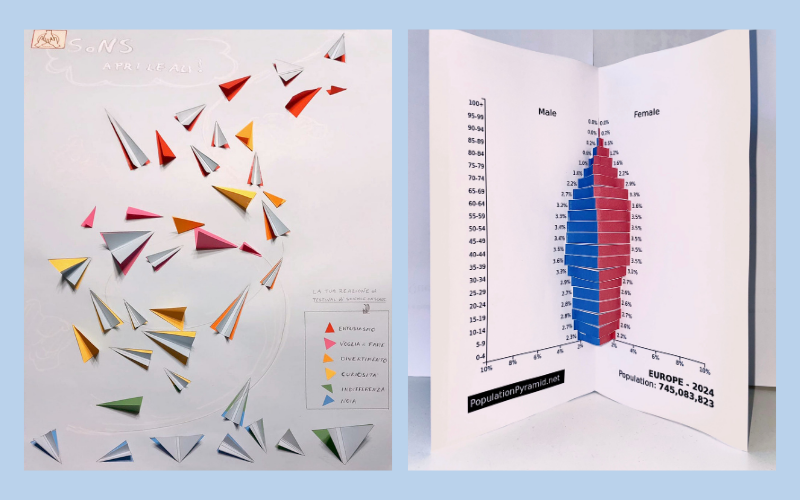
Experience data like never before! Use kirigami and participatory statistics to create low-cost, hands-on multisensory visualizations to engage and inspire.
Engineering, General science, Mathematics, Science and society
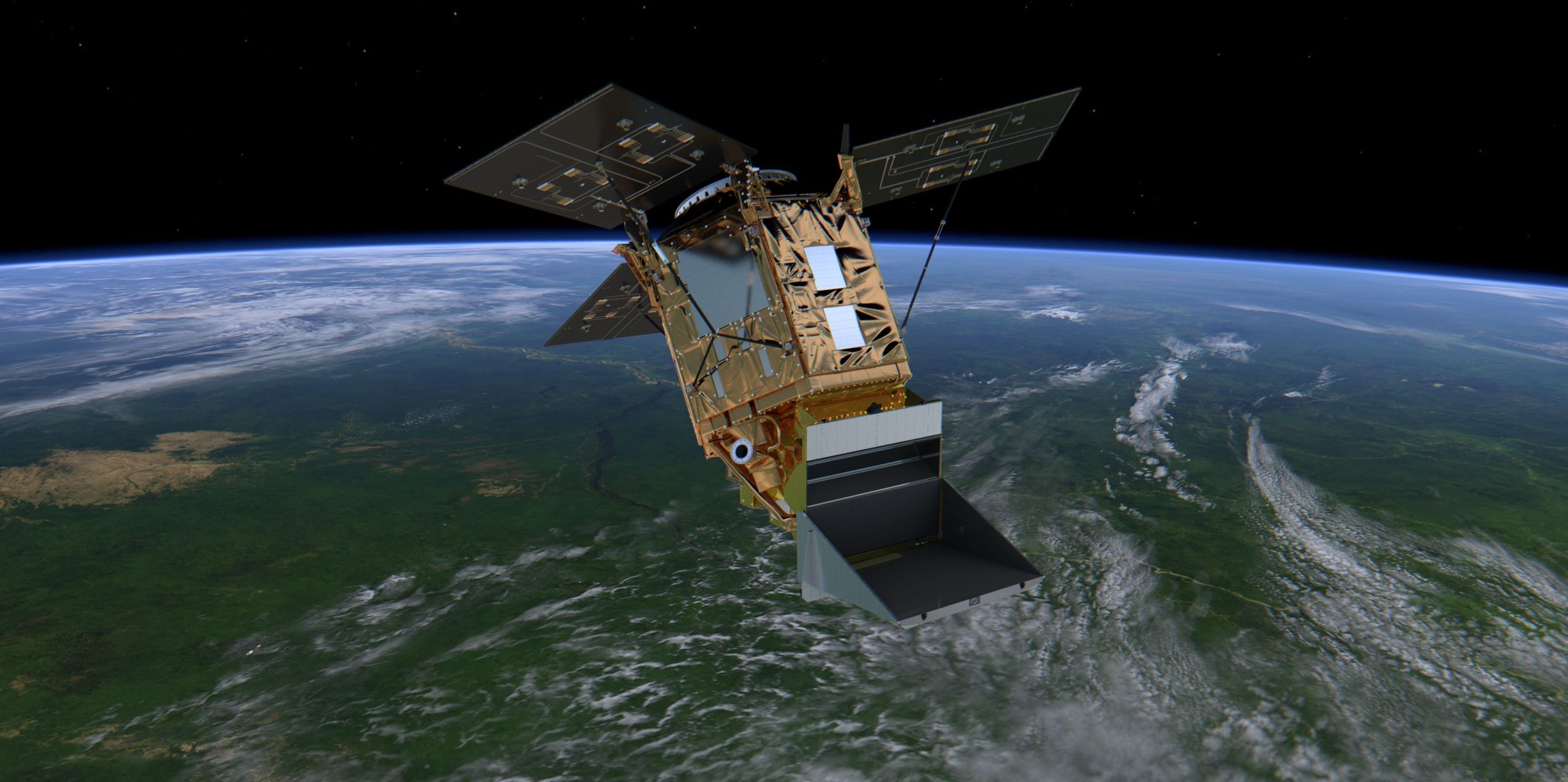
What can the colours on a satellite map actually tell us about the air we breathe?
Join us as we explore how the Copernicus Sentinel satellites detect gases such as nitrogen dioxide, and how chemistry helps us understand what’s happening in the atmosphere above us.
Astronomy / space, Chemistry, Earth science, Science and society, Sustainability