Sandy beaches: connecting land, ocean, and humans
Every tide tells a story. Discover how waves, shells, and even litter reveal clues about marine life and our shared connection with nature.
Biology, Earth science, General science




Most people know that the Moon and the Sun cause the tides, but few understand why we get two high tides each day, or why a tidal bulge forms on the opposite side of the Earth from the Moon.
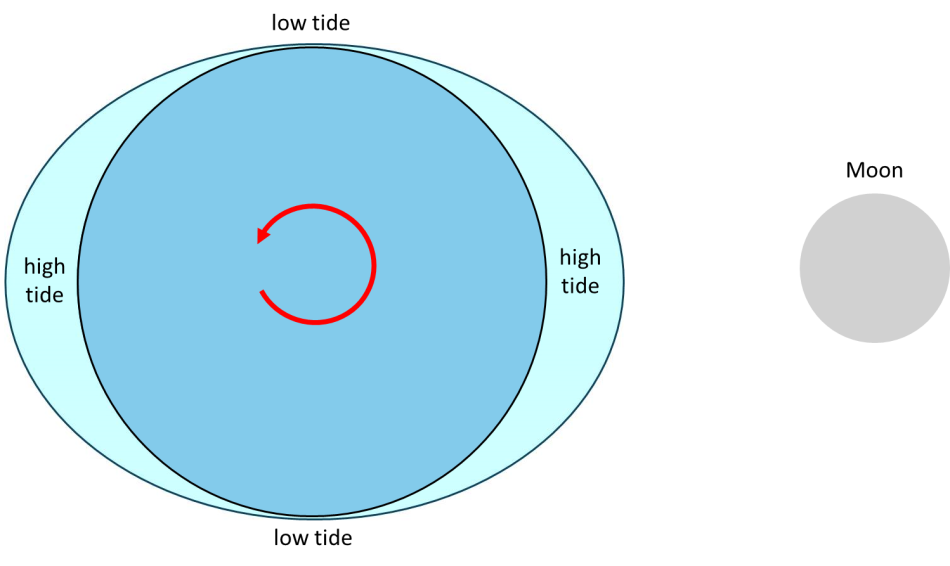
One simple way to understand why tidal bulges form on opposite sides of the Earth is to consider the near ocean, the solid Earth, and the far ocean as three separate bodies (figure 1).
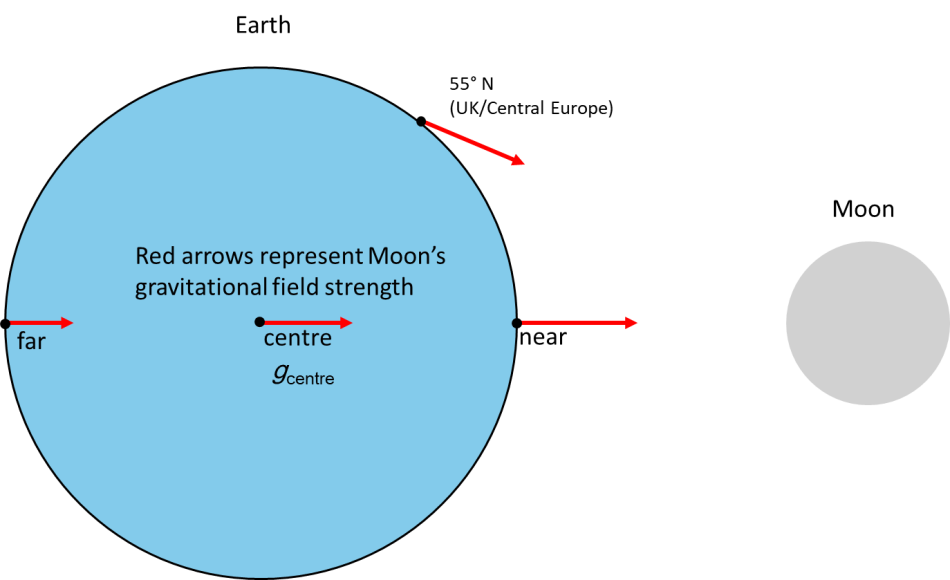
The Moon’s gravitational pull is strongest on the near ocean, drawing water into a bulge there. The far ocean is farthest from the Moon and experiences the weakest attraction, meaning the Earth is pulled towards the Moon more strongly than the distant ocean. This causes the Earth to accelerate slightly more towards the Moon than the far-side water, producing a second bulge. This is sometimes described as the far-side water being ‘left behind’.[1]
As the Earth spins, different regions of its surface pass through these bulges, giving rise to two high tides and two low tides each day.The tidal bulges can be thought of as broad, shallow domes of water centred on the Earth–Moon axis, which passes through the centres of both bodies. If the Earth had no continents and were covered by a uniform global ocean, the tidal range would be about 79 cm,[2] much smaller than real tides, which are strongly influenced by ocean basins and coastlines.
Continents cause the tidal range to vary widely, as water is funnelled into bays, forced through narrow channels, or raised as it flows over shallow continental shelves. In some locations, such as the Bay of Fundy in Canada, the tidal range can reach about 17 m.
This model is based on an Earth-centred reference frame, in which the Earth is treated as stationary and the Moon orbits around it. A more accurate description is that the Moon and Earth orbit around a common centre of mass, the so-called barycentre. Taking this into account leads to a more complete but also more mathematically complex analysis. If treated consistently, both models give equivalent descriptions of tides. To avoid complexity, we will focus on the Earth-centred model.
A gravitational field describes the force per unit mass at a point in space. The force experienced by an object in such a field is equal to its mass multiplied by the field strength. If the field were uniform, every part of an object would experience the same force per unit mass and accelerate as a whole without deforming. By analogy, if there were no differences in air pressure, there would be no wind; it is the pressure differences that drive air motion. Similarly, tides arise from differences in the Moon’s gravitational field across the Earth’s surface. This is not due to its overall strength, but to how it changes from place to place.
Since the Earth is spherically symmetric, its own gravitational field does not contribute to the tidal differences caused by the Moon and can therefore be ignored in this context. This allows us to focus only on how the Moon’s gravitational field varies across the Earth rather than on the forces holding the Earth together. To calculate the tidal force at any point on the Earth’s surface (i.e., the difference in gravitational acceleration between points on the Earth), the Moon’s pull at the Earth’s centre is subtracted. This removes the effect of the Moon pulling the Earth as a whole, leaving only the tidal component of its gravitational field.[3]
The tidal bulge on the far side of the Earth is the most difficult to understand. All of the Moon’s gravitational field vectors point towards the Moon (rightwards in figure 1). On the far side of the Earth, this field is weaker than at the Earth’s centre. Taking the vectors pointing towards the Moon as positive and subtracting the larger field vector at the Earth’s centre from the smaller one on the far side produces a negative result. This corresponds to a relative tidal acceleration directed away from the Earth-Moon centre of mass, not to be confused with negative gravity.[3]
The gravitational force between two bodies is given by Newton’s law of universal gravitation:
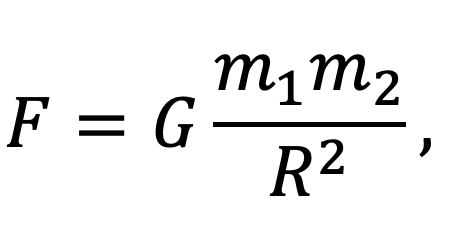
where m1 and m2 are the masses of the two bodies, R is their separation, and G is the universal gravitational constant. The Moon generates a radial gravitational field of strength:
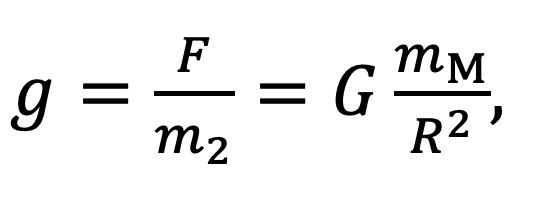
where mM is the mass of the Moon and R is the distance from the Moon’s centre. The field varies across the Earth. The tidal field is defined as the vector difference between the Moon’s gravitational field at a point on the Earth’s surface and at the Earth’s centre.[3]
Consider three points along the Earth-Moon axis – far ocean, centre, and near ocean – shown in figure 1. Here dM denotes the Earth–Moon distance and r the Earth’s radius. Using the values in table 1, the gravitational fields at these points are:
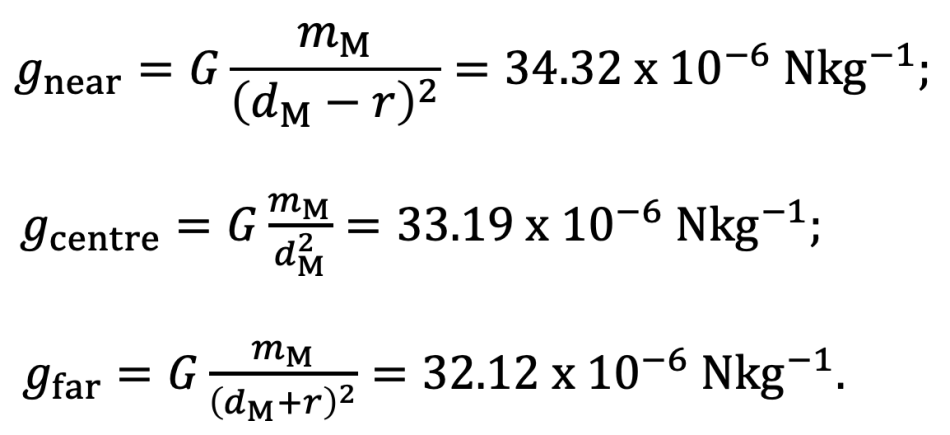
Subtracting the field at the centre gives the tidal field:

Although these differences are only of order 10-6 N kg-1, their effect accumulates over vast areas of ocean, producing the large-scale tidal bulges.
The negative value on the far ocean indicates a relative tidal acceleration directed away from the Earth-Moon centre of mass, explaining the far-side tidal bulge in figure 2.
| Quantity | Symbol | Value |
|---|---|---|
| Universal gravitational constant | G | 6.674 x 10⁻¹¹ N m2 kg-2 |
| Mass of Moon | MM | 7.348 x 10²² kg |
| Earth-Moon distance | dM | 384 400 km |
| Radius of Earth | r | 6371 km |
As mentioned, the Earth-centred treatment presented above is a simplified model that reproduces the correct tidal pattern while avoiding the mathematical complexity of a more complete barycentric analysis, where the Earth and Moon orbit their common centre of mass (the barycentre). In this alternative description, the motion is analysed in a reference frame that rotates with the Earth-Moon system.Then, additional apparent (inertial) forces such as the centrifugal force arise. These do not represent new physical interactions but result from the choice of reference frame. When treated consistently in the respective reference frame, the gravitational-field description and the rotating-frame description provide equivalent accounts of the same tidal behaviour. This provides an example of how the same physical situation can be described using different models depending on the level of detail and the choice of reference frame.
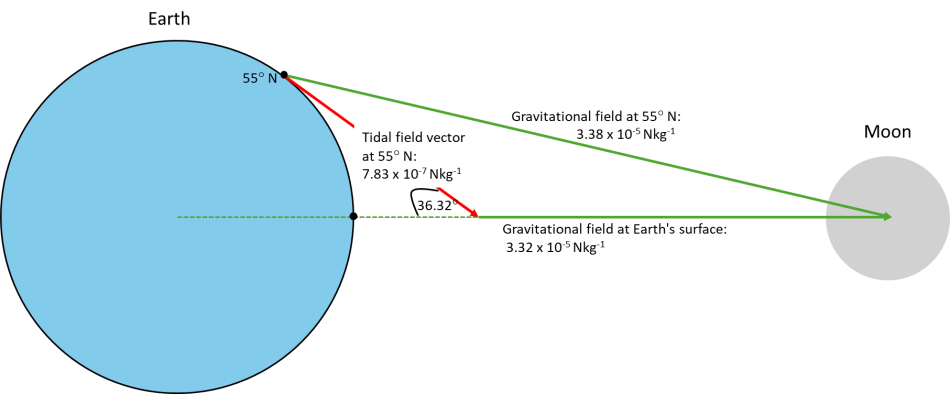
At latitude 55°N, roughly that of the UK or central Europe, the tidal field vector is inclined at 36.32° to the Earth-Moon axis (figure 3) and represents the additional acceleration relative to the Earth as a whole. Calculating these vectors for points across the Earth produces the tidal vector field (see figure 4), when the Moon is assumed to be directly above the equator. An animation of this tidal field as the Moon orbits the Earth is available here.[4]
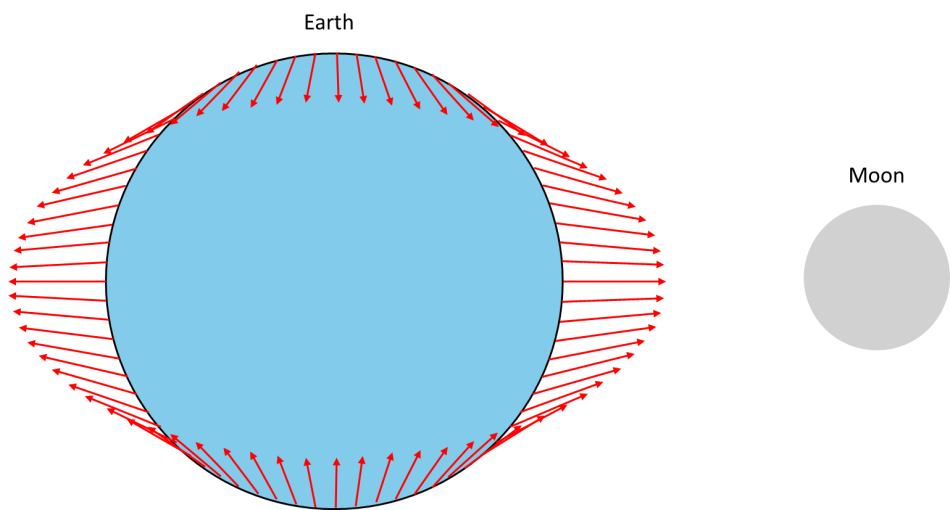
The Moon’s declination, which is its angular distance north or south of the celestial equator (an imaginary projection of Earth’s equator onto the sky) varies by up to 28.6°. This causes the Earth-Moon axis to tilt north or south, shifting the tidal bulges slightly, but the tidal field remains symmetrical about the axis.
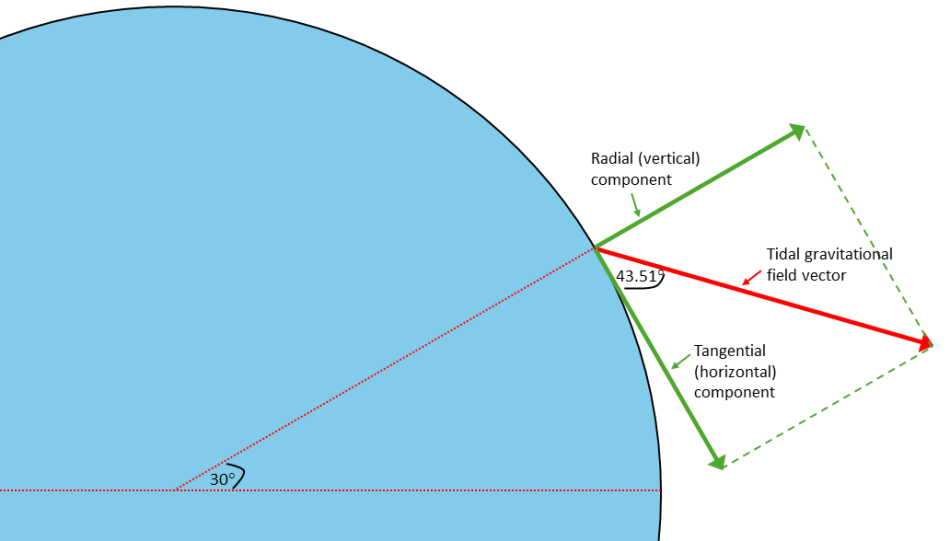
Each tidal vector can be resolved into a vertical (radial) component and a horizontal (tangential) component along the Earth’s surface (figure 5). In this idealised geometry, an angle of 54° from the Earth-Moon axis corresponds to a latitude of 54° on the Earth’s surface. Vertical components point inwards at higher latitudes, depressing the ocean surface, and outwards at lower latitudes, lifting the water surface. Tangential components drive water movement towards the Earth-Moon axis, forming the tidal bulges.
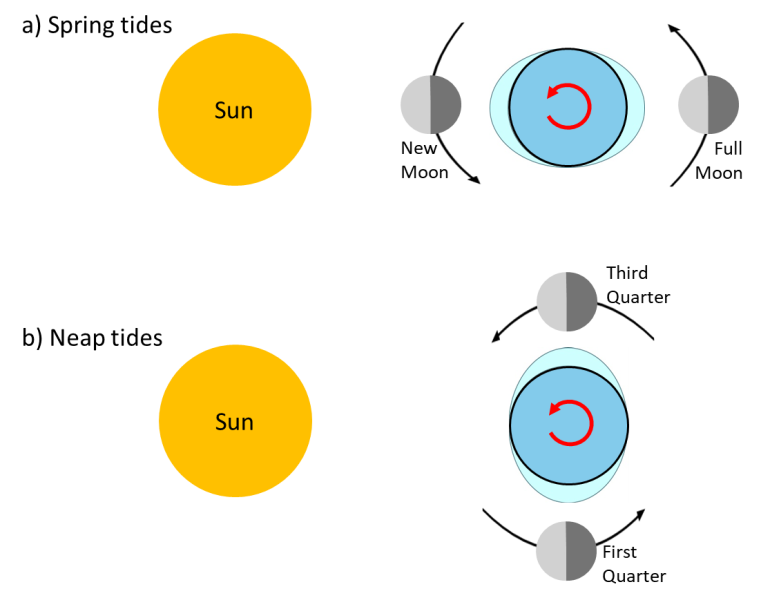
The Sun also causes tides. Although it is much more massive than the Moon, its greater distance reduces its effect to about 46% of the Moon’s. When the Sun and Moon are aligned (at new or full Moon), their gravitational pulls combine to produce spring tides, which have the greatest tidal range (highest high tides and lowest low tides) (see figure 6a). In contrast, figure 6b shows the first or third quarter Moon, when the Sun and Moon are at right angles to each other as seen from Earth. Their gravitational effects partially cancel each other out, producing neap tides, which have the smallest tidal range.[1]
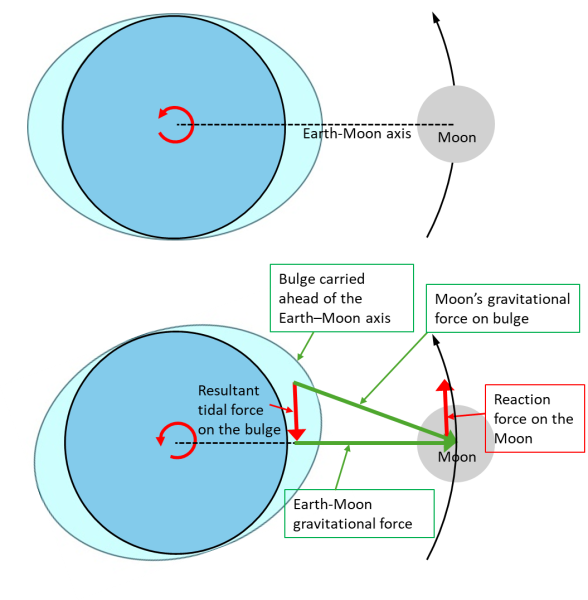
When viewed from above the North Pole, Earth spins anticlockwise and the Moon orbits in the same direction. Since the Earth completes one spin in less time than it takes the Moon to orbit once, friction between the oceans and the Earth’s surface carries the tidal bulge slightly ahead of the Earth-Moon axis (see figure 7).[1]
The Moon’s gravitational pull on this offset bulge exerts a clockwise torque (as shown in the figure) because it is displaced from the Earth–Moon axis. This torque slows the Earth’s spin, extending the length of the day from around five hours after the Moon formed 4.5 billion years ago to 24 hours today.[5]
According to Newton’s Third Law, the Earth exerts an equal and opposite (i.e., anticlockwise) torque on the Moon, pulling it forward in its orbit. To conserve the angular momentum of the system, the angular momentum lost by Earth is gained by an increase in the Moon’s orbital angular momentum. However, this is achieved by enlarging its orbital radius rather than increasing its speed, causing the Moon to recede at about 3.8 cm per year.
This progression from model 1 to model 3 illustrates an important idea in physics: different models can describe the same phenomenon at different levels of sophistication. Like models of the atom, they each add detail and explanatory power, but when applied correctly, they produce consistent predictions for observable quantities, such as the size of the tidal forces.
Thank you to the reviewers for their detailed and helpful comments.
[1] Tranfield E (2013) Life without the Moon: a scientific speculation. Science in School 26: 50–56.
[2] MacKay DJC (2009) Sustainable Energy – Without the Hot Air. UIT Cambridge. ISBN: 978-0954452933
[3] Pugh DT (1999) Tides, surges and mean sea-level. Wiley. ISBN: 0 471 91505 X
[4] Interactive tides simulation: https://beltoforion.de/en/tides/simulation.php
[5] Video on if we really need the moon: https://www.youtube.com/watch?v=VHNvPb2gbgM
Every tide tells a story. Discover how waves, shells, and even litter reveal clues about marine life and our shared connection with nature.
Soaring temperatures, a flooded landscape, violent winds…. What would our planet be like without the…


Contrary to the popular saying, deep waters are often far from still – which is just as well for marine life. Activities using simple water tanks…
