Supporting materials
Download
Download this article as a PDF



Challenge your students’ misconceptions about suction by using a simple gas syringe to demonstrate the impressive power of atmospheric pressure and pressure differences!
Gas pressure is a concept highly relevant to our daily life, such as when we breath or drink through a straw. However, its invisible nature makes it difficult for students to learn about it.[1] Students’ daily experience in sucking up liquids and the use of the colloquial term ‘suction’ can be both an obstacle and a resource for learning gas pressure. This article introduces a syringe balance activity developed for teaching the concept of gas pressure for students aged 12–18 years. The aim is to challenge students’ misconceptions about suction and teach gas pressure at macroscopic and sub-microscopic levels, while connecting pressure differences to Boyle’s law, resulting forces, and real-world engineering like hydraulics. Students are required to realise the existence of gas pressure, recognise that air pressure acts in all directions and understand how a pressure difference creates a net force acting on an object. They should be able to recognise the random motion of gas molecules and acknowledge the gas pressure resulting from molecular bombardment. Instructions for implementation, as well as worksheets, are also provided.
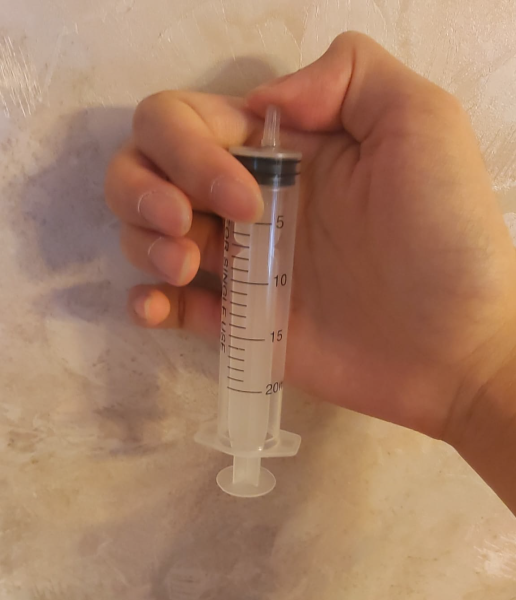
Weighing is one of the most common techniques performed in a laboratory. There are several types of balances mentioned in science textbooks, such as an electronic balance and a spring balance. However, these tools have their own limitations. For example, an electronic balance can only weigh objects with small masses and volumes, otherwise the balance will be damaged. In addition, a typical spring balance can withstand a maximum force of 25 N only. Common laboratory apparatus may not be suitable for weighing large and massive objects (e.g., a 5 kg bag of rice) and there is a need for using a new apparatus to weigh these objects.
In this activity, an alternative way for weighing massive objects in the laboratory will be proposed to students. Students will observe a gas syringe holding heavy loads, providing a context for them to explore why it works.
It is advisable for the teacher to practice managing the set-up to minimise danger. It is also important for teachers to explicitly state the safety precautions (e.g., place shock-absorbing materials on the bench beneath the syringe to prevent injury or equipment damage when the loads fall, ask students not to get too close to the set-up, etc.) to raise students’ awareness of lab safety.
Part I: Assembling the syringe balance
Note: to save classroom time, the syringe assembly (lubricating with Vaseline and inserting the plunger) can be completed in advance by a lab technician or teacher.
Part II: Testing the syringe balance without a clip
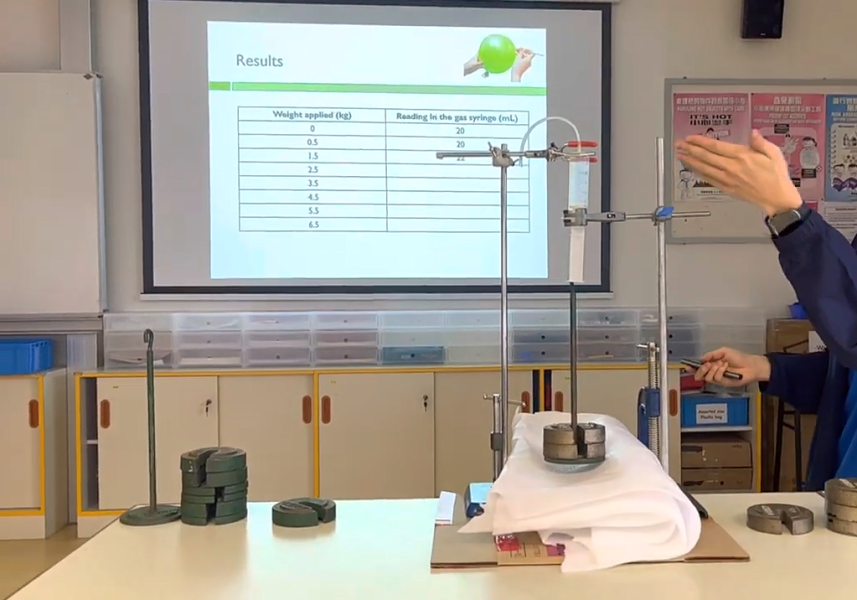
Part III: Testing the syringe balance with a clip
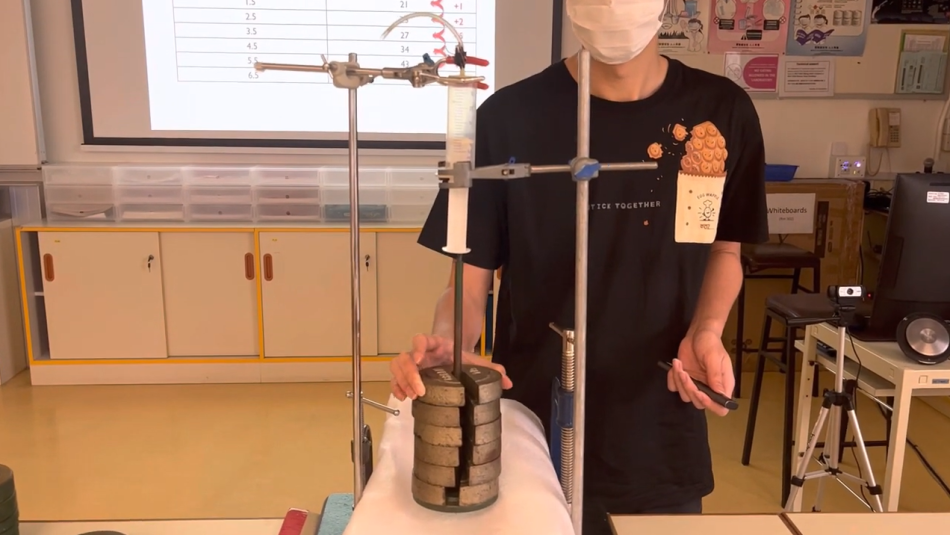
In the unsealed scenario, students will observe the plunger falling almost immediately as weight is added. However, when the tip of the gas syringe is sealed with a clip, the syringe can hold a surprisingly substantial load (often several kilograms) before the plunger is finally pulled out. As weights are added, students will observe that the enclosed volume reading increases slightly with each weight, which decreases the internal pressure and widens the pressure difference. Have students record their volume readings as weights are added and note the maximum weight limit for both scenarios. Comparing these outcomes provides a stark, memorable contrast that sets the stage for the theoretical discussion.
The strong contrast in the results provides an excellent opportunity to challenge students’ everyday misconceptions. Teachers are highly encouraged to facilitate a continuous student dialogue rather than simply lecturing. Establish ground rules for discussion and use ‘talk moves’ prompting students to share, expand and clarify their thinking with reasoning during discussions.[2] To guide the class effectively, structure the discussion in three main phases:
1. The macroscopic level: challenging ‘suction’
Teachers can present a concept cartoon, which provides a stimulus for focused discussion on the syringe balance.[3] This helps to address why the sealed syringe holds so much weight. Ask the students: “Is there a ‘suction’ force pulling the plunger from the inside, or an ‘upward’ force pushing it from the outside?” Use targeted questioning to provide just-in-time support.
The teacher then guides students to realise that ‘suction’ is not a scientific force. Instead, differences in air pressure are at the core of the observed phenomena and air pressure acts in all directions. The key to understanding the syringe balance is the pressure difference between the external atmospheric pressure and internal gas pressure. The external atmospheric pressure exerts a massive upward force that counteracts the combined downward forces of the hanging weights and the (now reduced) internal gas pressure.
As weights are added, the plunger is pulled down slightly, causing the volume of the trapped air to expand. According to Boyle’s Law, as volume increases at constant temperature, the internal gas pressure decreases. This causes the pressure difference to increase, generating a larger net upward force acting on the bottom face of the plunger to counteract the downward force of the hanging weights.
In addition, teachers can engage students in a simplified ‘claim-evidence-reasoning’ cycle, which prompts them to reason through experimental observations and evidence. This feature is commonly observed in intellectually demanding tasks[4] and is deemed challenging to many students. After the discussion, students will acknowledge that there are invisible forces acting on the plunger due to air particles, setting the stage for an extended discussion on the relationship between force and gas pressure.
2. The sub-microscopic level: the particle model
Once students understand the macroscopic forces, teachers can shift the focus to the behaviour of the gas particles themselves to deepen their reasoning. For example, teachers can ask students: “If air is mostly space, what is actually physically pushing against the plunger to create this atmospheric pressure?” Then, discuss the concept at a sub-microscopic level by explaining that gas pressure is not a static property, but rather the result of relentless, random molecular bombardment in all directions. Billions of air particles are constantly colliding with the container walls and both sides of the plunger. Outside the syringe, atmospheric gas particles collide with the exposed plunger face at a constant rate. Inside, as the trapped air volume expands, the gas particles spread out, leading to fewer collisions per unit area against the inside face. Because atmospheric particles strike the outside face more frequently than internal particles strike the inside face, the cumulative force of these impacts over the plunger area creates a net upward push.
3. Real-world applications: hydraulics & human breathing
To extend the lesson, teachers can introduce real-world applications in which pressure differences generate mechanical forces. For example, in fluid mechanics and engineering, hydraulics relies on pressure differences across fluid-filled pistons to transmit and multiply forces. Just as pressure differences across the syringe plunger produce substantial lifting forces, hydraulic systems use fluid pressure to move heavy machinery, operate car brakes, and power lifts. Another example would be the mechanics of human breathing. When the chest cavity expands during inhalation, lung volume increases, dropping internal pulmonary pressure below atmospheric pressure. The resulting pressure difference forces ambient air into the lungs.
By stepping back and allowing students to grapple with these concepts through guided peer-to-peer discussion, you ensure higher minds-on engagement and a more robust understanding of both atmospheric and internal gas pressures and foster their learning in multi-disciplinary application of science knowledge in real-world practices.
[1] Stavy R (1988) Children’s conception of gas. International Journal of Science Education, 10: 553-560. doi: 10.1080/0950069880100508
[2] Talk science primer: https://cadrek12.org/sites/default/files/TalkScience_Primer.pdf
[3] Chin C (2001) Eliciting students’ ideas and understanding in science: Diagnostic assessment strategies for teachers. Teaching and Learning 21: 72-85.
[4] Kang H et al. (2016) Designing, launching, and implementing high quality learning opportunities for students that advance scientific thinking. Journal of Research in Science Teaching 53: 1316-1340. 10.1002/tea.21329
Download this article as a PDF
Learn how to do quantitative chemistry using microscale techniques with bottle tops and inexpensive spirit burners that are relatively easy and quick to set up.



How can air hold the water in an upturned glass? Why does water stay in a bottle with a hole in its base? Find out with these entertaining…



We all know what a kilogram is – or do we? Researchers worldwide are working to define precisely what this familiar unit…

