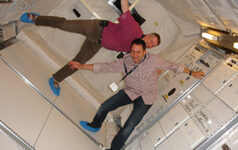
What do astronomy and film have in common? Both can involve Jochen Liske, astronomer and actor. Karin Ranero Celius takes us on a trip to the Paranal Observatory in Chile and tells us about Jochen’s latest film: Das Auge 3D.
How short is ‘very short’? Well, pretty short – between 120 and 150 pages. The pages are small, too, 175 mm x 110 mm, but then so is the type. ‘Introduction?’ …well, it depends what’s being introduced.
In the second of two articles, Jarek Bryk describes how scientists dig deep into our genes – to test the molecular basis of an evolutionary adaptation in humans.
Ages: 16-19; Topics: Biology, General science, Health
Do men and women share the same sense of humour? Perhaps, but their brains react differently to it, as Allan Reiss explains in this issue’s feature article.
Life Ascending: The Ten Great Inventions of Evolution gives a detailed account of the ten events that author Nick Lane considers to be the most important in establishing the direction that evolution has taken ever since the beginning of life on Earth.
Progress in science can be sporadic. For nearly 40 years, no human has visited the Moon, but interest in lunar exploration is now growing, as Adam Baker reports.
Gyro-cars, gymnastic cats and a slow-motion slap in the face. Lucy Patterson spoke to Rudolf Ziegelbecker, an Austrian physics teacher, about how to catch the imagination of even the most anti-physics students.