Harvesting light with the biggest eye on the sky Inspire article
Author(s): Wolfgang Vieser
”Faster, Higher, Stronger – Together”, the Olympic motto, could also apply to telescopes with a slight modification: “Bigger, Deeper, Sharper – Together”
Light is a fascinating phenomenon. Over the centuries, attempts to decipher this phenomenon evolved from intuitive models to increasingly abstract mathematical frameworks like quantum field theory, whose predictions fit the experimental data incredibly well but do not provide an explanation that lies within the realm of human experience. For centuries, light that emanates from cosmic objects has been the main source of information for scientists seeking to unravel the mysteries of the universe. Observatories like the European Southern Observatory (ESO), which designs, builds, and operates the biggest ground based optical telescopes in the world, play a crucial role in this regard. But why is using ever larger telescopes helpful in this quest?
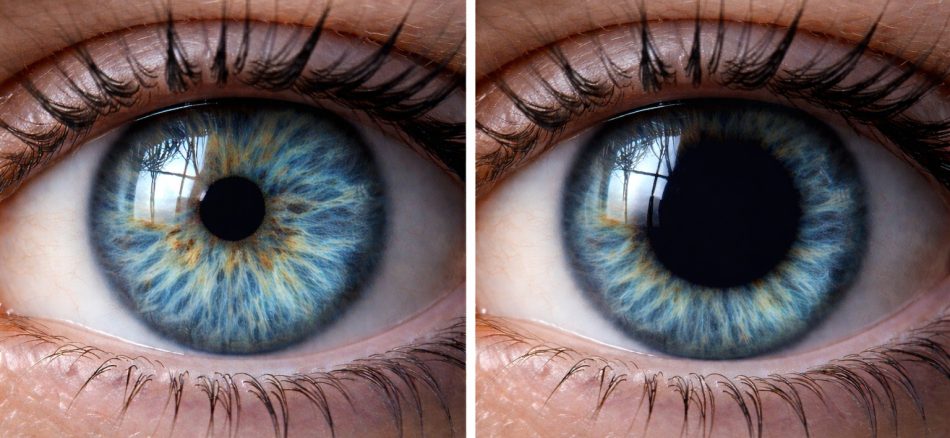
Anyone can harvest starlight even during daytime. The Sun, for example, is our closest star and is easy to see on a cloudless day. To make out the stars at night, the pupil of the eye must widen to let in the few photons that reach the Earth from distant stars. The pupil, together with the eye lens, acts like a funnel, collecting incoming photons and directing them to the retina. The amount of light collected is directly proportional with the cross-sectional area of the mouth of the funnel or aperture of the pupil. Thus, for a circular aperture, it scales quadratically with its diameter. Once the eye has adapted to the darkness, the pupil dilates to such an extent that the diameter of the area through which light can enter the eye is maximised to 8 mm. To stick with the analogy above: this is the largest funnel that can be realised by the human eye. If this is still not generating enough of a stimulus, larger funnels have to be built, i.e. telescopes are needed. The light-gathering areas of large telescopes have diameters of several metres, enabling them to collect far more light in the same amount of time than any eye of any living creature can.
The human eye under different lightning conditions: The dark, light-gathering area is small in bright light (left), but large when there are only a few photons to capture (right). Image generated with AI using ChatGPT and the following prompt: Create a photorealistic image of a human eye with blueish iris and reflection with a pupil of 1 mm size and one with 9 mm size
Size saves time
The difference in the light-gathering ability of different telescopes becomes apparent when the same object is observed using two telescopes of different sizes under nearly identical conditions (table 1). For example, consider two space telescopes.
Telescope
Hubble Space Telescope (HST)
James Webb Space Telescope (JWST)
Unit Telescope of the Very Large Telescope (VLT)
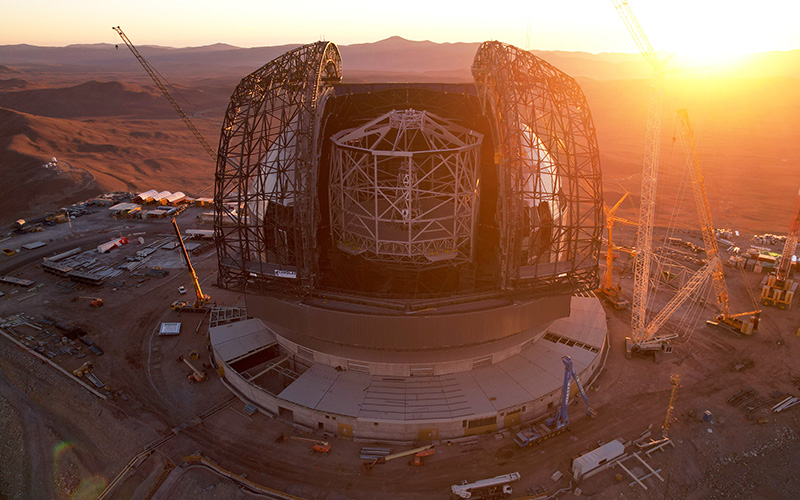
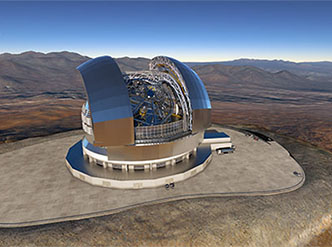
Extremely Large Telescope (ELT) under construction
Diameter of Primary Mirror
2.4 m
6.5 m
8.2 m
39 m
Light collection area*
4.5 m2
25 m2
53 m2
9.8102 m2
Table 1: Different types of telescopes *Since the primary mirrors of the JWST and ELT are composed of hexagonal mirror segments, the effective light-collecting area is smaller than that of a circle with the diameter of the primary mirror.
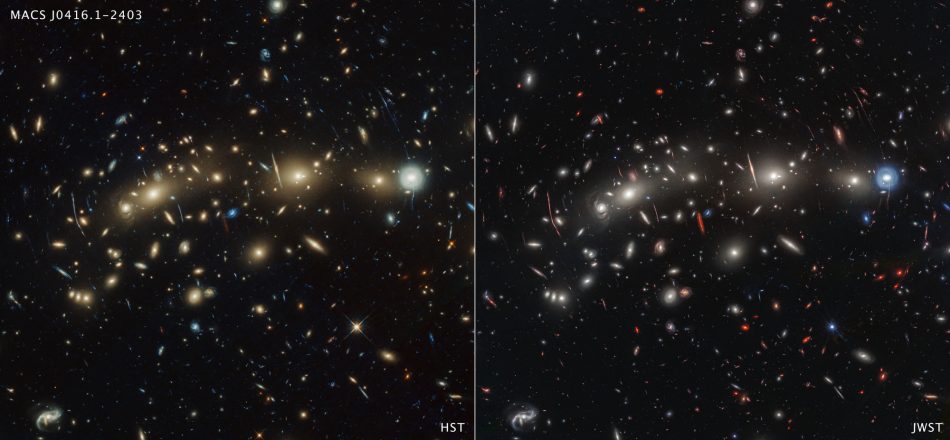
The Hubble Space Telescope (HST) and the James Webb Space Telescope (JWST) were used to observe the MACS0416 galaxy cluster in the constellation Eridanus, which is over 4 billion light-years away. The JWST’s light-gathering area is approximately 5.6 times larger than that of the HST, enabling it to collect 5.6 times more photons in the same amount of time as the HST. To obtain the two almost identical images below, the JWST observed for 22 hours, while HST required 122 hours, which is 5.5 times longer than the JWST observation, as expected.[1]
Bigger telescopes can achieve the same results in less time than smaller ones, meaning that more observation requests from researchers can be processed in a single night. Additionally, long exposure times with large telescopes reveal objects that cannot be observed with smaller telescopes because they are not bright enough. The brightness of an object as it appears in the sky (apparent brightness) depends, inter alia, on its distance from the observer: if the distance doubles, only a quarter of the photons reach the observer in the same time, making the object appear fainter in the sky.
Side-by-side comparison of the galaxy cluster MACS0416 as seen by the Hubble Space Telescope (left) and the James Webb Space Telescope (right) Image courtesy of NASA, ESA, CSA, STScI; image processing: Joseph DePasquale (STScI)
Size provides depth
A typical galaxy, such as the Andromeda galaxy, which is 2.5 million light-years away, can just be visible to the naked eye under perfect conditions. If the Andromeda galaxy were twice as far away, the pupil would need to span an area four times as large to gather enough light, i.e. its diameter would need to be twice as large for a human to still be able to see the galaxy. The diameters of the Very Large Telescope (VLT), which consists of an array of four 8-metre telescopes which can work independently or in combined mode, are about 1 000 times larger than that of a night-adapted human pupil. If the cameras on the telescopes were comparable to the human eye, the Andromeda galaxy could still be detected at a 1 000 times greater distance, i.e. 2.6 billion light-years away. Can you imagine the light-gathering abilities of the Extremely Large Telescope (ELT)?
In fact, the cameras of large telescopes are far more sensitive and can expose for much longer than the human eye can (several hours versus a few tenths of a second). These capabilities enabled scientists to use the VLT to study a galaxy approximately 13.2 billion light-years away.[2] Due to the expansion of the universe, the light emitted from this galaxy reaches Earth so redshifted that it is no longer in the visible spectrum, but in the infrared spectrum instead. To gather enough light for a spectroscopic analysis to determine the galaxy’s distance, the VLT had to collect light from it for almost 16 hours. Even after 42 hours, the Hubble Space Telescope did not have enough photons to make this measurement precisely.[3] This galaxy emitted its light at a time when the universe was only 600 million years old and the galaxy itself was just 100 million years old.
How many photons do we get? Let’s estimate.
The light from the galaxy, located 13.2 billion light-years away, has spread so far across the universe that the flux density received on Earth amounts to only 710–21 W per square metre. Based on the simplified assumption that the incoming photons in the infrared spectral range have an energy of 0.8 eV or 110–19 J, this means that only one photon from this galaxy strikes one square metre of Earth every 17 seconds. Thanks to the VLT’s large light-gathering area of over 52 m², the VLT collects approximately 3 photons per second. The long exposure time of 15 hours allowed more than 160 000 photons to be collected. With a light-collecting area approximately 20 times larger, the ELT could theoretically collect the same number of photons from this galaxy in the same amount of time if it were approximately 4.5 times farther away. The ELT will therefore be able to observe very early galaxies, including some from the cosmic dawn.
Size means sharpness
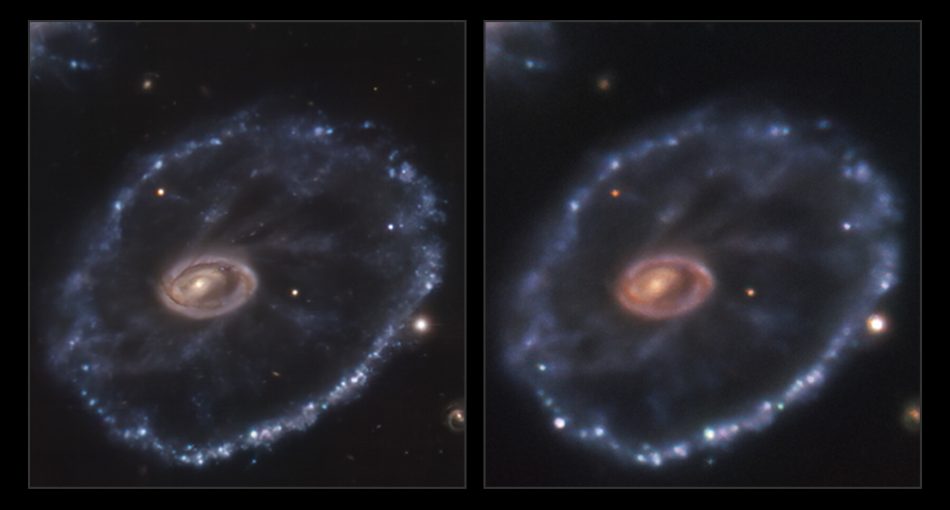
The light-gathering abilities of big telescopes are essential for detecting the faintest and most distant astronomical objects. Additionally, big telescopes also have a high spatial resolution since it fundamentally depends on the size of the primary mirror. The spatial resolution of a telescope describes its ability to distinguish between two closely spaced objects in the sky, and is also characterised as sharpness. This becomes immediately apparent when the same object is observed with telescopes of different primary mirror sizes.[4]
The relationship between resolution and the size of the primary mirror arises from the wave nature of light: even an ideal optical system cannot image a point source as a perfect point, but instead produces a diffraction pattern known as an ‘Airy disc’, whose diameter scales directly with the observed wavelength and inversely with aperture radius. In short, a larger mirror produces a smaller diffraction pattern and therefore provides a finer spatial resolution and a sharper image. If you were to observe the Moon from Earth using different telescopes, you would be able to see ever finer structures with increasingly bigger telescopes.
Telescope
Hubble Space Telescope (HST)
Unit Telescope of the Very Large Telescope (VLT)
Extremely Large Telescope (ELT) under construction
Smallest structure visible on the Moon
approx. 100 m
approx. 30 m
approx. 7 m
With the ELT, objects measuring 7 m would be visible on the Moon, and individual stars in galaxies some 10 million light-years away would be resolved. However, this requires a few engineering tricks, such as active[5] and adaptive[6] optics to counteract the effects of gravitational distortion of the mirrors or the Earth’s atmosphere, enabling astronomers to observe as if they were in outer space.
Telescopes with mirror diameters of 8–10 m are the workhorses of astronomers searching the universe. The large telescopes currently under construction, with diameters exceeding 10 m, will enable humanity to take decisive steps forward in understanding the universe.