Molecular mimicry in the AI era: teaching the universal architecture of deception Understand article
Author(s): Vittoria Buccigrossi
Discover how pathogens use molecular mimicry to hide from immunity, and how generative AI turns the tables by designing synthetic decoys.
Introduction: the biological disguise
In nature, camouflage is a brilliant strategy for survival. A similar strategy, known as ‘molecular mimicry’, occurs when molecules produced by a virus or bacterium, including certain toxins, closely resemble molecules found naturally in the human body.
Nature uses evolution to develop adaptations that help organisms survive in their environments.[1] This molecular camouflage typically occurs in one of two ways: It can manifest as short, identical sequences of amino acids (primary structure), or it can occur when completely different proteins fold into an almost identical three-dimensional shape (conformation), which our body mistakes for its own.
Stolen identities: the paradox of molecular mimicry
The story of molecular mimicry begins with an evolutionary plot twist. When scientist Raymond Damian formalised and popularised the concept in 1964, he described molecular mimicry as an ‘invisible cloak’. He suggested that microbes evolved surface molecules (antigens) that resemble host cells, thereby prompting the immune system to leave them alone.[2]
Researchers realised that this survival trick has a dangerous side effect: autoimmunity. Autoimmune disorders are complex and multifactorial, but molecular mimicry represents one key triggering pathway. When the immune system generates antibodies to attack an invading pathogen, those same antibodies can sometimes cross-react with healthy host tissues if the microbial and human proteins share structural similarities. Confused by this disguise, the immune response can target the body’s own cells.[3]
Beyond triggering antibody cross-reactivity, pathogens also use mimicry to interfere with cellular signalling. By mimicking human molecules (ligands), microbial proteins can bind directly to human receptors and alter cellular functions.[4] These are some examples:
HIV-1 Tat: The Tat protein produced by the human immunodeficiency virus 1 (HIV-1) acts as a structural mimic of the Vascular Endothelial Growth Factor (VEGF), which binds to VEGF receptors to interfere with the formation of blood vessels.[5] Furthermore, Tat compromises the intestinal epithelial barrier function by inducing enterocyte apoptosis.[6]
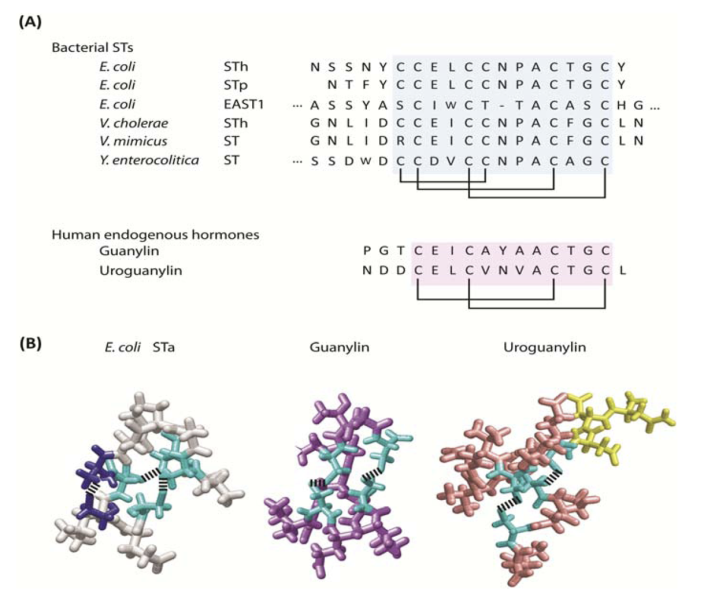
E. coli ST toxin: Pathogenic Escherichia coli produces heat-stable enterotoxins (STa toxin family) that structurally mimic human gut hormones like guanylin and uroguanylin. STa binds intestinal guanylyl cyclase C receptors with far higher potency and irreversible action compared to native hormones, triggering massive fluid secretion and severe diarrhea. Unravelling this irreversible process has deepened our understanding of bacterial pathogenesis and driven the design of novel drugs for gastrointestinal disorders and colorectal cancer (figure 1).[7-9]
Figure 1:The graphcompares the primary sequence alignment and 3D structural mimicry between bacterial enterotoxins (STs) and human gut hormones. (A) The primary sequence alignment illustrates that sequences can vary across human hormones (Guanylin and Uroguanylin) and bacterial toxins. Conservative amino acid substitutions (e.g., swapping isoleucine for leucine) retain key chemical properties. Variants like E. coli EAST1 demonstrate that mimicry of shape and function can persist even when their amino acid sequence show low similarity. (B) A comparison of 3D structures show how heat-stable enterotoxin type A (STa represents the toxin family responsible for human diarrheal disease) adopts the spatial fold of native human hormones to engage the exact same receptor. Image taken from Ref. [7]
AI as the medical detective
Finding these microscopic disguises was a slow and reactive process. Scientists use text-based software such as BLAST to compare amino acid sequences, using scoring matrices (such as BLOSUM62) based on chemical properties and evolutionary conservation (i.e, how frequently one amino acid replaces another during evolution).[10] However, our immune system does not read proteins like lines of text; it recognizes them as complex 3D biological puzzles. Many of these disguises are conformational, meaning how a protein folds in space. Varying amino acid sequences can produce similar 3D shapes, which linear comparisons may miss as they cannot directly predict 3D spatial folds.[11]
Deep learning platforms such as AlphaFold have bridged this gap by predicting 3D atomic coordinates directly from primary sequence data, allowing scientists to instantly visualise spatial interfaces without waiting for time-consuming experimental methods such as X-ray crystallography. During the COVID-19 pandemic, structural mapping tools helped researchers uncover cross-reactive antibody responses and correlate them with disease severity in patients.[12] Today, these predictive models can offer bioinformaticians a strategy to screen and identify potential targets of cross-reactivity between pathogens and hosts, thereby providing an additional tool to address epidemics in the future.
Fighting fire with fire
While pathogens have spent millions of years refining their disguises, structural biology now allows us to use their own strategy against them. Using generative protein design platforms such as ProteinMPNN, researchers no longer just study natural disguises but can also design synthetic traps from scratch.[13]
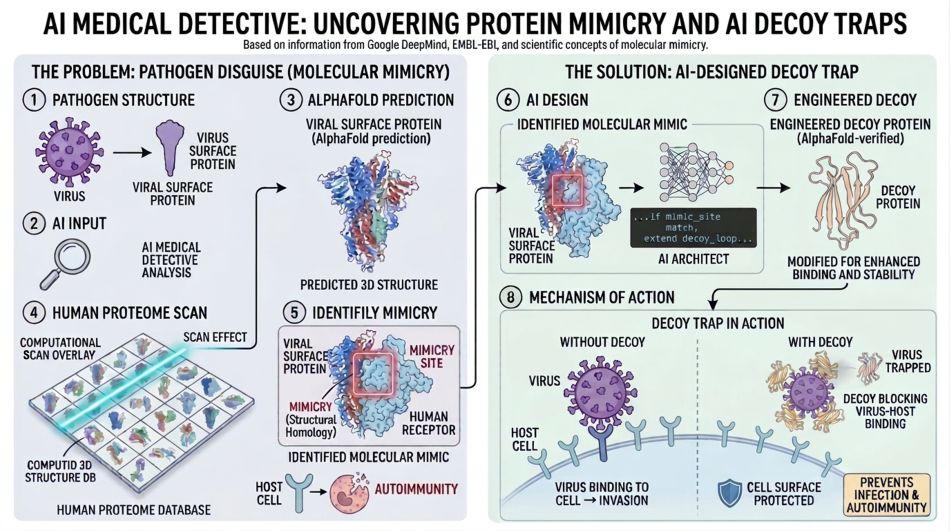
Here is how a molecular trap works (figure 2):
Generative artificial intelligence (AI) analyses the precise 3D interface of a human cell receptor that a virus normally attacks (steps 1–4)
The AI algorithm designs an artificial protein that mimics the human receptor, but with a much stronger binding affinity (steps 5–7)
In experimental models, these synthetic decoys intercept the pathogen. Tricked by this artificial mimic, the virus binds tightly to the decoy protein, becoming neutralised before it can reach host cells (step 8).
While AI-designed decoy proteins, such as engineered soluble hACE2 decoys (a decoy designed to bind to the spike protein of the SARS-CoV-2 virus), have demonstrated neutralisation efficacy in vitro and in preclinical animal models,[12] their deployment in human patients is currently undergoing early-phase clinical trials rather than being used as part of routine clinical practice. [14]
Bypassing the traditional, trial-and-error chemical screening process, generative AI mathematically optimises molecular traps for perfect stability, turning nature’s oldest deception into a brand-new class of targeted therapeutics.[15]
Figure 2: Deep learning tools like AlphaFold scan human proteome databases to identify structural mimicry hotspots where viral proteins disguise themselves as host molecules. Guided by these insights, the AI designs synthetic decoy proteins that bind to the pathogen, preventing host cell entry and halting autoimmune reactions. Image generated by AI assistant Gemini per user specifications and verified for conceptual accuracy by the author.
Conclusion
Molecular mimicry shows us that biological interactions depend on pattern recognition whether inside a human cell or within a computer model. Where there is a pattern, evolution finds a way to exploit it.
For a long time, medicine viewed molecular mimicry defensively, studying how microbes cause disease. Today, structural biology and generative AI allow us to uncover these disguises in seconds. However, transforming a computer-designed molecule into a clinically viable medicine requires a long and rigorous development process. No AI-designed decoy proteins or engineered molecular traps have yet been approved for routine clinical use, although several recombinant molecules are currently undergoing preclinical and early-phase clinical evaluation. Despite these advances, chemical synthesis, recombinant protein production, in vitro cell-based assays, tissue and organoid validation, animal safety studies and human clinical trials remain indispensable for translating computational predictions into clinically viable interventions.
Key takeaways
Biology intersects with information science. Biology involves highly complex living systems, but molecular and structural biology also rely on patterns of information. The structural principles underlying antibody and virus recognition are conceptually similar to the pattern recognition capabilities of AI algorithms applied to complex datasets.
Proteins are 3D structures, not just sequences. Understanding protein folding and three-dimensional architecture is essential for elucidating disease mechanisms and designing targeted therapeutics.
AI accelerates discovery, but biology requires validation. Generative AI can substantially accelerate early-stage drug discovery by predicting and selecting promising candidate molecules. However, translating in silico predictions into patient care still requires experimental validation, preclinical studies and clinical trials.
Learn about the science behind protein crystallography and grow your own crystals from protein: Blattmann B, Sticher P (2009) Growing crystals from protein. Science in School11: 30–36.
Explore how students can bring biological molecules to life through a science-inspired art exhibition: Stroe O (2019) Art meets molecular biology. Science in School 46: 29–33.
Author(s)
Vittoria Buccigrossi spent 20 years as a molecular biology researcher at the University of Naples Federico II. She now teaches natural sciences, chemistry and biology at a scientific high school, applying her academic expertise to integrate emerging research and AI tools into secondary STEM education.
Review
Some microorganisms have built their success on a subtle strategy: mimicking us at a microscopic level, getting almost invisible for our defenses, that carefully respect our body. That’s not all folks!! Besides, this trick puts our health in danger by a non-evident fact: it increases the ‘activity’ of our defenses at the boundary between what is ‘self’ and what is ‘non-self,’ making it more likely that the system would make a mistake – leading to the development of autoimmune diseases.
Understanding the structural details of this behaviour helps scientists devise AI-driven strategies to be even better prepared against infections. Evolution, once again, reveals itself to be like a game of tennis that is still being played.
José Ramón Blas Pastor, IES Airén, Tomelloso, Spain
Explore the form and function of ‘nature’s tiny sculptures’ – proteins – with an engaging art competition from the European Molecular Biology Laboratory.
Biology, Events, General science, News from the EIROs, STEAM