How we speak shapes what we think. For many years, linguists have been trying to find empirical evidence for the way language influences our thinking patterns and stereotypes. Are gender stereotypes, for example, more pronounced in places where the predominant language uses the generic masculine? It sounds logical, that if we keep talking about engineers and scientists using the male form, as it is still common in languages such as French or German, our brain is more likely to assume the person being talked about is male.
The effect of gender stereotypes is well documented, with studies showing that children as young as 2.5 years old already distinguish between stereotypically male or female occupations.[1–3] Unfortunately, it is a bit more difficult to prove if stereotypes are enhanced through gendered language. Researchers found that the effect of grammatical gender on perception strongly depends on what participants are asked to describe.[4] It’s therefore important to distinguish whether the effect of grammatical gender is assessed for all nouns, including inanimate objects, or specifically for nouns referring to humans. Some studies find no clear evidence that language affects gender bias because they include both inanimate and animate objects, while most studies focusing on nouns that describe humans find a clear effect of grammatical gender on participants’ perceptions.[4–7]
What about gender-neutral languages?
An analysis of text data in 45 different languages from Wikipedia and billions of texts from public facing websites (Common Crawl project) concluded that gender prejudice is more apparent in gendered language texts.[8] Moreover, in a worldwide study, researchers found that in countries with gendered languages, fewer women participate in the workforce and women tend to reach lower levels of education.[9] The analysis included 400 languages, representing those spoken by 99% of the world’s population. Sadly, a similar correlation was found between gendered language and higher levels of intimate partner violence, as well as a greater acceptance of it, at a country level.[10] While these findings suggest that gender-neutral language can help reduce gender bias, it’s important to note that people living in countries where genderless languages like Turkish and Finnish are dominant still exhibit male bias.[11]
This raises the question, if adapting to gender-fair language would be beneficial. Indeed, researchers have found a positive impact of using gender-fair language in fighting stereotypes and discrimination against women and LGBTQ+ (lesbian, gay, bisexual, transgender, queer and other) individuals.[12,13] For example, gender-neutral pronouns were formally introduced in Sweden several years ago, and a study shows that this has led to a decrease in the mental presence of males, resulting in more favourable attitudes towards women, lesbians, gays, bisexuals and transgender individuals.[14] In a study with French-speaking participants, researchers found that feminisation (i.e., using the masculine and the feminine form) is more effective in reducing male bias than neutralisation (i.e., using a new gender-neutral form), although both strategies were proven effective.[15] These findings show that it’s worth putting effort into adapting our language to a more inclusive standard. It can help bring gender equality into our daily lives.
Choosing a profession: boy = engineer and girl = nurse?
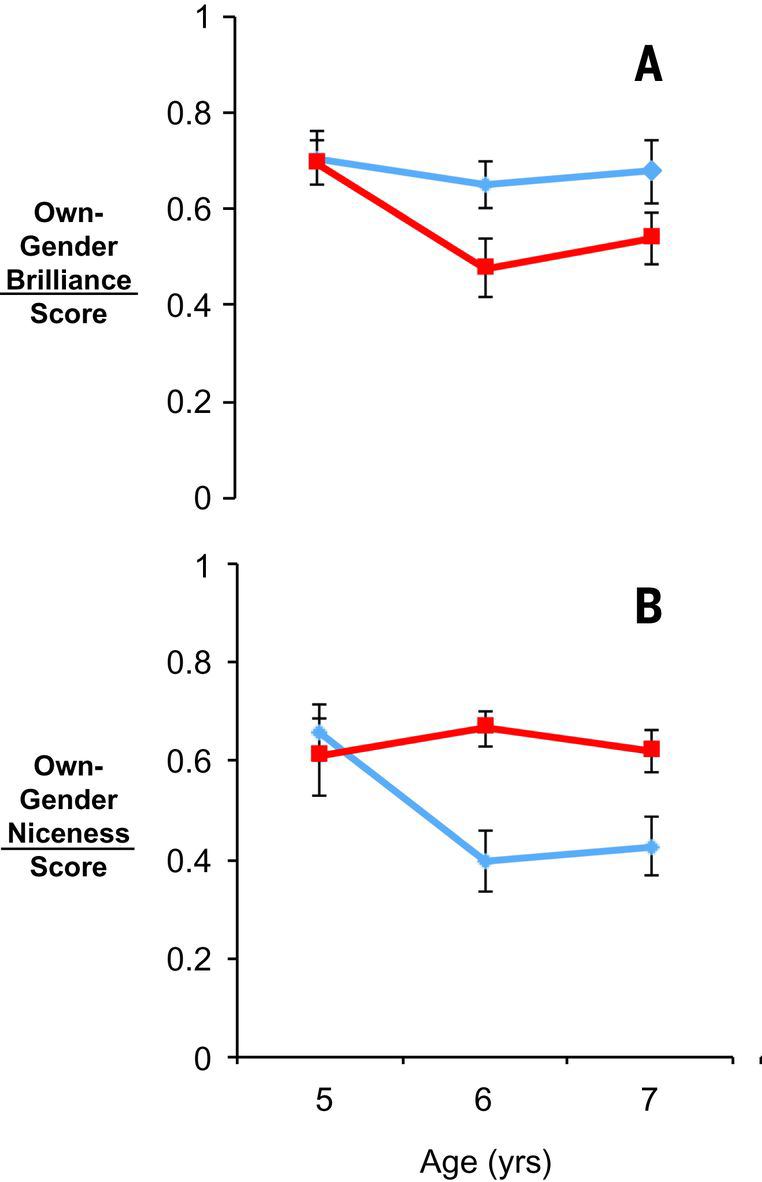
Gender stereotypes can influence our professional choices. A study published in 2017 has shown that from the age of 6 years on, girls start to more likely perceive boys as ‘really, really smart’ than members of their own gender (figure 1).[16] Consequently, they begin to avoid games and tasks for ‘really, really smart’ children. So, how can we change this?
Figure 1: The graphs show how often boys (blue) and girls (red) aged 5 to 7 associated their own gender with being ‘really, really smart’ (A) and ‘really, really nice’ (B). From the age of 6, girls were less likely than boys to describe their own gender with being very smart. Image taken and adapted from Ref. [16]
A simple starting point is including women when we talk about professions. In job descriptions, using a pair form (i.e., using the masculine and feminine form of the profession) instead of the generic masculine form leads to a more gender-balanced perception of jobholders in children and adults.[17,18] Moreover, job descriptions that do not use adjectives that are viewed as stereotypically masculine (e.g., leader, dominant, competitive) seem to attract women more, regardless of whether the field of work is male- or female-dominated.[19] Especially in school, it’s essential to fight stereotypes related to intelligence or future work options in order to create equal possibilities for all students, regardless of their gender.
Does artificial intelligence (AI) put our stereotypes on steroids?
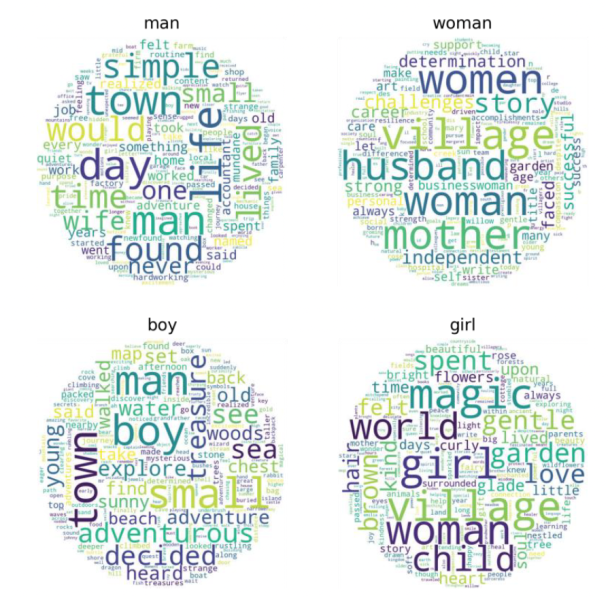
In the era where AI-generated text and other media have entered our daily lives at an exceptional pace over the past few years, we need to ask ourselves whether AI can reinforce these gender stereotypes. The short answer is: yes. Trained on the biased data that we have built as a society, it perpetuates our stereotypes and, without appropriate governance, it might even amplify them (figure 2).[20,21]
Figure 2: The word clouds show the most overrepresented words in AI-generated stories about boys, girls, women and men, created using Llama2. Comparing the frequencies of these words demonstrated significant stereotypical differences. Image taken from Ref. [20]
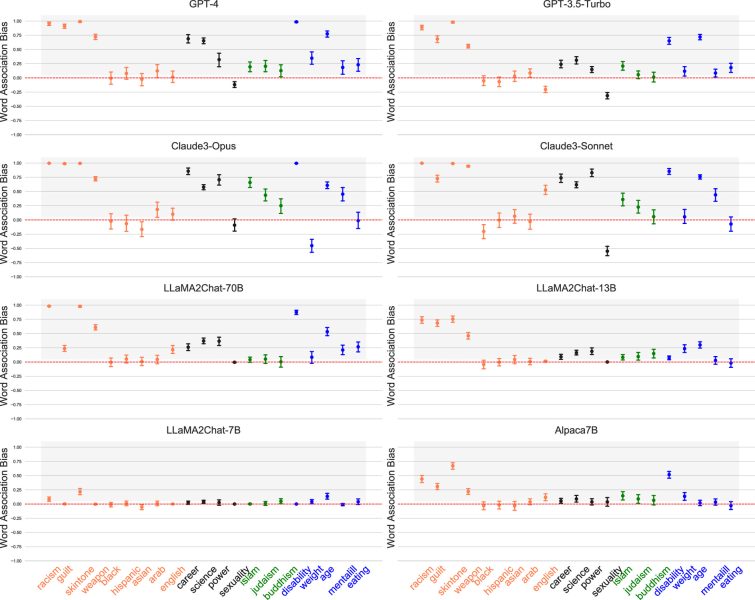
An early study from 2023 found that LLMs not only perpetuate gender biases, for example, related to jobs, but also provide inaccurate explanations when they are being called out on it.[22] Yet, a lot has changed in the past three years. LLMs are evolving fast and some corrective measures have been undertaken to reduce bias.[23] However, the problem is far from solved; if anything, it might have gotten harder to detect. Some more recent analyses show that while explicit bias is less pronounced these days, implicit bias still very much exists and can shape our perceptions subconsciously (figure 3).[24] For instance, LLMs that are used in hiring might have overcome some bias and might even preferably choose a female candidate, but are still more likely to suggest a lower salary than for a male applicant.[25]
Figure 3: The graph shows how strongly different AI models reproduced 21 tested social stereotypes in word association tasks, i.e., pairing a set of words to check for stereotypical associations. Image taken from Ref. [24]
AI for women – less jobs, more violence
In a recent article, the United Nations Entity for Gender Equality and the Empowerment of Women (UN Women) calls for gender equality in every stage of AI, emphasising that:[26]
AI is already being broadly implemented in marketing and communication, and we have to act fast to shape it.[27]
discrimination against women through AI systems is systematic.[24]
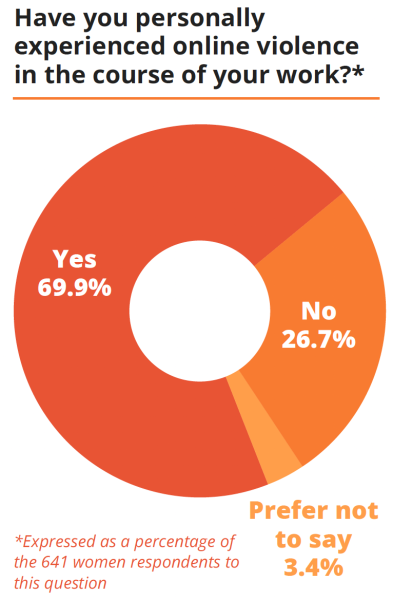
women and girls are targeted by AI-assisted violence in digital spaces to a significantly higher proportion than men and boys (figure 4).[28-34]
women are still underrepresented in the AI sector and have therefore limited influence on the design of these systems.[35]
women are almost twice as likely to hold jobs at high risk of automation than men.[36]
inclusive advertisements free of gender-stereotypes leads to a significant business profit.[37]
Figure 4: The graph shows how women working as writers, public communicators, journalists, media workers, human rights defenders or activists to the question: Have you personally experienced online violence in the course of your work? Image taken from Ref. [28]
For centuries, women were given less opportunities and rights. These include voting, education, property ownership, political representation and other rights, that are fundamental human rights. Feminist activism has achieved a lot during the last centuries, from sparking an educational revolution and giving women the possibility to pursue higher education and university degrees, to securing legal rights and political influence. These achievements were based on strong, courageous women who insisted on their right to equal chances. Let us not undermine the achievements of the last decades through an accelerated propagation of information based on a history of inequality by AI.
What can we do?
Critical thinking: our responsibility to decrease the accelerated propagation of age-old biases
Coming back to the original question: does gendered language and LLMs amplify gender biases? Many studies have shown an effect of grammatical gender on gender bias, which can be perpetuated and amplified by LLMs.
Global regulation and governance of AI systems is necessary to prevent bias from prevailing and amplifying. It’s important to advocate for it and to hold companies accountable for their products.
As educators and individuals, we must take responsibility in making sure that children learn about and deal with those biases when using AI chatbots, to not leave them with that skewed few of the world.
When I asked ChatGPT to give me scientific publications supporting and opposing the claim that gendered language amplifies gender stereotypes, it gave me an equal number of papers for both sides. After reading the publications, I argued, that the one’s opposing my hypothesis are mainly stating that this cannot be easily generalised. The LLM agreed with me and changed its position to “most of the available publications support the hypothesis, but there’s a few exceptions”. This is a completely different picture. It shows just how important it is to use specific prompts, not trust AI blindly, always check the sources, use the right system for your question, ask critical questions and expect that a chatbot will often try to agree with you.
[9] Jakiela P, Ozier O (2020) Gendered Language. IZA Discussion Paper Series: 13126.
[10] Davis L, Mavisakalyan A, Weber C (2024) Gendered language and gendered violence. Journal of Comparative Economics52: 755–772. doi: 10.1016/j.jce.2024.08.008
[21] Nadeem M, Bethke A, Reddy S (2021) StereoSet: Measuring stereotypical bias in pretrained language models. Proceedings of the 59th Annual Meeting of the Association for Computational Linguistics and the 11th International Joint Conference on Natural Language Processing1: 5356–5371. doi: 10.18653/v1/2021.acl-long.416
[22] Kotek H, Dockum R, Sun D (2023) Gender bias and stereotypes in Large Language Models. In Proceedings of The ACM Collective Intelligence Conference (CI ’23). Association for Computing Machinery: 12–24. doi: 10.1145/3582269.3615599