The Beamline for Schools (BL4S) competition was created in 2014 to celebrate CERN’s 60th anniversary by Christoph Rembser. Since then, the competition has grown having a significant impact on students, scientists and many others from all around the globe. This competition is unique. It gives high school students, no matter their location on Earth, the chance to create and carry out their own particle physics experiments in a real particle accelerator. For a total of two weeks, they can operate a fully-equipped accelerator with the help of highly qualified support scientists – just like real scientists do.
Three different facilities and one outreach programme united for science
In 2026, BL4S will host the 13th edition since its creation in 2014. In 2024, the entire team celebrated a huge milestone: the 10th anniversary of the competition – a moment to remember and celebrate the impact it has left on all those young minds that love exploring and understanding the world around them. The competition started at CERN, and for many years, the winning teams were invited to come and develop their experiments at the CERN experimental areas located in the East Hall, such as T09 and T10.
In 2019, the DESY facility joined the competition, bringing a new laboratory with different beam properties into play and enabling students to travel to Germany and discover a different location.
It was not until after the COVID-19 pandemic in 2022 that BL4S partnered with the Belgian project Stars Shine for Everyone. This collaboration encourages students to submit an outreach proposal with the main goal of engaging people in their local community who are less exposed to science. The participation also gives students the chance to win truly special telescopes: thanks to the project creator Jean-Pierre Grootaerd, each telescope is signed by different Nobel Prize Laureates and by CERN’s Director-General (DG) Fabiola Gianotti. In 2026, Marc Thomson, the new DG at CERN, will have the honour to sign these telescopes for the very first time.
Last year, BL4S was pleased to begin another partnership with a new facility: the ELSA accelerator at the University of Bonn in Germany. This new accelerator not only brought a new facility to discover, but also new options for conducting experiments, thereby enriching the BL4S ecosystem.
Overall, we now have three contributing facilities, each working with different particles at different energies, which provides students with plenty of flexibility for designing all kinds of experiments. In 2025, teams from Belgium, Canada, Mexico, Türkiye and the USA won the competition and spent two weeks at CERN, DESY, and ELSA. BL4S set several records in that year:
The number of applications received (n = 508) and the number students who applied (n = 3372) were the highest since 2014, which is a testament to how the competition has grown in popularity over the years.[1,2]
The nomination for the 2025 European Physical Society Conference on High Energy Physics (EPS HEP) outreach award recognises the collective efforts of everyone involved in this project.[3]
The additional facility, ELSA, was hosting a team from the USA for the very first time as part of the competition at its installations in Bonn, Germany.
For the very first time, a Belgian and Turkish team won the competition and came to CERN.
The competition has certainly evolved since its creation, bringing together scientists, engineers, high-school students and teachers with a main objective: sparking their curiosity about science. This initiative fosters a vibrant community that inspires year after year thousands of students to dive deeper into physics, its societal applications, and scientific outreach.
A life-changing experience with many lessons
The experience is not limited to students being invited to come to CERN, DESY, or ELSA and performing their experiments for two weeks. Local organising teams, scientists and collaborators keep in touch with the students after their departure, consolidating a new network and shaping their future through collaborative projects. Moreover, students are encouraged to present and to publish the results of their experiments like scientists do. Over the past years, at least 14 scientific publications have resulted from experiments that started as a simple high school proposal for BL4S, 9 publications appeared in educational journals, and 12 participations have presented at international conferences.[4] Year after year, students also have the chance to present their experiments at international workshops[5], giving them recognition and valorising their projects after several weeks of intense work.
In total, 30 teams from several continents have won the competition:[6]
America: Canada (x2), Mexico (x2), USA (x4)
Africa: Egypt, South Africa; Asia: India, Japan, Pakistan, Philippines
Europe: Belgium, Estonia, France, Germany, Great Britain, Greece, Italy (x3), Netherlands (x3), Poland, Spain, Switzerland, Türkiye.
The experiments carried out go from testing their own detectors to characterising the beams and even investigating intriguing physical phenomena such as transition radiation or the Smith-Purcell effect.
Besides learning about science, students also discover the infinite possibilities CERN, DESY, and ELSA have to offer in terms of experiences: from seeing the projects come to life, to getting the first set of data, to connecting with people and forming new bonds with the other teams and the support scientists. As many of the members of the teams participating in the 2025 stated: “We learned to overcome challenges, work effectively under pressure, and strengthen our teamwork.” They see their design come to life, while being active contributors to the experiment rather than being passive observers.
Taking part in BL4S gives students a deeper understanding of how scientists work and opportunities they would not normally have, finding inspiration for their future careers.[7]
To sum it all up: The BL4S competition offers high-school students a unique gateway into real scientific research. It allows them to explore data analysis, carry out hands-on experimental work in a beamline environment, and begin building networks with experts across different fields. It is, without a doubt, an opportunity like no other, one that can truly enrich and have positive impact in their futures.
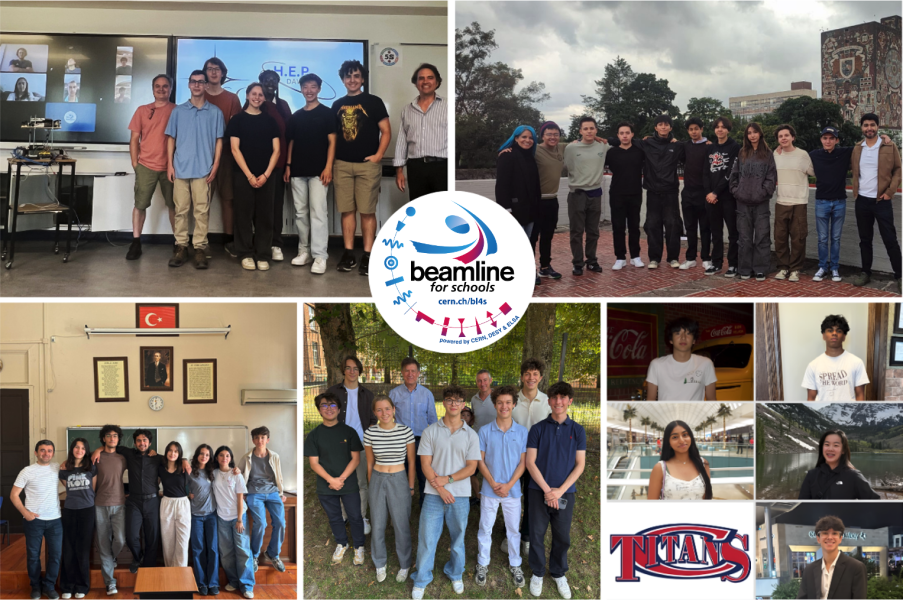
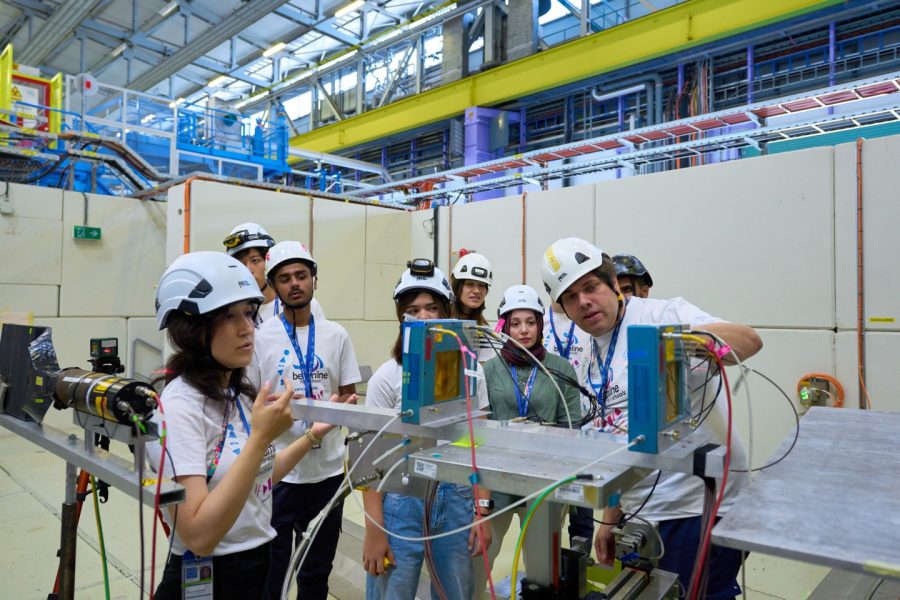
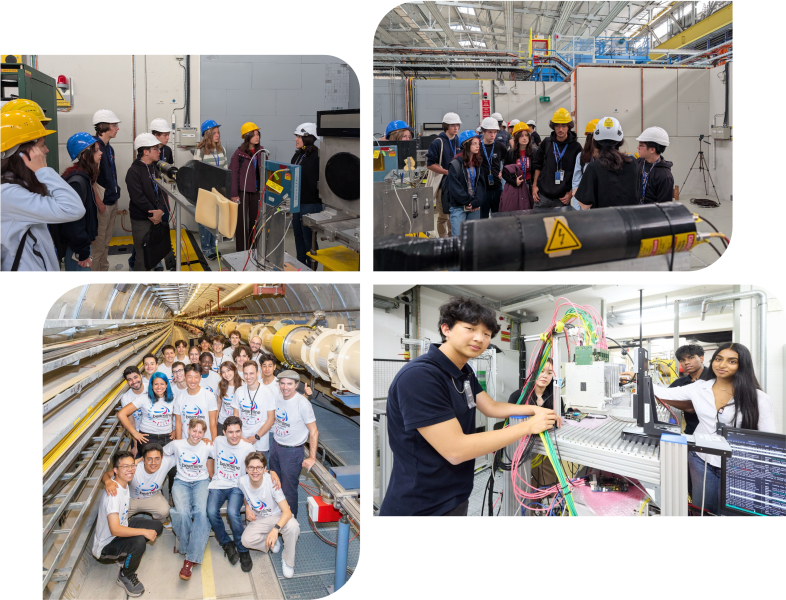
CERN teams in the experimental areas (top left and right), DESY teams in the HERA tunnel (bottom left), ELSA team in the experimental area (bottom right) Images: top left and right: CERN; bottom left: Marta Mayer/DESY, bottom right: Volker Lannert/University of Bonn
How to participate
If you want to participate as a student or a leading teacher, please visit our website. This year, the deadline for submitting proposals will close on March 13th, 2026. The BL4S team at CERN, DESY and ELSA will be more than happy to answer questions about the competition, the experiments or any doubt you may have. Please write to us via: bl4s.team@cern.ch, bl4s-desy@desy.de or elsa-bl4s@listen.uni-bonn.de.
This project is funded through philanthropic donations. If you would like to help us find new contributors or like to contribute yourself, you can do so through the CERN and Society Foundation,[7,8] which enables individuals, companies and entities to connect CERN’s science with society.
Engage your students with a teaching activity on accelerator science: Welsch CP (2021) Build your own virtual accelerator. Science in School54.
Build a particle accelerator in your classroom: Brown A, Merkert J, Wilson R (2014) Build your own particle accelerator. Science in School 30: 21–26.
Institutions
Author(s)
Jorge Andrés Villa Vélez is an astrophysicist by training and the School and Student Programmes manager at CERN. He has been coordinating the Beamline for Schools competition since 2025. He is part of the Teacher and Student Programmes team at CERN, in the Education, Communications and Outreach group of the stakeholder relations sector.