
Blended senses: understanding synaesthesia
What would it be like if numbers and musical tones had colours? People with synaesthesia experience the world in this way – and scientists are…
Biology





Your ear can detect movements smaller than atoms and turn them into music, voices and laughter. How does it work?
Imagine someone calling your name from across the playground. How does the sound of your name travel through the air, enter your ear and suddenly become something your brain can understand?
Our sense of hearing has an extraordinary dynamic range: we can detect sounds as soft as a whisper and can tolerate sounds as loud as a rock concert or fireworks near the threshold of pain.[1] This is a remarkable dynamic range. Hearing is also unique among our senses because it allows us to detect sounds coming from all directions at once. Even in the dark, when we cannot see what is around us, hearing helps us to stay aware of our environment. We rely on hearing every day: to communicate with other people, to enjoy music and to notice danger in the dark. But how does the ear transform tiny vibrations in the air into signals in our brain?

Sound begins as vibrations in the air, known as sound waves. When someone speaks, plays music or closes a door, the air molecules vibrate back and forth, creating pressure waves that travel through the air.[2] The outer part of your ear, also called the pinna, acts like a funnel. It catches these waves and guides them into the ear canal, where they hit the eardrum. The eardrum then begins to vibrate, just as the skin of a drum does when it is tapped (figure 1).
These vibrations are then passed to the three tiny bones in the middle ear called the ossicles. The stapes, one of the three bones, is the smallest bone in your body, smaller than a grain of rice. These bones act like a system of levers that amplify the vibrations and send them deep into the ear. The vibrations finally reach the cochlea, a spiral-shaped and fluid-filled organ (figure 1). Its name comes from the Greek word for snail, because of its spiral shape.
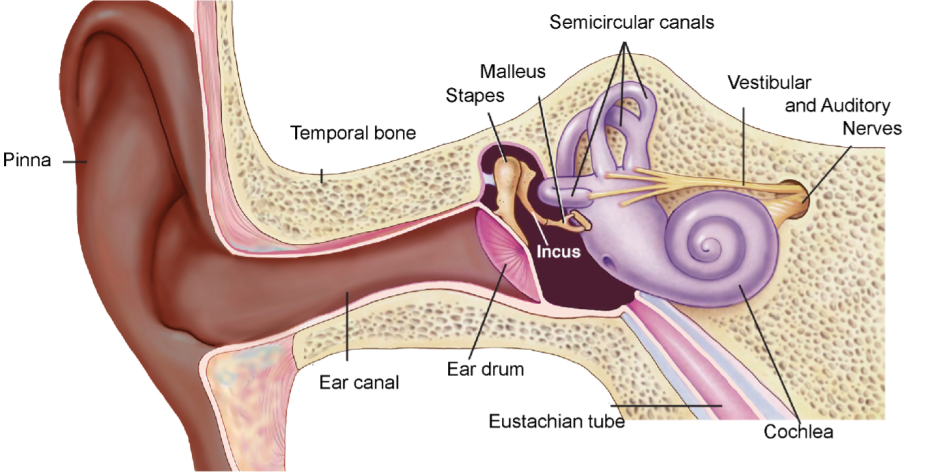
Inside the cochlea, sound vibrations travel through fluid and stimulate different regions along the spiral. Scientists sometimes say that your ear contains a piano played in reverse.[3] On a real piano, you press a key to make a particular note. In the cochlea, the reverse happens: different frequencies stimulate different locations along the spiral:
The frequency of a sound determines its pitch (i.e. how high or low it sounds), while its intensity determines its loudness. For example, a soprano singer can produce very high-pitched notes, which have a higher frequency than the notes produced by a typical speaking voice. Humans can hear sounds between roughly 20 and 20 000 hertz (Hz). One vibration per second is one hertz; 20 Hz means 20 vibrations per second, and so on. Our hearing range covers the notes of a piano and even extends slightly beyond them. However, our ability to hear the highest frequencies gradually declines with age, which is why older adults sometimes have trouble hearing high-pitched sounds.
Many smartphones or computers can play tones at different frequencies.
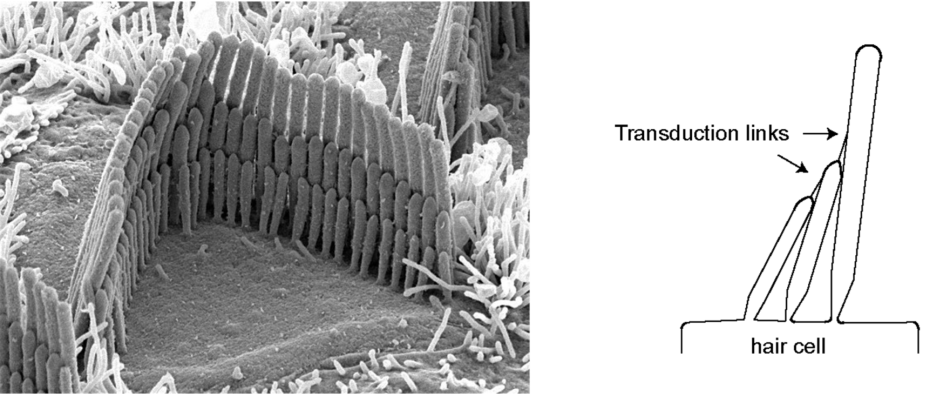
The cochlea contains about 15,000 sensory cells called hair cells. They are named for the tiny hair-like protrusions on their surfaces called the stereocilia (figure 2). When the vibrations reach the cochlea, these stereocilia move back and forth. These movements cause tiny molecular gates near the tips of the stereocilia to open. These gates are called ion channels. When they open, charged particles (ions) rush into the cell, converting the movement of the stereocilia into a tiny electrical signal. These electrical signals carry information about the sounds we hear.
For decades, scientists knew that these gates existed; they could measure them opening. But nobody knew what the gates were made of or what they looked like. It was one of the longest-standing puzzles in sensory biology. In 2018, researchers found strong evidence that a protein called TMC1 forms part of the pore – the tiny opening through which the ions pass.[4] As the ions enter, they change the voltage across the hair cell membrane, producing an electrical response. This electrical change causes the hair cell to release a chemical messenger called glutamate onto nearby auditory nerve endings. The auditory nerve carries this information as electrical impulses that travel to the brain. What began as invisible vibrations in the air has now been transformed into signals that the brain can interpret as a voice, music or laughter.
All cells carefully control the ions inside and outside their membranes. Pumps and other transport proteins use energy to create unequal concentrations of ions on the two sides of the membrane. When ion channels open, ions flow across due to the built-up concentration and electrical gradient, changing the cell’s voltage and creating an electrical signal. The ions are then transported back so that the cell can respond again. Hair cells, nerve cells and muscle cells all rely on this same basic principle.
In pioneering experiments in the 1970s and 1980s, A. James Hudspeth and David P. Corey used tiny electrodes to record from hair cells while gently moving their stereocilia. They discovered that even extremely small movements produced an almost immediate electrical response. Their work helped establish that mechanical force directly opens ion channels in the hair-cell membrane – long before scientists knew the molecular identity of those channels.[5]
For a long time, scientists thought that the ear worked like a microphone: sound waves enter, hair cells detect them and the brain receives the signal. However, researchers later discovered something surprising: the inner ear is not just a detector of sound. Hair cells can also boost faint sounds by adding energy back into the vibrations, making them easier to detect. This built-in amplifier allows our ears to detect incredibly quiet sounds.[6] Sometimes this amplifier becomes so active that the ear produces its own tiny sounds, called otoacoustic emissions.
Humans are only part of the story. Across the animal kingdom, hearing systems have evolved to detect the sounds that matter most for each species. For example:
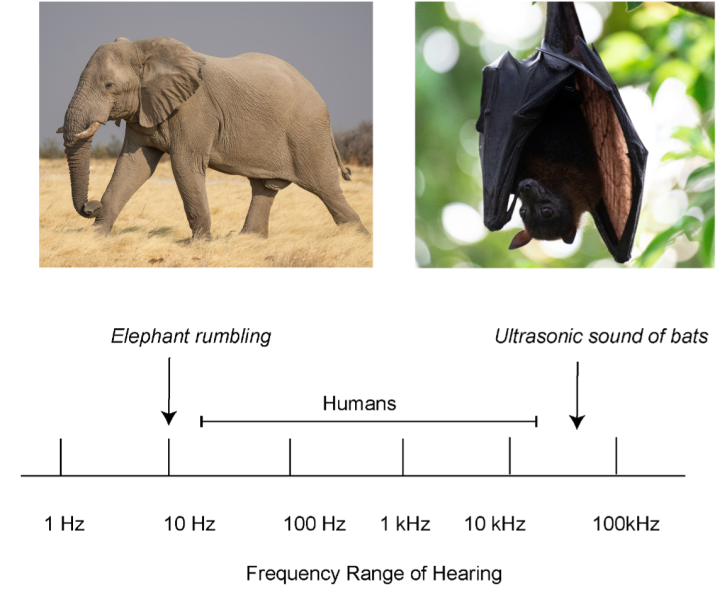
Although all these systems look very different, they often rely on the same basic idea: tiny mechanical vibrations are turned into electrical signals.
Our ears are remarkably sensitive, but they are not invulnerable. Very loud sounds can damage sensory hair cells of the inner ear, and in humans these cells do not regenerate. Remarkably, birds and some other vertebrates can generate them, which has made this process a major focus of hearing research. Loud noise can also destroy the delicate connections between hair cells and the auditory nerve fibres. The risk of hearing damage depends both on sound intensity and the duration of exposure. This is why listening volume matters when we use headphones and earbuds, and many devices now allow users to monitor their listening levels or set a maximum volume. Hearing aids also amplify sounds but selectively: they boost the frequencies that a person struggles with and must be properly fitted so that their output stays within safe limits.
The parts that detect sound are extremely small, far too small to see with the naked eye. Because of this, scientists use special tools to understand how hearing works. This includes:
Understanding how healthy hair cells detect sound can also help scientists understand what goes wrong when hearing is damaged:
By studying the inner ear, scientists are not only learning how we hear; they are also discovering ideas that could shape future technologies. And it all begins with something very small: tiny moving hair-bundles that turn the vibrations of the world into the sounds of life.
[1] Hudspeth AJ (1989) How the ear’s works work. Nature 341: 397–404. doi: 10.1038/341397a0
[2] Kinsler LE et al. (1983) Fundamentals of acoustics 3rd edition. Journal of Vibration, Acoustics, Stress, and Reliability in Design 105: 269–270. doi: 10.1115/1.3269099
[3] Von Békésy G (1960) Experiments in hearing. McGraw-Hill Book Company.
[4] Pan B et al. (2018) Tmc1 forms the pore of mechanosensory transduction channels in vertebrate inner ear hair cells. Neuron 99: 736–753. doi: 10.1016/j.neuron.2018.07.033
[5] Corey DP, Hudspeth AJ (1979) Response latency of vertebrate hair cells. Biophysical journal 26: 499–506. doi: 10.1016/S0006-3495(79)85267-4
[6] Hudspeth AJ (2008) Making an effort to listen: Mechanical amplification in the ear. Neuron 59: 530-545. doi: 10.1016/j.neuron.2008.07.012
What would it be like if numbers and musical tones had colours? People with synaesthesia experience the world in this way – and scientists are…
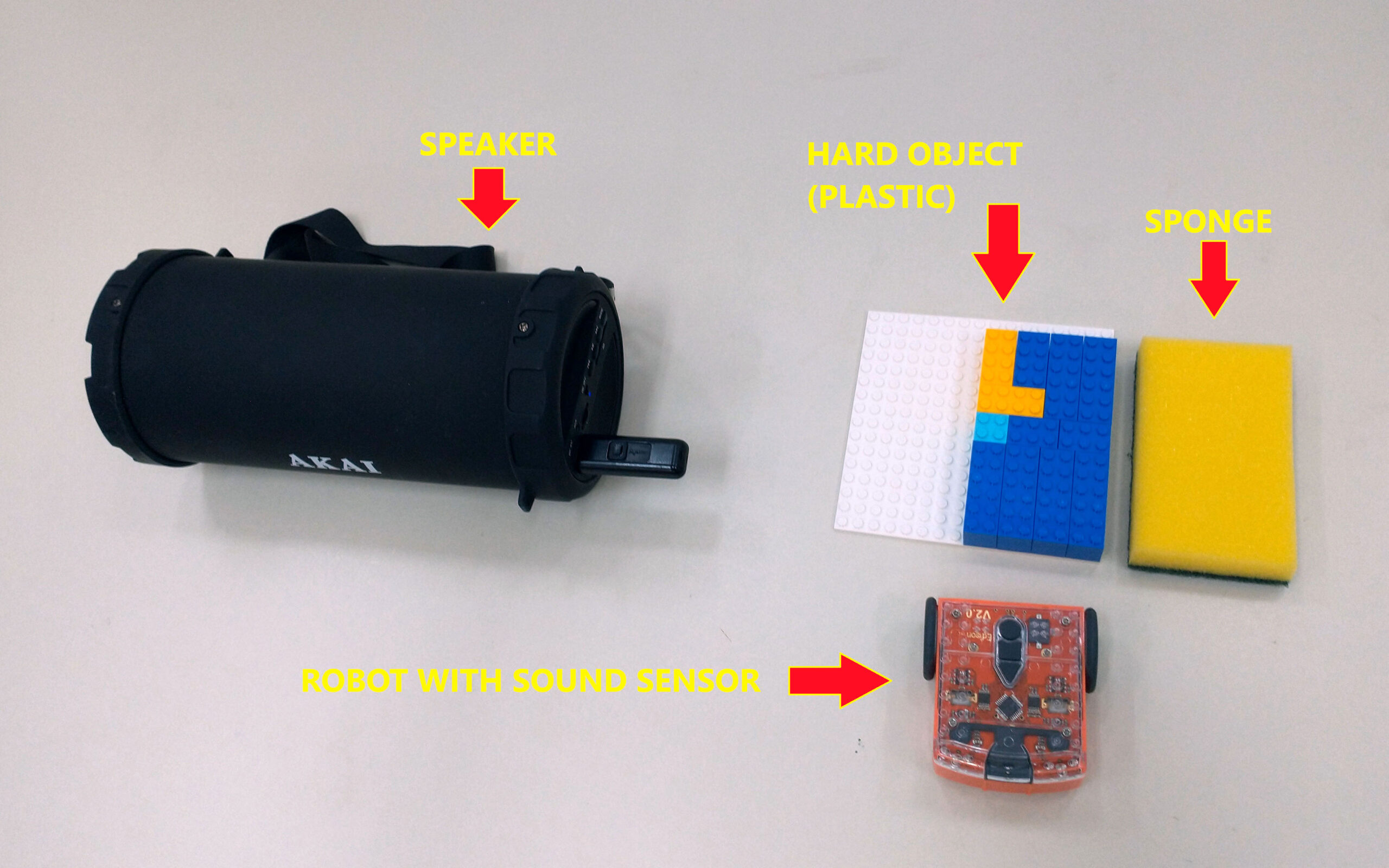
Sounds good: try some simple activities that use robots to explore the basic properties of sound waves – reflection, absorption, and propagation.

Explore the science of sound and electromagnetism with this practical build-it-yourself…

