Author(s): Nathalie Wössner, Chiara Obermüller
On 16 May we’re celebrating the International Day of Light. Light is omnipresent in our lives. We are so used to it, we often forget how essential it is to our existence. There would be no life on Earth if it wasn’t for the warming rays of light shining on us from our Sun. We wouldn’t see any colours if it wasn’t for the different energies with which light reaches our world and the ways it is diffracted, reflected, or scattered.
A shiny new member
Before introducing this new issue, I want to take the opportunity to welcome the European Spallation Source (ESS), a neutron source based in Lund, Sweden, as a new member of the EIROforum and thereby a new funder of Science in School! We are very happy to have them on board and look forward to learning more about the exciting work and science carried out at ESS. If you like a first glimpse, have a look at this Teach article on building a linear accelerator model from ESS.
But now, let’s come back to what this issue offers…
Science needs light
Light is not only essential to most processes on Earth, but also to our pursuit of understanding them. Scientists have discovered countless ways of using light to explore what our world is made of, what processes are taking place in living organisms, what is in our Universe, and how we can create and test new technologies.
In this issue of Science in School, we want to learn more about the many ways that light helps us to understand, develop and engineer. We asked the members of the EIROforum – an association of 8 major European research organisations that fund the Science in School magazine – to share a story or activity that shows how they use light in their everyday scientific work. Learn how…
- … to understand signals from space in a fun activity from CERN called Cosmic SOS;
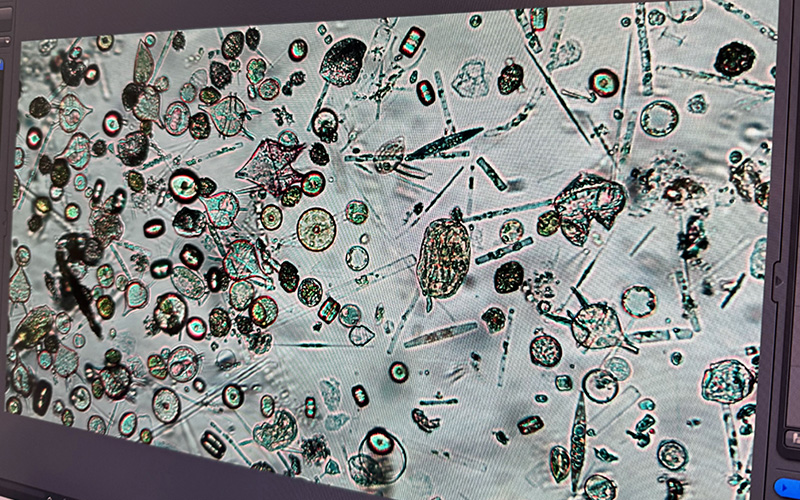
- … light microscopes can be used to study plankton, a tiny living organism that hugely shapes our ecosystem, in an activity designed by EMBL;
- … scientists at ESA use light to detect distant exoplanets to search for signs of life beyond our solar system;
- … ESO builds gigantic telescopes to catch light that has travelled across billions of light-years;
- … scientists at ESRF use X-rays to uncover why old famous paintings crack and fade in colour;
- … light helps to heat and control plasma at EUROfusion in order to create a Sun-like sustainable energy source on Earth;
- … researchers at ILL are learning from photosynthesis to understand how plants can turn light into food;
- … powerful X-rays at XFEL help us to understand the world on a nanoscale advancing developments in medicine, energy research and materials sciences.
So, let’s use our eyes’ great ability to recognize words and sentences from a bunch of photons sent towards them from a screen, and watch the members of the EIROforum shine some light on the importance of visible and invisible light in science!
Institutions

License
Text released under the Creative Commons CC-BY license. Images: please see individual descriptions.