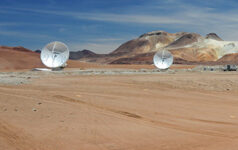
Claudia Mignone and Douglas Pierce-Price take us on a trip to the Chilean Andes, to the site of ALMA, the world’s largest radio astronomy facility, which is set to discover the secrets of our cosmic origins.
This year is the International Year of Astronomy. To celebrate, Chris Starr and Richard Harwood suggest some useful websites and other resources to inspire your astronomy teaching.
Lucy Patterson spoke to Greek science teacher Theodoros Pierratos, who recently won the chance to bring physics to life for his students in a truly extraordinary way with the help of the European Space Agency.
Ages: 14-16, 16-19; Topics: Physics, Astronomy / space
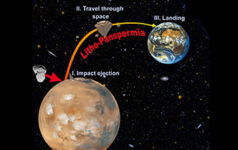
An enormous meteorite impact and then a rocky flight from Mars. Is that how life appeared on Earth? Cornelia Meyer takes us on a space trip through the lithopanspermia theory and describes how she is putting it to the test with the help of student colleagues.
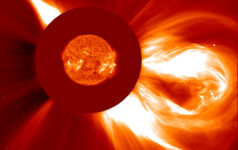
Ever wondered what the solar wind means to us on Earth or what happens when the surface of the Sun erupts sporadically? Lucie Green from University College London's Mullard Space Science Laboratory, UK, describes some of the recent research into the Sun’s atmosphere.
Students Jan Měšťan and Jan Kotek and teacher Marek Tyle from the Gymnázium Písek in the Czech Republic won the 2007 Catch a Star competition. Sai Pathmanathan describes their prize-winning project.
Ages: 14-16, 16-19; Topics: Physics, Astronomy / space
Ever wanted to take a closer look at the stars? Rachel Dodds from the Faulkes Telescope Project explains how you can do just that – together with your students and without even leaving your classroom!
Ages: 14-16, 16-19; Topics: Physics, Astronomy / space
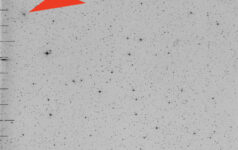
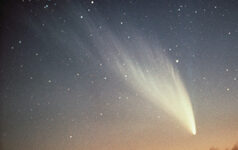
The challenge can be read in ‘The joy of discovery: a personal experience‘ The trail from which Comet West was discovered is indicated by an arrow Image courtesy of ESO
Catch a Star!, an international competition for school students, is starting its fifth year. Douglas Pierce-Price from ESO invites students from all over the world to take part.