Science comics and cartoons
Comics have generally been considered as nothing more than a cheap pastime. However, Mico Tatalovic suggests some useful comics to help promote and…
Resources





Cartoons are fun to watch but can also help inspire students and enhance their understanding of science. Here’s how to do that with some classics of European animation.
Cartoons and comics are a popular visual aid in teaching, and their potential in science education is well documented.[1] They can be an informal and fun way to approach curriculum topics, and the use of images, humour, and narrative stories makes them relatable and helps capture students’ attention. Some studies have found that cartoons and comics can lead to a better understanding of scientific concepts and enhance learning outcomes.[1,2]
Apart from instructional cartoons made specifically for teaching, animated fiction films can be used to kick-start discussions about important curriculum topics in a fun and unconventional way. For example, Professor Balthazar, a whimsical Croatian cartoon about a famous inventor who uses the power of science and technology to solve his world’s problems, is fun to watch and can be used to illustrate the scientific method. Balthazar goes from encountering a problem, to thinking and researching it, and then to developing a solution. To achieve this, he often uses books, mathematics, scientific equipment and expeditions.[3] His colourful ‘miraculous machine’ – a tool of creativity leading to people’s happiness – also raises interesting questions about the use of scientific instrumentation and the role of engineering and technology in making scientific discoveries. For example, why does science need big machines, and how do they work? Do societal problems always require a technological solution?
This cartoon was originally produced in the 1960s by the renowned Zagreb School of Animation. According to the non-governmental organisation Association Professor Balthazar, which is using the character in educational initiatives while also producing new episodes, the cartoon was especially popular in former Yugoslavia, Scandinavia, Germany, France, and Portugal.
The Zagreb School of Animation came to fame due to their innovations in animation techniques and their focus on humanistic topics that examine an ordinary person’s struggles in an urbanised and polluted world in a humorous way.[4]
Their cartoons, which are freely available on the Zagreb Film’s YouTube channel, deal with timeless topics such as the importance of friendship and altruism or persevering through challenges and failures. Many episodes tackle environmental pollution, war and the challenges of capitalism and technological change. These are all topics relevant to education and society today. Some of their films deal with scientific topics, providing an entry point to discuss issues such as astrobiology, artificial intelligence and climate change.
Here is a selection of cartoons that are freely accessible, categorised by the relevant topics they address, and complemented by suggestions for discussion starters arising from those.
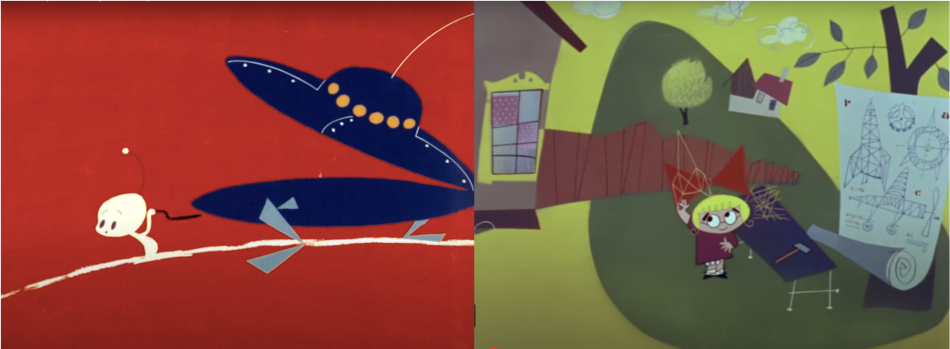
A Visit From Space and Cow On The Moon feature space travel, moon landings, astronautics and girls in science. They also tackle the importance of helping newcomers, as well as the possibility of life beyond Earth – an active research area for astrobiologists.
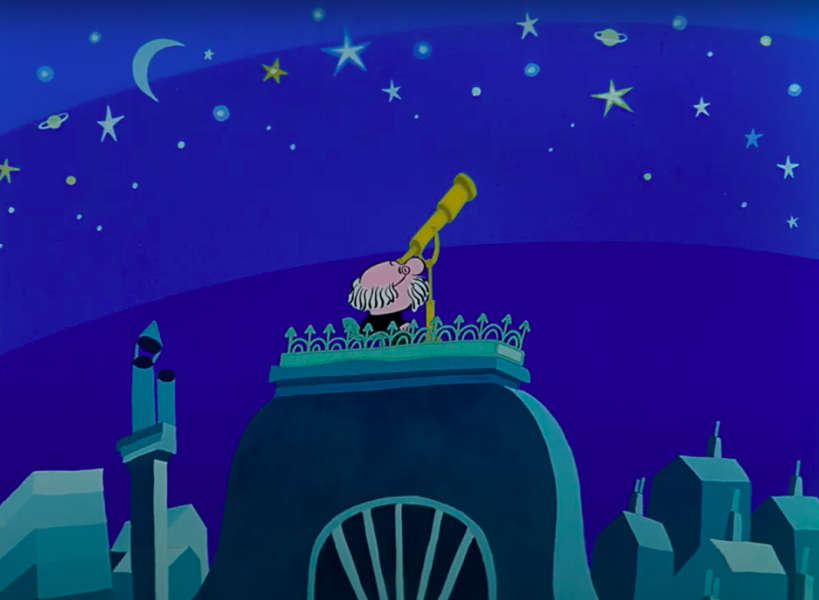
The topics astronomy, exoplanet discovery and space travel are also featured in several others episodes of Professor Balthazar, including in Victor’s Egg-o-mat, Starlight Serenades and Bald Is Beautiful.
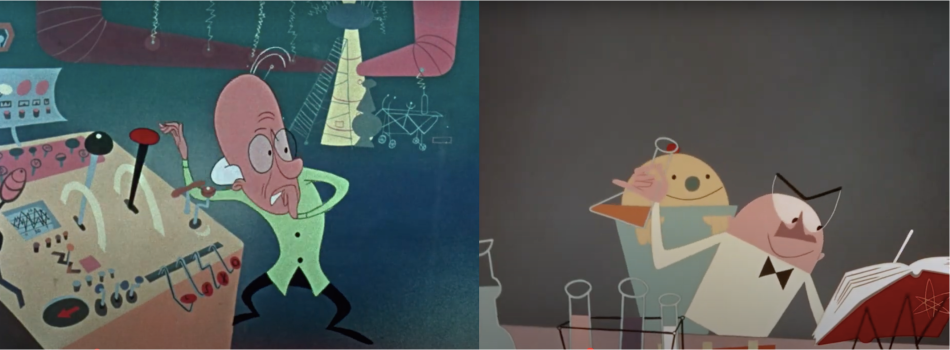
Playful Robot, Inspektor Maska: Citizen IM-5 and An All-round Help, tackle robotics and the quest for automation, which are relevant to today’s discussions about AI and its impact on society and the economy. They deal with the inventors’ motivations, the programming of robots and unintended consequences, such as what happens when AI starts to make its own decisions.
The importance of automation on people’s lives, and the citizens’ oversight of its deployment, also feature in Professor Balthazar’s episode Steeples Are Funny.
Meanwhile, Abrakadabra contrasts old ways of thinking and acting, rooted in tradition, beliefs and magic, with new approaches grounded in modernity, evidence and technology. It addresses the relationship between scientific and non-scientific worldviews in a fun way, and it offers starting points for discussing the benefits of technological progress.
The Devil’s Work is about a young office worker who uses chemistry to make a potion to make himself more confident and popular. It features citizen science and raises questions about lab safety and scientific methodology, as well as how science differs from magic in its methods and outcomes.
A Windy Story and Snowtime For Comedy deal with environmental disasters and suggest sustainable, natural ways of adapting to the changing climate by recycling renewable resources. They can inspire discussions about the importance of climate mitigation, adaptation, as well as geoengineering – controversial large-scale manipulations of the Earth’s climate to counteract the effects of global warming.
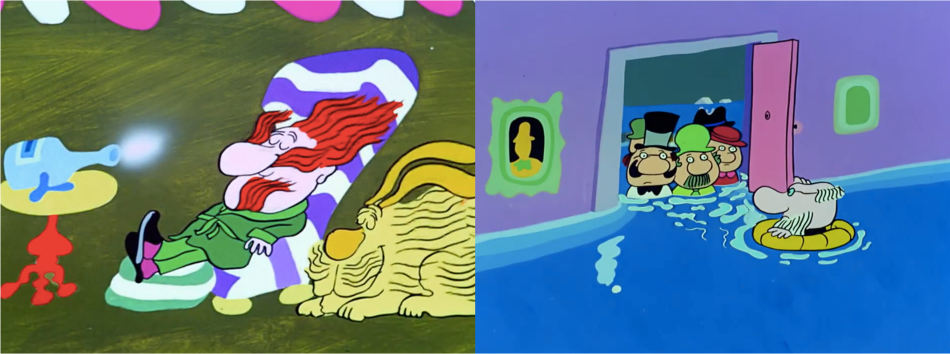
Two Bees Or Not Two Bees and The Endless Deviltry are focused on human-made pollution and present ideas of recycling a bad by-product of industry into something useful through upcycling and the circular economy.
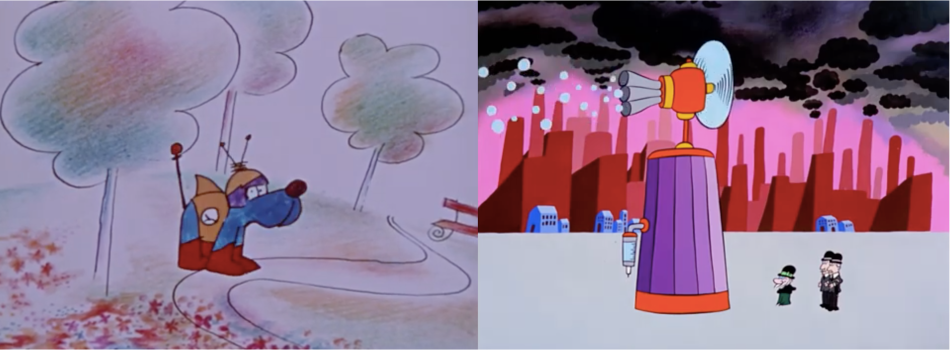
Man: The Polluter is a series of short animations, compiled into a single 50-minute programme, co-produced with the National Film Board of Canada. The films talk about pollution, the balance between economic and ecological needs and the democratic control of new technology. It does so in an unusual way, for example, by examining an imagined new way of dealing with rubbish: removing it with time machines and what consequences that might have. It raises a range of questions about climate change, pollution, recycling and the striking reality that some environmental issues have been known for decades but yet remain an unsolved problem to this day. Can we inspire the future generations to finally find sustainable solutions?
Of course, all of the animations can be viewed and interpreted differently, which is another strength in that it can help to teach critical viewing skills, allow for a diversity of opinion and encourage a healthy debate about important curriculum topics.
All in all, this intriguing, award-winning collection of animated films, made by one of the most celebrated groups in animation history, offers many opportunities to engage with scientific and societal topics while exploring one of the most impressive bodies of work in European art history.
[1] Shurkin J (2015) Cartoons to better communicate science. Proc. Natl. Acad. Sci. U.S.A. 112: 11741–11742. doi: 10.1073/pnas.1515144112
[2] Putri SA et al. (2024) Effectiveness of Using Animation Videos in Science Learning in Elementary Schools: A Systematic Literature Reviews. Indonesian Journal Of Educational Research and Review 7: 667–678. doi: 10.23887/ijerr.v7i3.82242
[3] Tatalović M (2025) The educational value of representations of science and innovation in the animated TV series Professor Balthazar. Cultures of Science 8: 241-248. doi: 10.1177/20966083251356764
[4] Tatalović M (2025) Representations of science and innovation in Professor Balthazar and related films of the Zagreb school of animation. Pulse: the Journal of Science and Culture 12. doi: 10.5281/zenodo.20042547
This article offers teachers an excellent opportunity to explore science through creativity, storytelling, and media analysis. Using Professor Balthazar as a starting point, educators can encourage students to discuss themes such as technology, sustainability, ethics, innovation, and the relationship between science and society. The article is particularly suitable for interdisciplinary or STEAM-oriented teaching and could be used in science, media studies, citizenship, language, or arts classes.Teachers may find the article especially useful as a stimulus for discussion-based learning, project work, or media literacy activities. Students could analyse how scientific ideas are represented in animation, debate ethical questions surrounding technology, or create their own science-inspired stories and visual projects. The resource is flexible, low-cost, and adaptable to different classroom contexts, making it accessible for a wide range of secondary-school teaching environments.
Cleidison da Silva Santos, Instate Federal do Pará – Public University in Brazil, Brazil
Comics have generally been considered as nothing more than a cheap pastime. However, Mico Tatalovic suggests some useful comics to help promote and…

Encouraging your students to create science videos can be a way of catching – and keeping – their…