Halina Stanley from the American School in Grenoble, France, reviews some of her favourite ‘ask a scientist’ websites in English and French. Thanks to the help of many readers throughout Europe, we can also draw your attention to sites in Croat, Danish, Finnish, Hungarian, Norwegian,…
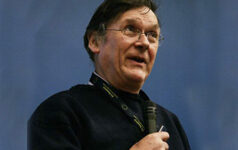
Professor Tim Hunt, winner of the 2001 Nobel Prize in Physiology or Medicine, talks to Philipp Gebhardt about his passion for science, the importance of pure research, the influence of enthusiastic colleagues – and the role of serendipity in scientific discovery.
Ages: 14-16, 16-19; Topics: Biology, General science, Science and society
Fossils: A Very Short Introduction and Dinosaurs: A Very Short Introduction are both real tours de force and very engaging books. Their small size makes them easy to pack and take away to read during any spare moments.
The Exploring the Living Cell DVD includes a wide range of films about the cell, covering many topics and providing background information for lessons: the history of the discovery of the cell, ethical debates about stem cells and evolution/creationism, and current research in cell biology. For the…
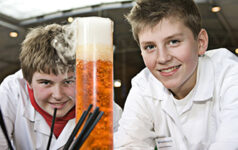
Sheena Laursen from Experimentarium in Denmark describes how the centre’s Xciter project helps students motivate each other to delve deeper into science.
Have you ever wondered what bioinformatics is? Or what a bioinformatician does? Sai Pathmanathan and Eleanor Hayes talk to Nicky Mulder, a bioinformatician at the European Bioinformatics Institute in Cambridge, UK.
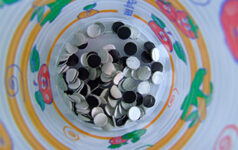
Pongprapan Pongsophon, Vantipa Roadrangka and Alison Campbell from Kasetsart University in Bangkok, Thailand, demonstrate how a difficult concept in evolution can be explained with equipment as simple as a box of buttons!
One of the many purposes of science is to support the humanities. With this in mind, Gianluca Farusi and his students set out to investigate and prepare iron-gall ink, a historically significant material for the transmission of knowledge.
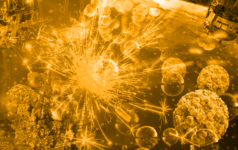
Péter Székely from the University of Szeged, Hungary, and Örs Benedekfi from the European Fusion Development Agreement in Garching, Germany, investigate how a star dies and what a nearby supernova explosion would mean for us on Earth.
Ages: 14-16, 16-19; Topics: Physics, Astronomy / space