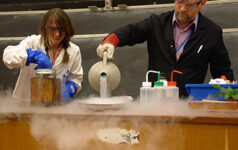
Claire Le Moine from Explor@dome in Paris, France, explains the formula of the explor@mobile: two scientists, some computers and a gas-powered vehicle!
Ages: 11-14, 14-16; Topics: Science and society, General science
Ever wanted to take a closer look at the stars? Rachel Dodds from the Faulkes Telescope Project explains how you can do just that – together with your students and without even leaving your classroom!
Ages: 14-16, 16-19; Topics: Physics, Astronomy / space
Why are enzymes so special? How do they differ from inorganic catalysts? Isabella Marini from the University of Pisa, Italy, describes a classroom protocol to enable students to answer these questions for themselves.
Karen Smith from NEF, the New Economics Foundation, London, UK, describes an approach to creating a safe space where students can discuss sensitive topics, like stem-cell research or genetically modified food. How can students be encouraged to explore their values in relation to science topics, and…
Ages: 14-16, 16-19; Topics: Science and society, General science
Do you ever get frustrated with that mess of cables connecting your DVD player to your satellite dish, TV and video recorder? Did you know that you can cut those cables – and still get a signal to pass between the machines? Alessandro Iscra, Maria Teresa Quaglini and Giuseppina Rossi from Italy…
Tim Harrison and Dudley Shallcross from the University of Bristol, UK, describe some of the University’s activities to share a delight in chemistry with school students.
Many of you were fascinated (and disgusted!) by the article about forensic entomology in our last issue. Paula Starbäck, the reviewer, suggested that it would be a fascinating activity for students, if only someone could find a way to avoid the terrible smell. We challenged you to come up with a…
Graham Gardner from the Inter-Community School in Zürich, Switzerland, describes how an attempt to interest his students in chemical separation techniques developed into a full-scale interdisciplinary detective mystery.