Science comics and cartoons
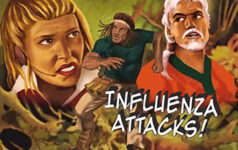
Comics have generally been considered as nothing more than a cheap pastime. However, Mico Tatalovic suggests some useful comics to help promote and explain science to students.
Showing 10 results from a total of 243
Comics have generally been considered as nothing more than a cheap pastime. However, Mico Tatalovic suggests some useful comics to help promote and explain science to students.
Health and disease are themes that run through this issue of Science in School. In our feature article, Alan Leshner describes his varied career, including his involvement in a major campaign to show that schizophrenia is a brain disease and not a result of environment. In contrast to this concern…
Research offers exciting and challenging job opportunities, but sometimes the price to pay in terms of personal sacrifice is very high. Claudia Mignone interviews a young astronomer who found satisfaction in the classroom – teaching mathematics.
Jeanne Keweloh is a substitute teacher, going wherever she is needed to share her passion for science. She tells Sonia Furtado about the ups and downs of teaching on the move, and shares some of her strategies.
In this issue’s feature article, Leroy Hood, the ‘father of systems biology’ describes his commitment to encouraging concept-driven, hands-on science teaching. He explains how he introduced this approach across schools in Seattle – and why his achievements in science may be due to his…
Are you curious to find out what life will be like in a hundred years’ time? Or have you always fancied living in ancient Egypt? According to Jim Al-Khalili, it may one day be possible – or will it? Is time travel science fact or science fiction? Find out more in this issue’s feature…
Have you ever wondered what a decasievert or a petahenry is? Why some symbols are written in capitals and others in lower case? What the difference is between ps and pS? How many ampere there are in a zettaampere? Or what Nikola Tesla’s nationality was? These and many other questions can be…
As well as a good science encyclopaedia, all classrooms need a science dictionary, preferably with pictures and graphs as well as clear and correct explanations.
Life has a funny habit of turning out quite differently from what you expect. Take Christian Mellwig, for example. He explains to Vienna Leigh that he was determined that, whatever path he took in life, it wouldn’t be teaching.
Conspiracies are at the heart of many a good film and book. Swedish biology teacher Per Kornhall is the author of a critical book on intelligent design and how it is taught in biology lessons in religious schools in Sweden. He talks to Sai Pathmanathan and Marlene Rau about his fascination with…
Science comics and cartoons
Welcome to the thirteenth issue of Science in School
A star-struck teacher in Italy
Teaching on the move
Welcome to the twelfth issue of Science in School
Welcome to the eleventh issue of Science in School
A Dictionary of International Units: Metric-Matters: Names and Symbols, By Philip Bladon
A Dictionary of Science and Collins Internet-linked Dictionary of Science: Science Defined and Explained
Serendipity in life (and) science: Christian Mellwig
Teaching in Sweden: tackling creationism, making waves