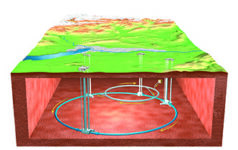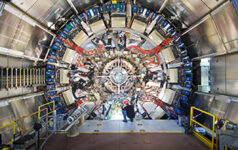
On 10 September 2008 at 10:28 am, the world’s largest particle accelerator – the Large Hadron Collider – was switched on. But why? In the first of two articles, Rolf Landua from CERN and Marlene Rau from EMBL investigate the big unresolved questions of particle physics and what the LHC can…
Herbi Dreiner and Tobias Strehlau describe how a university physics show inspired a secondary-school teacher and his students to perform their own school physics show. Why not try it in your school?
Any book that has in its introduction “Physics is the action department of science... only physics can explain what happens if you throw [an apple] at a brick wall at 200 mph” has my attention.
Henri Boffin from ESOw1 in Garching, Germany, follows the mystery of gamma-ray bursts from their first discovery to the most recent research on these dramatic astronomical explosions.
The Science Magic books are part of a series of home-based practical science books that take as their unusual theme the use of items typically found in particular rooms of the house.
Jenny List, a young particle physicist working at DESY in Germany, leads her own research group to find out how the Universe works. She talks to Barbara Warmbein.
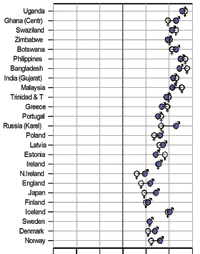
Svein Sjøberg and Camilla Schreiner from the University of Oslo, Norway, explain how they are investigating young people's attitudes towards science and technology.
The energy demands of our society continue to increase, while the stocks of fossil fuels - still our major energy source - are declining. Chris Warrick from the European Fusion Development Agreement explains why research into fusion offers the hope of a safe and environmentally responsible energy…
Scientists working at the Institut Laue-Langevin (ILL) and the University Joseph Fourier in Grenoble, France, have discovered a crystal that appears to defy the laws of physics. Giovanna Cicognani from ILL reports.