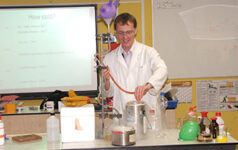
Lucy Patterson spoke to Nick Barker, a former secondary-school chemistry teacher and head of year who, after 12 years in the classroom, landed a dream job as a Royal Society of Chemistry (RSC) Teacher Fellow.
Nanoscale: Visualizing an Invisible World is a beautifully produced book, filled with engaging text and attractive illustrations, which provides a captivating tour of the ‘invisible’ world of the nanoscale.
The scope of Why the Lion Grew its Mane: A Miscellany of Recent Scientific Discoveries from Astronomy to Zoology, as stated by the author, is to offer a “fascinating collection of recent discoveries that overturn popular conceptions, enter realms that were previously the preserve of science…
Helke Hillebrand has always been fascinated by science, but on the back of a career in plant biology, her urge to work more closely with people helped her decide to go into tending young minds instead of new shoots. Vienna Leigh reports.
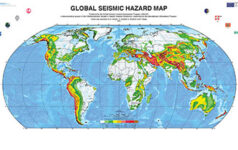
Earthquakes, global climate or the placement of wind farms – with the help of geographic information systems, these can all be investigated dynamically in the classroom. Joseph Kerski describes how.
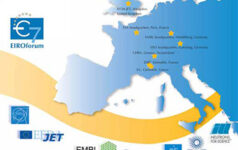
EIROforum Click to enlarge image EIROforumw1 is a collaboration between seven European inter-governmental scientific research organisations. The organisations focus on very different types of research – from molecular biology to astronomy, from fusion energy to space science. They use very…
Ages: not applicable; Topics: Physics, General science, Biology, Astronomy / space
We’ve all sometimes felt ‘beside ourselves’, but have you ever felt that you were actually outside yourself – looking at yourself from outside your own body? Marta Paterlini talked to Henrik Ehrsson, a scientist studying this phenomenon.
Ages: 14-16; Topics: Biology, General science, Health, Science and society
Earthquakes can be devastating. Is there anything we can do to resist them? Francesco Marazzi and Daniel Tirelli explain how earthquake-proof buildings are designed and tested.
Are you looking for ideas to spice up your earth science class? Why not try out one of the rich collection of activities developed by Chris King, Elizabeth Devon and Peter Kennett from Earth Learning Idea.