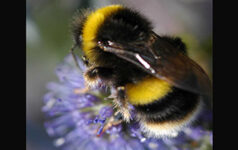
Dave Goulson and Ben Darvill from the Bumblebee Conservation Trust at the University of Stirling, UK, explain why these furry insects are under threat – and what schools can do to help.
Ages: <11, 11-14, 14-16, 16-19; Topics: Biology, General science
Does Anything Eat Wasps? is a user-friendly, easy-to-read collection of questions and short answers that covers a wide range of science topics, from galaxies colliding in outer space to the amount of fat necessary to render a human bulletproof. These questions and their corresponding answers were…
Karen Smith from NEF, the New Economics Foundation, London, UK, describes an approach to creating a safe space where students can discuss sensitive topics, like stem-cell research or genetically modified food. How can students be encouraged to explore their values in relation to science topics, and…
Ages: 14-16, 16-19; Topics: Science and society, General science
Does alchemy sound too good to be true? Paola Rebusco, Henri Boffin and Douglas Pierce-Price, from ESO in Garching, Germany, describe how creating gold – and other heavy metals – is possible, though sadly not in the laboratory.
At Science on Stage 2, the European Science Teaching Awards 2007 were presented for the 12 best projects. Eleanor Hayes, editor of Science in School, describes how the jury made their difficult decisions
Many of the national Science on Stage organisations are becoming increasingly well established: running inspirational national events, inviting participants from across Europe to join them, and setting up projects with teachers in other countries. This commitment to European science education…
How better to inspire thousands of schoolchildren across Europe than by motivating and educating their teachers? As Eleanor Hayes explains, that is the idea behind Science on Stage – a network of local, national and international events for teachers.
Sabine Hentze and Martina Muckenthaler tell Lucy Patterson about their work – detecting genetic diseases and counselling potentially affected patients.