Do you think particle physics is a complex subject? Having moved from basic research to science education, Sven-Olof Holmgren would disagree. He tells Lucy Patterson and Marlene Rau about the challenges of this shift, and about a major reform in the Swedish education system.
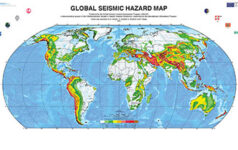
Earthquakes can be devastating. Is there anything we can do to resist them? Francesco Marazzi and Daniel Tirelli explain how earthquake-proof buildings are designed and tested.
Are you looking for ideas to spice up your earth science class? Why not try out one of the rich collection of activities developed by Chris King, Elizabeth Devon and Peter Kennett from Earth Learning Idea.
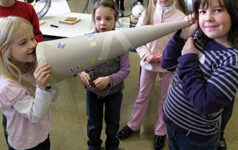
Werner and Gabriele Stetzenbach tell us how kindergarten and primary-school children discover the world of physics together with secondary-school students as their mentors. Why not try it in your school?
Molecules of Murder: Criminal Molecules and Classic Cases is a highly readable book that is a must-read for those interested in crime or popular science. It follows on from author John Emsley’s earlier book: Elements of Murder: Criminal Molecules and Classic Cases.
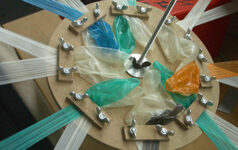
Can you imagine building a motor from latex gloves? Physics teachers Ludwig Eidenberger and Harald Gollner, and their students Florian Altendorfer and Christoph Eidenberger, show how, exploiting the reversible thermodynamic processes of thin layers of latex.
This year is the International Year of Astronomy. To celebrate, Chris Starr and Richard Harwood suggest some useful websites and other resources to inspire your astronomy teaching.
The vast majority of chemists with whom I come into contact recall that the first experiences that excited them about chemistry were either seeing or doing practical work.