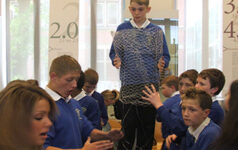
Do you have more than the average number of ears? Is your salary lower than average? When will the next bus arrive? Ben Parker attempts to convince us of the value of statistics – when used correctly.
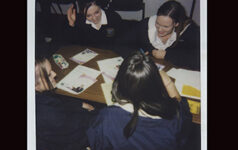
Germany, like many other European countries, has difficulties attracting women into science. Diana Schimke from the University of Ulm, is working improve matters by putting schoolgirls directly in contact with women scientists.
Ages: 11-14, 14-16, 16-19; Topics: Science and society, General science
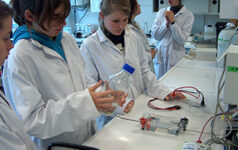
Teaching science in the classroom is all very well, but wouldn’t it be wonderful to let your students learn for themselves what it’s really like to work in a research laboratory? Sooike Stoops from the Flanders Institute for Biotechnology (VIB), Belgium, describes a project that does just…
Ages: 14-16, 16-19; Topics: Biology, General science
Claire Le Moine from Explor@dome in Paris, France, explains the formula of the explor@mobile: two scientists, some computers and a gas-powered vehicle!
Ages: 11-14, 14-16; Topics: Science and society, General science
Karen Smith from NEF, the New Economics Foundation, London, UK, describes an approach to creating a safe space where students can discuss sensitive topics, like stem-cell research or genetically modified food. How can students be encouraged to explore their values in relation to science topics, and…
Ages: 14-16, 16-19; Topics: Science and society, General science
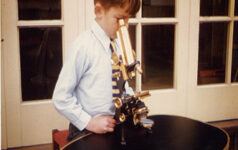
Professor Sir Alec Jeffreys, the inventor of DNA fingerprinting, remembers his childhood passion for science, explains what we have learned from direct DNA analysis, and describes his work with Chernobyl survivors. Interviewed by Russ Hodge and Anna-Lynn Wegener from the European Molecular Biology…
Ages: 16-19; Topics: Biology, General science, Chemistry, Science and society
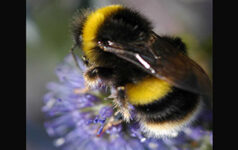
Dave Goulson and Ben Darvill from the Bumblebee Conservation Trust at the University of Stirling, UK, explain why these furry insects are under threat – and what schools can do to help.
Ages: <11, 11-14, 14-16, 16-19; Topics: Biology, General science
Emm Barnes from the British Society for the History of Science describes an initiative to develop exciting interdisciplinary activities. And gives the recipe for a delicious edible geology project!
Ages: 14-16; Topics: Biology, Earth science, Science and society, General science