


Education resources for the International Year of Astronomy Inspire article
This year is the International Year of Astronomy. To celebrate, Chris Starr and Richard Harwood suggest some useful websites and other resources to inspire your astronomy teaching.
Space science plays an important role in our lives today, more so than most of us are aware. Communications networks, weather forecasts and climate studies, oceanography and many areas of environmental management depend on space technology.
To commemorate the 400th anniversary of Galileo’s first discoveries at the telescope, the International Astronomical Union and UNESCO proclaimed 2009 to be the International Year of Astronomy (IYA). To mark this special year, a large range of activities has been organised worldwide, many of which have some application in the classroom. Below is a selection of resources that we have found useful in our teaching activities over the course of this year.
The official IYA website
Officially, the IYA activities are being co-ordinated through the national hubs of the countries involved (currently 142 of them), and focused through the IYA 2009 website: www.astronomy2009.org
Portal to the Universe
Another useful point of contact is the newly opened ‘Portal to the Universe’, created as one of IYA 2009’s twelve cornerstone projects: www.portaltotheuniverse.org
Worldwide astronomy clubs and organisations
Whatever your level of interest or expertise, if you wish to get advice or participate, you can contact your IYA 2009 national node: a local astronomy club, planetarium or science museum. See: www.astronomy2009.org/organisation/nodes/national/list
A list of other astronomy organisations worldwide can be found on www.skyandtelescope.com/community/organizations or www.astronomyclubs.com
40th anniversary of the first manned Moon landings
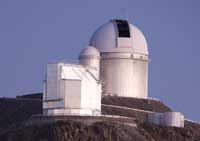
Image courtesy of ESO / H H Heyer
This year is also the 40th anniversary of the first manned Moon landings. This could be an incentive for a class project on the history of manned spaceflight and the Apollo missions. Students can use the major space agencies’ websites to follow current developments in space exploration. The websites of the US National Aeronautics and Space Administration (NASA) and the European Space Agency (ESA) feature TV and video-casts which give up-to-the-minute coverage of missions: www.nasa.gov and www.esa.int
Astronomical image exhibition
‘From Earth to the Universe’ is a collection of astronomical images representing the wide variety of astronomical objects. It is being exhibited in more than 250 locations throughout the world in 2009 and 2010. Visit the website to find out when it might be coming to your area: www.fromearthtotheuniverse.org
The full collection of images with explanatory captions is also available online; see ‘Tour the Images’ in the website’s section for visitors.
The ESA and the European Southern Observatory also offer useful multimedia collections, including image galleries and videos: www.esa.int and www.eso.org/gallery
Build your own telescope
Your students might enjoy the challenge of building their own telescopes, an exciting physics project using simple tubes and lenses, allowing them to learn about optics in the process. IYA 2009 can provide simple telescope kits through the ‘Galileoscope’ cornerstone project. See: www.astronomy2009.org/globalprojects/cornerstones/galileoscope
Ready-made telescopes and other astronomical equipment can also be purchased online:
www.telescopehouse.com (in the UK)
www.galileo.cc (for all of Europe)
www.siriusobservatories.com (for observatory domes, including European outlets)
If you already have a telescope at your school, you might like to know that for a modest investment in a Stellacam video camera, you would be able to transmit live images from your telescope to a large TV screen – a great tool for explaining the night sky to a group of people. The Stellacam is available from: www.astrovid.com
Resources of the European Space Agency
For a range of educational resources in English and other European languages for all school levels, offering teaching materials, competitions, kits, DVDs, online lessons, ideas for projects and more, visit ESA’s Education and Human Spaceflight and Exploration websites: www.esa.int/SPECIALS/Education and www.esa.int/esaHS/education.html
Aimed at children in primary and lower secondary schools, the ESA Kids website includes information about space, as well as ESA’s activities, quizzes, competitions and more: www.esa.int/esaKIDSen
Other useful websites and online resources
- Astronet is a network for astronomy research in Europe. Teachers might find the ‘Infrastructure Roadmap’ useful as it includes strategies for education and public outreach. See: www.astronet-eu.org
- A variety of paper models of spacecraft for students to build can be downloaded from the NASA website here: http://solarsystem.nasa.gov/kids/papermodels.cfm
- Further downloadable paper models of various spacecraft are offered by ESA. See: www.esa.int/esaKIDSen/build.html and http://sci.esa.int/science-e/www/object/index.cfm?fobjectid=35013
- Spacecraftkits is a supplier of useful kits for project work and astronomy / space club activities: www.spacecraftkits.com
- The International Year of Astronomy brochure, version 4, is available for download from: www.astronomy2009.org
- Mickledore Publishing offers resources for junior- and middle-school astronomy courses. See: www.mickledoreastronomy.co.uk
Selected useful publications
- Kerrod R, Sparrow G (2002) The Way the Universe Works. London, UK: Dorling Kindersley. ISBN: 9780751345759
- Sagan C (1994) Pale Blue Dot: A Vision of the Human Future in Space. New York, NY, USA: Random House. ISBN: 9780679438410
- Sparrow G, Aldrin B (2007) Spaceflight: The Complete Story from Sputnik to Shuttle – and Beyond. London, UK: Dorling Kindersley. ISBN: 9781405318181
- Thimmesh C (2006) Team Moon – How 400,000 People landed Apollo 11 on the Moon. Boston, MA, USA: Houghton Mifflin. ISBN: 9780618507573
- Space for Kids is an interactive DVD in the space and science series produced in 2007 by Finley Holiday Film Corp. Order from: http://finleyholiday.com
- The Complete Cosmos is a multilingual (Dutch, English, French, German, Japanese, Spanish) set of two DVDs produced in 2000 by Beckmann Visual Publishing: www.beckmanndirect.com
- The Lives of Galileo: a Journey through the History of Astronomy – a cartoon book by Swiss illustrator Fiami – is available in Dutch, English, Finnish, French, Italian, Portuguese and Thai, and can be ordered from www.fiami.ch